CHAPTER 2: THE NIGHT AUDIT
The tail-lights of Brenda Clery’s floral windbreaker vanished around the curve of the cul-de-sac, but the hum of her threat hung in the damp morning air like exhaust. Nora didn’t watch her retreat. She turned her back to the street, her boots grinding a fine layer of chalk line dust against the concrete apron, and walked straight to the timber frame at the base of the driveway.
She knelt in the damp soil where the first trench was dug. The rain garden was half-framed, the treated four-by-fours pinned with rebar that sank three feet into the hardpack clay. Nora reached into her apron pocket, her fingers finding the heavy brass casing of her father’s spirit level. She laid the flat milled edge across the timber. The green vial’s bubble hovered dead-center between the two black marks. True. Level.
“She’s going to call them, isn’t she?”
Nora didn’t look up immediately. The voice was soft, slightly thinned by the strain of three months in a rehabilitation facility. Maya stood behind the screen door, her fingers hooked into the mesh, her weight resting on the rubber-gripped handles of her fore-arm crutches. Through the mesh, her eyes looked too large for her face, dark-ringed and watchful.
“She can call whoever she wants,” Nora said, rising smoothly. Her knee joint popped—a dull, quiet sound in the morning still. “The trucks have a municipal clearance. The stone is paid for.”
“She told Mr. Miller you were carving up the utility easement.” Maya pushed the screen open with the tip of her left crutch, stepping out onto the porch with the slow, deliberate rhythm she’d practiced for sixty days in physical therapy. Thump. Drag. Step. “She had a map in that binder, Nora. She was showing people red lines.”
Nora paused at the bottom step. “What map?”
“An overhead layout. It had yellow highlighter across our whole front yard.” Maya stopped at the top of the timber porch stairs, looking down at the steep four-step drop that still separated her from the driveway. Her knuckles turned white on the crutch grips. “She told them the HOA owns the first fifteen feet from the curb. She said you’re building on common ground.”
Nora climbed the steps, taking them two at a time without making a sound. She stopped just in front of Maya, blocking the view of the street with her shoulders. She reached out and adjusted the sleeve of Maya’s fleece jacket, tucking a loose thread into the seam.
“The county survey was signed off in 1998, Maya. The easement is seven feet from the flowline. Not fifteen.”
“She’s making them believe it,” Maya whispered. “Mr. Miller wouldn’t even look at me when they drove me home yesterday. He just turned his sprinklers on.”
Nora felt a small, cold knot tighten just beneath her sternum. It wasn’t anger; anger was fluid, hot, unpredictable. This was the same cold clarity she used when assessing dry rot in a hundred-year-old load-bearing beam. You don’t yell at the rot. You carve it out until you reach sound grain.
“Go back inside and check the morning intake,” Nora said gently, placing a palm against Maya’s shoulder. “I have calls to make before the county office opens at eight.”
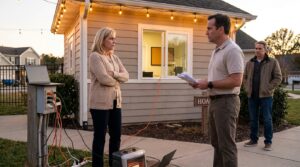
Once the screen door clicked shut behind Maya, Nora didn’t go into the kitchen. She walked around the side of the house, where the shadow of the garage kept the grass slick with dew. Beside the air conditioning condenser, half-hidden beneath the overhang of the cedar fence, sat a grey plastic utility box. It was where the municipal fiber-optic feed entered the house, mounted three feet off the ground.
Nora pulled a small multi-tool from her apron, flipped out the security bit, and unscrewed the faceplate.
Inside, nestled alongside the thick black cable line, was a small, secondary wire she had run three nights ago—a hardline data feeder connected to the three high-definition camera nodes mounted under the roofline. She pulled her phone from her pocket, slotted the micro-USB adapter into the base, and opened the local storage buffer.
She didn’t look at the footage of Brenda slapping the yellow sticker on the truck. She already had that archived. She scrubbed backward, past three in the morning, past midnight, stopping at 11:42 PM the previous night.
The infrared sensor on Node Two—the camera angled down the side property line—had triggered a sixteen-second recording.
On the small screen, rendered in high-contrast monochrome green and grey, a figure moved along the fence line. It was Brenda. She wasn’t wearing the floral windbreaker; she wore a heavy dark coat and her oversized visor, carrying a long wooden rod in her right hand.
Nora zoomed in. The resolution held crisp at 4K.
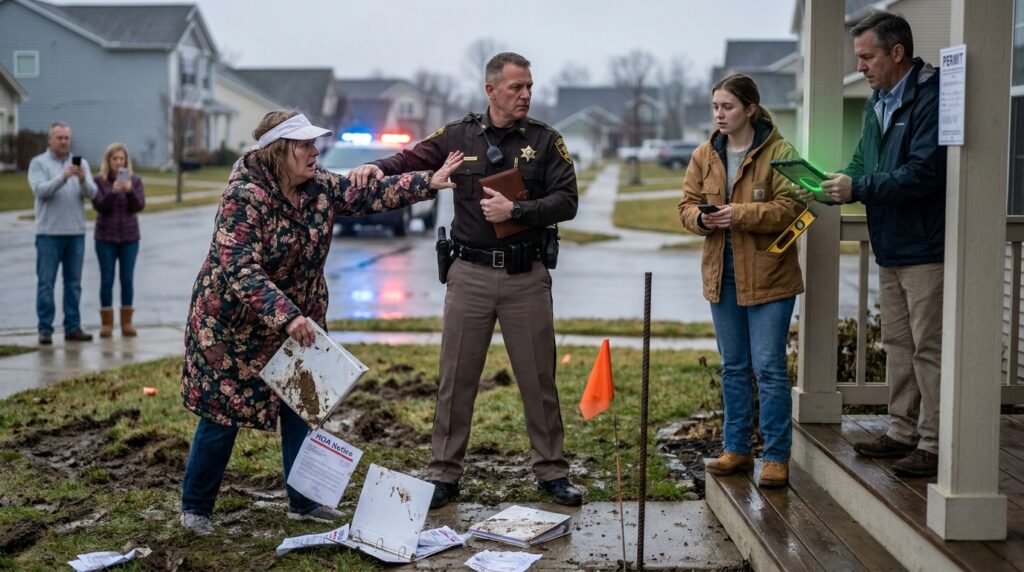
Brenda wasn’t just inspecting the perimeter. She was holding a steel survey stake—one of the three-foot rebar rods topped with neon pink ribbon that the county surveyor had driven into the ground four weeks ago to mark Nora’s legal property boundary.
In the video, Brenda leaned her weight onto the stake, rocking it back and forth in the wet soil until the earth loosened with a faint schlick sound. Then she lifted it straight out of the ground, walked four feet toward Nora’s porch, and drove it back into the turf with the heel of her boot.
Nora froze the frame.
She looked at the timestamp in the bottom right corner: 11:43:12 PM. Then she looked at the position of the stake relative to the corner of her garage. Brenda had effectively cut six feet off Nora’s legal lot, placing the entire proposed concrete footing of the accessibility ramp inside what now looked like “unauthorized” property.
Nora didn’t curse. She took a screenshot, saved the raw video file to two separate cloud drives, and locked the phone screen.
A rustle of wet leaves sounded from the far side of the cedar fence.
Nora didn’t move her head, but her eyes slid sideways. The fence shared a boundary with house forty-six—a property owned by an elderly widow, Mrs. Gable, who hadn’t left her home in six months following a hip replacement.
Through the narrow gap between the fence pickets, something glinted. Not a camera lens. Paper. White, thick, and bound in plastic.
“You’re checking the lines late, aren’t you?” Nora asked, her voice dropping into that low, flat register.
The shadow behind the fence froze. For three long seconds, the only sound was the drip of water from the cedar shakes above.
Then Brenda stepped around the corner of the fence, her boots sinking an inch into the muddy border where the grass met the gravel path. She didn’t have her visor on now; her graying hair was pinned back tightly, highlighting the hard, thin line of her mouth. She held her laminated binder tucked against her stomach like a shield.
“I don’t need to check what’s already documented, Nora,” Brenda said, her voice dropping into a tight, theatrical whisper designed to carry just far enough without echoing. “You think because you work with old buildings you understand land rights? Covenants run with the land. Not with your personal feelings.”
“You moved the rebar at 11:43 last night, Brenda,” Nora said. She didn’t raise her phone. She didn’t point at the camera under the eaves. She just stood there, her hands resting flat inside her apron pockets, her fingers wrapped around the brass spirit level. “That’s a class two misdemeanor under county code 304. Altering a boundary marker.”
Brenda’s chest rose, a sharp, quick inhalation that rustled the plastic sleeves inside her binder. Her hand tightened on the binder’s edge, and for a split second, the plastic cover buckled, revealing a sheaf of pink paper tucked behind the printed HOA bylaws.
Nora’s eyes caught the top margin of the pink sheet. It wasn’t an HOA letterhead. It was a county tax assessment envelope—the kind sent to delinquent property owners before a public lien auction—and across the top, written in thick black marker, was a handwritten list of names: Miller – $400, Jenkins – $600, Gable – $1,200.
“You don’t know what you’re looking at,” Brenda said, her voice dropping an octave, losing its performative authority, replaced by a raw, jagged edge. She slammed the binder shut with a loud thwack. “This community stays stable because I keep it stable. You bring contractors, you bring trucks, you bring down the valuation of every house on this curve. I won’t let one broken family ruin thirty years of equity.”
Brenda turned on her heel, her boots tearing up a strip of wet turf as she cut back toward her own driveway.
Nora stood by the utility box, watching the dew drip off the plastic housing. She reached into her apron, pulled out her phone, and opened her contacts. She didn’t dial the HOA board. She didn’t dial the police department’s main line.
She scrolled down to a saved contact from three months ago when she had first filed her construction blueprints: Hewitt, Thomas – County Code Enforcement, District 4.
She hit call.
“Hewitt,” a voice grunted on the third ring over the speaker, accompanied by the background noise of a truck heater blasting.
“Inspector Hewitt,” Nora said, her voice calm, clear, and unhurried. “This is Nora Abbott at 114 Laurel Crossing. I have an active building permit, #4409-B, for an accessibility modification.”
“I remember the file, Ms. Abbott. Ramp and rain garden. Clean submittal.”
“I have a boundary dispute in progress,” Nora said, watching the front curtain of house forty-two twitch across the street. “The neighbor has physically moved the county survey stakes, issued a private monetary penalty on a delivery driver, and is threatening a private tow at seven tomorrow morning.”
A long pause on the other end of the line. The sound of a pen tapping against a clipboard.
“Did she touch the rebar?” Hewitt asked.
“I have 4K video of her pulling it out of the ground at 11:43 PM,” Nora replied. “And I have the original county surveyor’s digital benchmark coordinates saved on my portal.”
Hewitt let out a low, dry whistle. “Don’t touch the stake, Ms. Abbott. Leave the mud exactly how it sits. I’ll be on Laurel Crossing at 6:45 AM tomorrow with a deputy.”
“Thank you, Inspector.”
Nora hung up. She walked back to the front porch, sat on the top step where the morning sun was just beginning to burn through the grey clouds, and pulled the brass spirit level from her apron. She laid it across the top step—the step Maya would never have to climb again once the stone was laid.
The bubble hovered perfectly in the center.
Across the cul-de-sac, Brenda’s garage door began to rise, slowly revealing the rear end of her white SUV and a stack of orange traffic cones lined up against the wall like soldiers waiting for a command.
Nora picked up her coffee mug, took a slow sip of the cold brew, and waited for tomorrow.