
CHAPTER 3: THE DIGITAL FLICKER IN THE AISLE
The intake counter at the precinct annex smelled of floor wax and stale air conditioning. A plastic placard bolted to the laminate read Public Service Desk: All Statements Recorded.
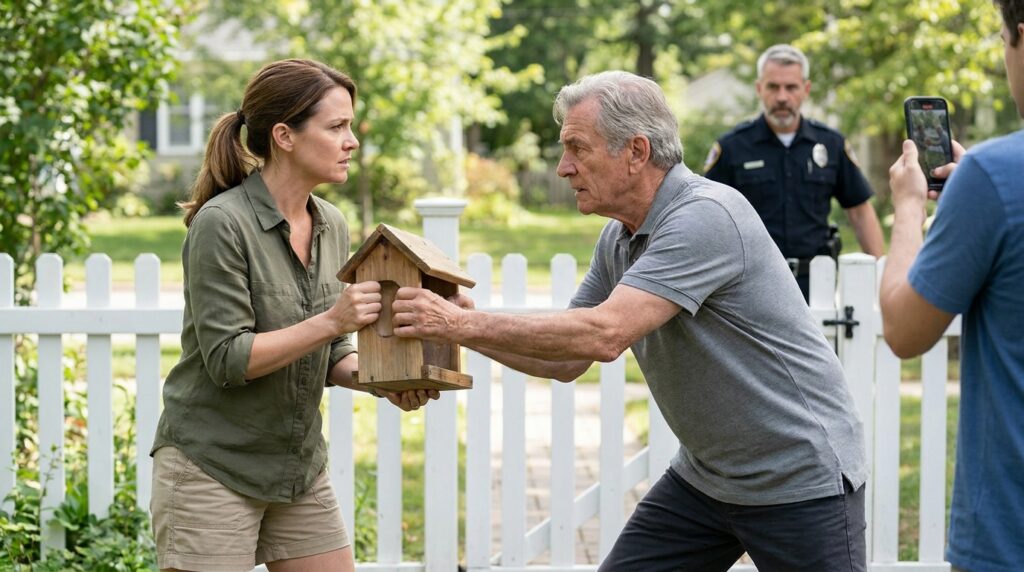
Sarah kept her weight balanced on her heels, hands still stinging from the microscopic pine shards embedded in her palms. Across the divider, Officer Vane didn’t look at her. He tapped a plastic stylus against an open electronic tablet, his eyes scanning a digital portal screen that displayed a half-cropped thumbnail of the video the neighborhood kid had captured three doors down. In the frozen image, her knuckles were locked around the cedar framing like iron claws, while Arthur stood a half-pace back, framed against the sunlight with his hands raised in defensive posture.
It was a brilliant piece of framing. The smartphone lens hadn’t captured the ten minutes of muffled harassment, the delivery truck blocked intentionally in the turnaround, or the three prior municipal notices shoved into her storm door while she was at work. It had captured only the climax—her fingers gripping the wood, her voice snapping across the property line like a whip.
“You want to make a formal statement, or are we signing the disorderly citation as written?” Vane asked, not looking up. His thumb scrolled down the report, revealing a string of prior dispatch numbers tied to her address. Four calls in six months. All originating from the same IP routing gateway used by the neighborhood association’s automated portal.
“That video cuts off the context,” Sarah said, her voice low, steady, and stripped of anger. She leaned forward, resting her forearms on the cold laminate. “Arthur didn’t just walk over to chat. He’s been locking the easement access gate every time my contractor tries to deliver gravel for the foundation drain. Check the utility logs for parcel 41-B. That’s not his land; it’s an active drainage right-of-way.”
Vane stopped tapping. He looked up, his gaze heavy, slate-gray, and entirely unimpressed. “Property disputes are civil matters, ma’am. When you put your hands on a neighbor and destroy a fixture over a three-foot turf war, it crosses the line into local disturbance. The portal records show four separate complaints filed by your address regarding noise and boundary lines. You’re building a pattern.”
“A pattern of defending my property line from manufactured code violations,” Sarah shot back, feeling the hot pulse of blood in her temples.
“The neighborhood association filed those logs through the municipal liaison,” Vane replied, sliding a printed copy of the incident summary across the desk. “They have an operational agreement with the county to maintain common-area corridors. If the board says the fixture was on their designated easement, then your removal of it constitutes property damage under municipal code 12-A.”
Sarah looked down at the paper. At the bottom of the digital intake summary, printed in tiny, gray dot-matrix text, was a filing code referencing District Assessment District 9-C. It wasn’t a standard neighborhood maintenance code. It was a municipal rezoning classification—the kind used by commercial developers when consolidating adjacent residential parcels for civic expansion.
She stared at the code, her mind abruptly backtracking through the months of minor harassments: the misplaced survey stakes, the sudden insistence that her fence was four inches too far east, Arthur’s relentless presence at the property edge like an accountant auditing a dying business. They weren’t just trying to annoy her into moving. They were establishing a cumulative record of blight and neighborly discord to force an administrative variance.
Before she could point to the file string, the heavy double doors behind the intake desk swung open with a pneumatic sigh, letting in a draft of dry suburban heat and the sharp crunch of gravel from the parking lot. Arthur walked in, wearing the exact same gray polo shirt, his posture measured and calm, holding a blue folder bearing the stamp of the regional property board.