
CHAPTER 2: SPLINTERS IN THE GRASS
The metallic rasp of handcuffs sliding from a utility belt sounded like an iron gate dropping on an open nerve.
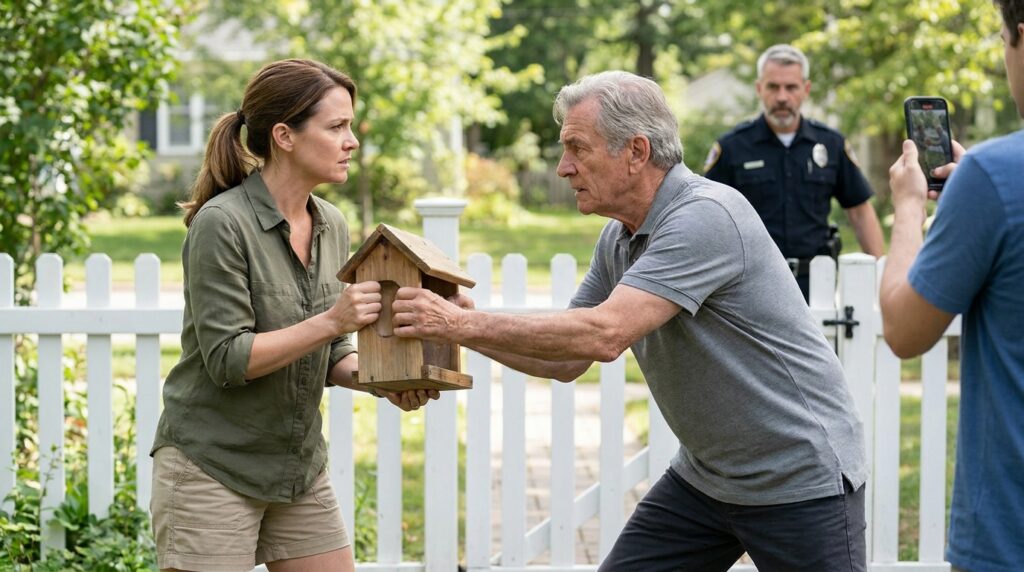
Sarah didn’t flinch, but her weight shifted, heels planting hard into the sparse turf as Arthur’s posture unbent with a quiet, triumphant sigh. The broken timber of the cedar feeder—what was left of its roof-shingle gable—rested against his shins like a discarded limb. He looked down at it, then up at the dark-uniformed officer whose boots had planted themselves squarely between the two properties, blocking any further lurch toward the boundary line.
“She initiated the physical contact, Officer,” Arthur said, his voice dropping an octave into the register of a man who had spent three decades testifying at municipal zoning board hearings. He didn’t point; he simply gestured with an open, aggrieved palm toward the scattered splinters. “Look at the property marker. She tore it straight off the anchor stake. It’s criminal mischief.”
“I was standing six inches inside my own fence line,” Sarah countered, her voice tight, vibrating with the raw edge of a compressed spring. She kept her hands deliberately away from her sides, fingers curled into loose, hollow fists to hide the fine pine splinters embedded in her palms. “He reached across. He’s been putting notices in my mailbox for four months. Ask him about the municipal notices.”
The officer—nametag a flat silver rectangle reading Vane—didn’t look at the mailbox. His eyes remained fixed on the blue-lit rectangle still held by the kid three doors down. The kid’s thumb was locked on the record button, tracking the lens like a small, unblinking predator. Vane’s jaw tightened beneath a salt-and-pepper beard that smelled faintly of cold rain and stale chicory.
“Ma’am, step back from the boundary,” Vane said, his tone entirely level, evacuated of all human warmth. It was the voice of a man who had cleared two hundred suburban driveway disputes this month and expected to clear two hundred more before the shift bell rang. “You’re standing over contested municipal right-of-way. The property plat filed with the county clerk designates this three-foot strip as a utility access easement. Neither of you owns it.”
Arthur’s mouth twitched—a microscopic flinch that didn’t reach his eyes. “That’s right. It’s common ground. Which means she has no right erecting permanent fixtures.”
Sarah stared at him, the blood humming behind her ears. Common ground. For four years, Arthur had mowed it, watered it, and hung his thrice-damned bird feeders from its posts as if it were the interior of his own living room. The moment she tried to clear the mess of pigeon droppings fouling her air conditioner intake, it suddenly became a municipal trust.
Underneath her left boot heel, something hard and metallic bit through the decaying grass blades. A buried survey pin, old and squared off at the top, rusted deep into the clay. It wasn’t on any plat map she had signed at closing.
“Common ground doesn’t give him the right to harass my foundation,” Sarah said, taking half a step forward despite the officer’s warning hand drifting toward his holster. “And it doesn’t give him the right to file four false code violations a week through a portal he shares with the zoning administrator.”
Vane didn’t answer. He simply reached out, his fingers wrapping firmly around her forearm just above the elbow. There was no cruelty in the grip—only the dull, inexorable gravity of procedure. “Step back, ma’am. We’re going downtown to file a formal incident report regarding the property destruction.”
As the heavy fabric of her olive shirt bunched beneath the officer’s glove, Sarah caught the reflection of her own face in the blank, dark screen of the bystander’s phone across the grass. Her expression wasn’t angry anymore. It was hollow, carved out by the sudden, cold realization that the argument over the bird feeder was never an argument about birds at all.