
CHAPTER 6: THE RISING LEDGE
The water did not drain; it surged.
With the subterranean bypass valve slammed tight on its bronze seat, eighty pounds of hydrostatic head had nowhere left to travel except straight up through the seams of Julian’s new construction. The gray mortar along the foundation skirt turned black with moisture, then began to weep. A low, subterranean groan vibrated through the bedrock beneath their feet, followed immediately by the dull crack of high-pressure flow blowing out a weep hole behind the drywall of Julian’s garage.
Deputy Mercer stopped four paces short of the fallen cedar pickets. His right hand remained resting on the retention strap of his sidearm, but his boots—heavy, lug-soled service leather—sank two inches into the sudden swamp pooling around the surveyor’s stake.
“What the hell did you just turn off?” Mercer demanded. His eyes flicked between the sheared padlock on the trench floor and the gray silt boiling out from under the brickwork.
“The illegal diversion,” Nora said.
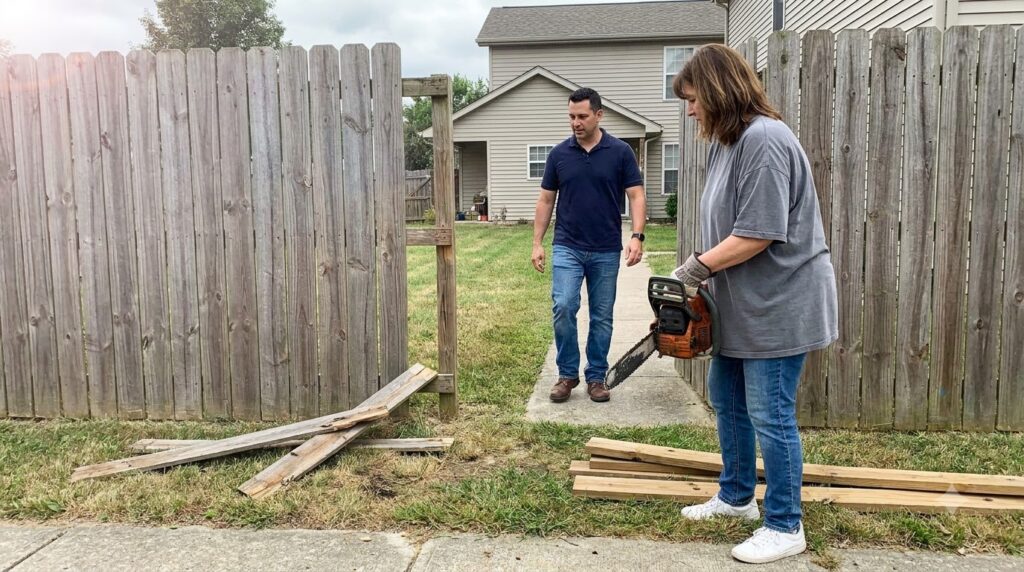
She did not wipe the clay from her jaw. She stood balanced, her weight evenly set, letting the chill of the afternoon air bite through her damp flannel coat. Beside her, the Stihl sat cold in the grass, but the yard was louder now than when the two-stroke engine had been screaming. The rushing sound inside the crawlspace sounded like an open fire hydrant trapped beneath floor joists.
Julian was still on his knees in the mud, his navy polo splattered with black sediment. He pushed himself upright with a jerk, his fingers clawing into the splintered rail of the fallen fence for leverage. The administrative mask had peeled completely off. His hair was disheveled, plastered against his forehead by cold sweat and drizzle, and his eyes were wild with a frantic, internal calculation.
“She broke the utility collar, Mercer,” Julian gasped, his voice cracking on the surname. He pointed a trembling, glove-clad finger at Nora’s boots. “She took a sledge and an iron bar to a pressurized municipal riser. It’s malicious sabotage. She’s flooding my slab deliberately—you’re looking at ten thousand dollars in foundation displacement every ten minutes this stays closed!”
Mercer’s gaze slid toward the trench. He wasn’t a builder, but he was a deputy in a county carved out of shale and limestone ledge; he knew what happened when groundwater got trapped beneath poured concrete.
“You’ve got a shutoff key on your truck, Vance?” Mercer asked, stepping closer to the pit, keeping his distance from the jagged cedar edges. “Get it open before the floor buckles.”
“She sheared the stem lock,” Julian hissed, taking a step toward Nora. “The city has to pull the main valve at the curb.”
“The curb valve doesn’t control this line, Mercer,” Nora cut in. Her voice was flat, devoid of panic, dropping like lead weights into the rushing sound of the backwash. “That line isn’t county infrastructure. Look at the tag floating in that slurry.”
Mercer hesitated, his heavy brow furrowing. He looked down into the trench where yellow, silty water was already swirling six inches deep over the cracked cinder blocks. Bobbing against the bronze bonnet of the gate valve was the lead disk Nora had severed—its wire pigtail trailing in the eddy, the embossed initials and engineer license number gleaming dully against the gray scum.
Mercer squatted, the leather of his duty belt creaking under the strain. He didn’t reach into the muck, but he leaned in close enough to read the stamp. His eyes hardened. He looked up slowly, not at Nora, but straight into Julian’s face.
“That’s your private seal, Julian.”
“It was an emergency stabilization sleeve,” Julian said immediately, the lie smooth and fast, rehearsed against the possibility of exposure. “The township approved an interim flow variance during the storm season while the probate division settled the title. I held the bond myself to protect both parcels.”
“You held the bond?” Nora took half a step forward, the iron chisel still resting securely against the surveyor’s cap behind her heels. “My mother’s cellar has four feet of standing water in it right now. The joists over her boiler are rotted through because you’ve been pumping your roof runoff and footing discharge into her fieldstone foundation since June. You didn’t file an interim variance. You filed a notice of structural abandonment under her forged signature so the county would condemn the house before probate cleared.”
Julian didn’t answer her. He looked past her shoulder, down the road toward the utility flatbed idling near the hedge. “Mercer, do your job. She’s trespassing across a recorded line, holding an edged tool, and refusing to clear a utility easement.”
Mercer straightened up slowly. He looked at the fallen fence panels, the sheared 4×4 posts, and the fresh aluminum cap of the surveyor’s pin sticking out of the torn sod like a clean tooth. Then he looked at the water now pouring over the threshold of Julian’s garage side door, carrying floating scraps of cardboard and sawdust out onto the driveway.
“Nobody’s getting arrested until the county engineer gets his transit on this line,” Mercer said, his voice dropping an octave into pure procedure. “And nobody touches that valve until we see the plat folio.”
“The folio is restricted under Code 14-B,” Julian snapped, stepping into Mercer’s space, his tone turning sharp and threatening. “You don’t have the jurisdiction to audit a sealed civil filing, Mercer.”
“I have the jurisdiction to secure a structural hazard on an active roadway,” Mercer shot back, his hand dropping flat against his utility belt. “And right now, Vance, your garage is sliding into the ditch.”
A sharp, hollow crack echoed from inside the flooded addition—the sound of an interior drywall seam splitting under hydraulic pressure.
As the ground shifted slightly beneath the trench, the churning backwash dislodged a section of the old fieldstone footer near the property line. The mud sucked downward with a violent, hollow gurgle. Exposed in the dark, gaping pocket where the earth collapsed was not another pipe, but the rotted remnants of an old galvanized tin document cylinder, wedged deep between the stones thirty years ago, its soldered cap popping open in the rising tide.