CHAPTER 4: THE SUBTERRANEAN SLEEVE
The sharp, medicinal sting of chloramine cut straight through the hot oil fumes.
It was not the mineral damp of river clay. It was the sterile, chemical vapor of pressurized municipal flow mixed with dissolving masonry mortar. Nora kept the cold shank of the mason’s chisel pressed flat against her thigh, feeling the bite of its squared iron corners through the denim.
Julian’s gaze had dropped from her face to the black mud oozing past the sheared post. His jaw clenched until the knot of muscle under his cheek bone stood out like a river stone.
“The county water main runs down the street side,” Nora said, stepping past him into the cleared slot where the fence panels had fallen. She didn’t ask permission. She planted her boot directly on the flattened corrugated plastic shielding the foundation gap. “Why is treated township water bleeding under your footings, Julian?”
“It’s runoff from the terrace drains,” he said, his voice tightening, dropping that clean administrative calm. He reached out to seize her jacket sleeve, but she pivoted, her elbow locking inward to knock his forearm aside with a dull strike of bone against bone.
“Don’t touch me.”
“You’re on private curtilage—”
“You forfeit curtilage when your structure floods an adjoining basement.”
She dropped her weight, driving the chisel’s hardened tip beneath the edge of the corrugated skirt. The plastic had been screwed to treated furring strips with self-tapping hex heads. She jammed the steel wedge under the upper lip, gave it a savage downward yank with both hands, and ripped the sheet clean off its anchors.
The sound of shearing vinyl echoed against the brick wall of Julian’s garage.
Beneath it, there was no French drain. There was no gravel bed, no perforated filter fabric.
Instead, the earth had been hollowed out into a reinforced trench lined with gray cinder blocks. Protruding through the core of Julian’s exterior wall was a heavy, four-inch schedule-80 PVC sleeve. And fitted inside that sleeve, gleaming dull and greasy under the overcast daylight, was a massive three-piece bronze gate valve.
The valve wheel wasn’t open to the air. A custom steel lockout hasp was looped around its spokes, fastened tight with an industrial brass padlock stamped with a municipal department monogram: D.P.W. INSP.
Connected to the discharge side was a heavy ribbed hose, its mouth turned downward into a core-drilled bore hole that plunged straight toward the bedrock beneath Nora’s mother’s property line.
Nora knelt into the slurry, oblivious to the mud soaking her knees. The water in the pit wasn’t standing still; it was surging under high head pressure, gurgling through the borehole with a hollow, rhythmic suction that vibrated the soil under her palms.
“A bypass,” she whispered.
She reached into the trench. Her thumb caught the brass body of the valve. The metal was sweating, icy cold from deep ground flow.
“You didn’t move the boundary pin six feet to claim yard space,” she said, looking up over her shoulder.
Julian hadn’t lunged. He stood entirely motionless above the pit, his shadow stretching across the ripped plastic like a fallen beam. The panic had drained from his face, replaced by the grim, predatory stillness of a man who realized his flank was exposed.
“The surveyor’s pin was the cover,” Nora continued, her words measuring each heartbeat. “You got the township variance stamped to build the garage addition over an unplatted retention easement. But you couldn’t pass hydrostatic soil inspection because the retention basin would hold three feet of static head against your slab.”
“You don’t know what you’re talking about,” Julian murmured, though his eyes remained locked on the brass lockbox.
“You couldn’t build without draining the ledge,” Nora said, rising to face him, the mud dripping from her work gloves. “So you drilled through the subterranean rock ledge and tapped into my mother’s foundation drain. You’ve been discharging your entire roof runoff and sub-slab pressure into the crawlspace of an eighty-year-old stone house.”
“Your mother’s house was already ruined,” he said, his tone dropping into a chilling, rational cadenced murmur. “The fieldstone mortar was crumbling before I broke ground. She didn’t maintain the downspouts. The mold was climbing the joists three years ago.”
“Because you turned the bedrock under her living room into a hydraulic sump!” Nora’s voice finally cracked through the quiet, striking him like a slap. “That’s why the floor buckled in May. That’s why the town inspector flagged her foundation for structural condemnation right after she went into Saint Jude’s.”
Julian didn’t look away. His chest rose and fell in a slow, calculated measure.
“A condemned parcel on this block sells at tax lien value,” he said softly, every word precise and venomous. “If the foundation fails completely, the lot gets condemned for public nuisance. The county acquires the easement, demolishes the structure, and auctions the parcel to adjoining abutters at assessed land cost.”
He took one slow step forward, his boot coming down right on the edge of the pit, pinning the ripped plastic down into the mud.
“I offered her fifty thousand before she went into hospice. She could have spent her last four months in a private room with nurses who gave a damn. She tore the check up on this lawn.” His eyes were hard, flat, empty. “She was stubborn. Just like you.”
From down the road, past the turn where the old oaks hung low over the road, the low, mechanical whine of a heavy engine drifted through the trees. Not a patrol car’s siren.
A flatbed with an air brake hiss.
Julian smiled, a thin, colorless curl of his lips that held no warmth at all.
“That’ll be Mercer’s impound wrecker,” he said, reaching into his pocket and this time drawing his hand out fully, holding a pair of thin leather driving gloves. “You ran an unregistered power tool across a disputed boundary line. You damaged structural property. You dug into a certified municipal utility sleeve without an excavator’s dig-ticket.”
He slipped his fingers into the black leather.
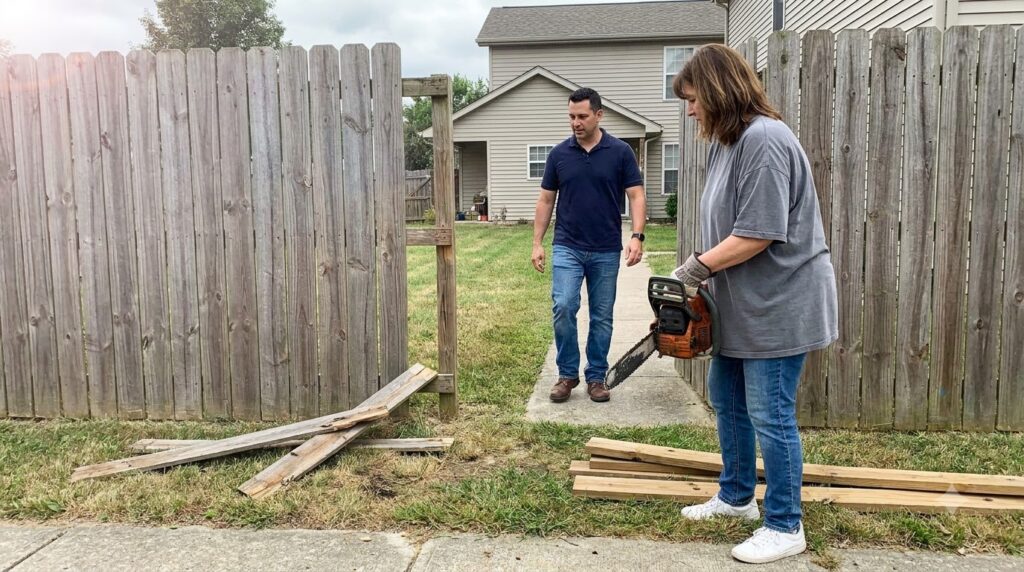
“When the sheriff steps through that opening, Nora, he isn’t going to look at the pipe under the mud. He’s going to look at the chainsaw on my grass, the fence you cut in half, and the chisel in your hand.”
He turned his head toward the driveway as tires crunched on gravel.
“Let’s see what probate says about a felon executor.”