
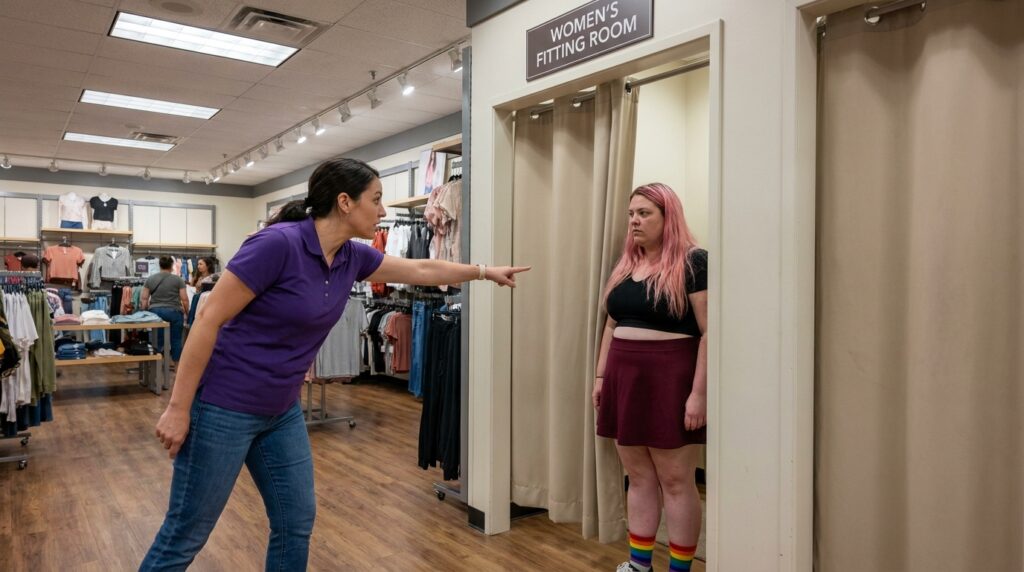
CHAPTER 6: THE CUT OF THE LANYARD
The steel door swung open with a dull clatter, and the bright, sterile expanse of the department store hit us like a slap of cold water.
The customer service lobby had gone completely still. The queue of shoppers that had backed up into the shoe department was still there, but nobody was looking at discounts or receipts anymore. Dozens of eyes tracked our movement across the linoleum—Miller walking half a step ahead, his jaw locked tight; Mark holding the heavy wooden clipboard by its metal clip; Denise trailing behind them, her shoulders slumped, her gaze pinned uselessly to the floor.
I walked beside Mark, my boots making clean, solid contact with the floor. The heavy black canvas tote remained on my shoulder, unsearched and untouched. The single burgundy skirt rested over my forearm, its barcode facing forward.
Miller stopped behind the main register island, his polished shoes resting on the black anti-fatigue rubber mat. He reached down, tapped the register terminal with his supervisor key, and pulled the scanner cord taut.
“Clear the register lane,” Miller said to the cashier on duty, his voice quiet, flat, and carrying absolute finality.
The cashier stepped back without a word, her eyes darting to Denise’s bare collar where her plastic name badge had hung just ten minutes earlier.
Miller took the burgundy skirt from my arm. He laid it flat across the glass scanner window. The laser emitted a single, high-pitched beep that seemed to echo off the high sheet-metal ceiling. He didn’t bag it immediately. Instead, he pressed the management override button, keying in a series of promotional codes that reduced the total balance on the glowing green screen to zero.
“There will be no charge for the skirt, ma’am,” Miller said, his eyes coming up to meet mine. He kept his hands flat against the register counter, the cold fluorescent lights catching the deep lines around his mouth. “On behalf of the store, and our parent corporation, I want to offer our deepest apologies for the conduct of our floor staff and the disruption to your afternoon.”
The apology sounded polished, honed by years of corporate liability training, but behind Miller’s wire-rimmed glasses, the sweat on his forehead told the real story. He wasn’t just apologizing for a mistaken stop; he was standing in the center of his own sales floor, surrounded by thirty customers holding active smartphones, trying to contain the fallout of a fabricated theft accusation.
Behind the counter, Denise stood frozen against the display case of novelty watches. Her purple shirt looked loose and rumpled now that her posture had collapsed. Her hands stayed stuffed deep into her jean pockets, her knuckles bulging through the denim as she tried to stop them from shaking.
Mark stepped forward, placing the wooden clipboard flat on the counter next to the register. He took a pair of heavy utility shears from his duty belt, reached down, and cleanly snipped the purple nylon lanyard that held Denise’s store credentials.
The sharp snip of the synthetic weave cut through the room like a hammer striking stone.
“Denise,” Miller said, not turning around. “Go to the breakroom, collect your personal belongings from your locker, and wait for the district office to call your home phone. You are not to return to the sales floor.”
Denise didn’t speak. She didn’t look at the crowd, and she didn’t look at Miller. She turned on her heel and slipped through the employee swing door, the spring-loaded hinges squeaking once before settling into dead silence.
A woman near the front of the customer line let out a long, audible breath. Across the aisle, a teenager slowly lowered her phone, giving me a short, deliberate nod of acknowledgment. The collective tension that had held the entire department captive since the fitting-room corridor finally broke, dissolving into the normal rustle of paper bags and register chatter.
Mark picked up the receipt slip that chattered out of the thermal printer. He stamped it with the green loss-prevention clearance seal, folded it neatly, and slipped it into the bag containing my skirt.
“Ma’am,” Mark said, his voice dropping into that low, even register he’d used in the aisle. He extended the bag across the counter, holding my gaze with steady, respectful clarity. “I apologize for the escort. You handled this right.”
“I knew what was on the cameras,” I said simply, taking the bag from his hand. The plastic handles felt light in my grip. “And I knew what she was trying to do.”
I turned away from the counter and walked down the main concourse toward the heavy glass exit doors.
The air outside the vestibule was cool and damp, carrying the heavy scent of wet asphalt and early evening exhaust from the suburban ring road. Behind me, the automatic doors slid shut with a soft pneumatic sigh, sealing off the hum of the fluorescent fixtures, the clinking metal hangers, and the manufactured rules of the sales floor.
I stopped near the curb, looking down at my reflection in the dark puddle near the crosswalk—the bright pink hair catching the amber glow of the parking lot lamps, the solid silhouette of my boots against the rain-slicked concrete.
They had thought the color and the clothes made me easy to corner. They had thought the badge and the clipboard gave them the right to invent the truth.
I adjusted the strap of my tote, stepped off the curb, and walked out into the gray evening air.