
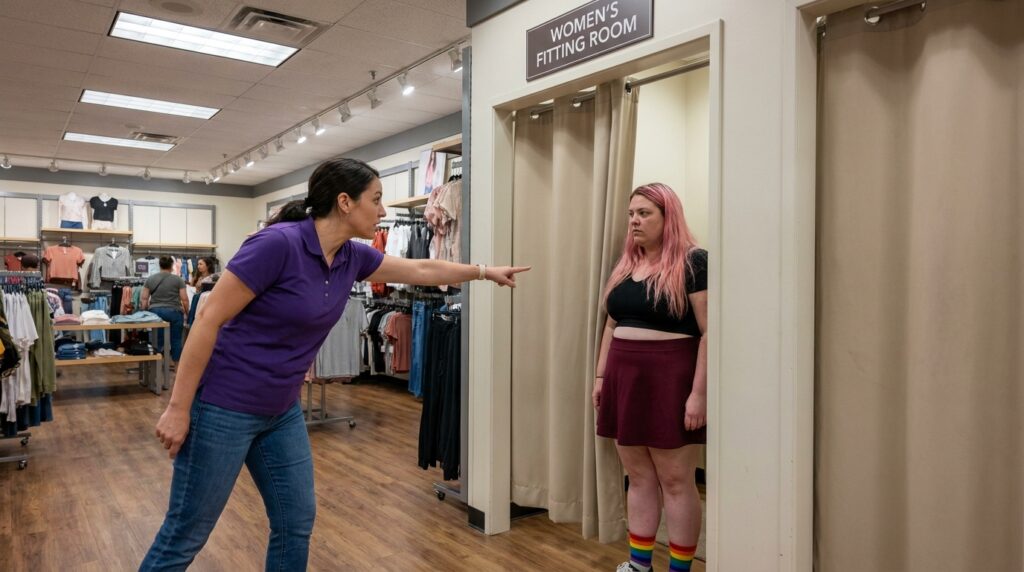
CHAPTER 3: THE WEIGHT OF THE AUDIT
The silence that followed my dare was heavy, filled only with the dull, continuous thrum of the HVAC unit overhead.
Mark didn’t reach for his radio. He didn’t dial the precinct. Instead, his heavy forearms came down across the scratched formica counter, his thumbs rhythmically rubbing the worn fabric of his dark sleeves. He looked at Denise, then down at the wooden clipboard lying between them.
“Nobody is calling the township over an unverified bag check,” Mark said, his tone dry as chalk. “Not before we pull the morning sheet.”
Denise’s jaw twitched. Her fingers remained clawed against the edge of the particle board, her knuckles pale under the relentless white tubes of the ceiling lights. “The morning sheet has nothing to do with this, Mark. She bypassed the fitting-room perimeter. We have high-ticket leather unaccounted for in section four.”
“You logged the leather into stall three,” I said, keeping my posture rigid, my boots shoulder-width apart on the linoleum. “Except the lambskin bomber was never on the women’s clearance carousel to begin with.”
The air between us felt thin, dry, and charged with the smell of old cardboard and industrial floor solvent.
Forty-five minutes earlier, before the confrontation at the beige canvas curtain, the floor had been running on the slow, mechanical grind of a Saturday shift change. I had watched Denise from two aisles over, standing near the chrome circular racks of wool blends and synthetic knits. She hadn’t been greeting customers. She had been hunched over a rolling metal return cart, a yellow inventory printout clutched in one fist, violently snapping plastic hangers along the steel bar.
Every few seconds, her gaze had darted toward the manager’s glass partition near the back hallway.
A red ink stamp had been visible across the header of her manifest: FINAL AUDIT NOTICE – DISCREPANCY PENDING.
In retail, a discrepancy pending on a weekend shift isn’t just a paperwork error; it’s a deduction against the department’s bonus pool, a formal write-up waiting on the general manager’s desk by five o’clock. Denise had been tracking the shrinkage since noon, sweating through the collar of her purple polo, checking every empty hanger with the manic urgency of someone running out of hours.
And then she had seen me.
I had walked into the department carrying my canvas tote, dressed in my cropped knit top and burgundy skirt, my pink hair catching the harsh spotlights above the designer display. To Denise, I wasn’t a shopper evaluating fabric weight or seam allowances for an upcoming gallery showcase; I was an anomaly. An outsider whose style didn’t match the suburban soccer-mom demographic of the strip mall. A walking liability that could easily be framed as the author of an already-missing SKU.
When I picked up four items—three linen blouses and one structured burgundy skirt—Denise had stepped up to the fitting-room intake podium. She hadn’t handed me the standard four-count numbered plastic card. She had simply leaned over the clipboard, making aggressive, scratching motions with her pen, her eyes deliberately avoiding mine.
“You took five items,” Denise had muttered then, her voice hushed and hurried, barely looking at the hangers as I passed.
“Four,” I had replied immediately, pausing at the threshold of stall three. “Count the hangers yourself.”
“I see what I see,” she had clipped, turning her back before the canvas curtain could even slide shut.
Now, standing at Customer Service under the gaze of three watching cashiers and half a dozen stranded shoppers, that manufactured reality was being laid out on the counter like a bad hand of cards.
“Look at the ledger, Mark,” Denise insisted now, shoving the board closer to the security guard. “Five tick marks. One, two, three, four, five. Section four lost a four-hundred-dollar lambskin bomber during the 2:00 PM cycle. She entered stall three at 2:15. Do the math.”
Mark reached down with two calloused fingers, turning the clipboard toward his own chest. His eyes scanned the smudged sheet, lingering on the jagged column of numbers.
“The item code for the bomber isn’t written on this line,” Mark observed, his voice slow, measured, devoid of warmth. “Just five ticks.”
“I didn’t have time to write the SKU,” Denise fired back, crossing her arms tightly, her chin thrust forward. “The traffic in junior apparel was backed up. I had to clear the queue.”
“The queue was empty when I walked in,” I said. “And the fourth tally mark has a ballpoint groove pressed into the paper. The fifth has no indentation at all. It’s just purple dye resting on top of the grain.”
I pointed to the base of the clipboard, where an older, dried smudge of citrus-based label remover had degraded the slick sheen of the wood. The fifth mark ran directly over the discolored patch, the wet edges of the dry-erase marker bleeding into the exposed paper fiber like ink in wet sand.
Mark leaned down, his face inches from the wood. He took the cuff of his dark sleeve and dragged it lightly across the bottom of the fifth tally mark.
The tail of the mark wiped away clean, leaving a faint violet smear across the cuff of his shirt, while the other four marks beneath it remained solid, stubborn black ballpoint.
Denise’s posture locked. The blood rushed to her cheeks, mottling the pale skin beneath her eyes.
“That doesn’t prove anything,” Denise stammered, her voice pitching higher, cracking against the high acoustic ceiling. “The marker could have brushed against the board from my pocket. It doesn’t change the fact that the jacket is missing from the floor, and her bag hasn’t been searched.”
The customer service door behind the counter swung open with a heavy, pneumatic hiss. A tall man in a charcoal button-down with a silver manager’s nameplate—MILLER, GENERAL OPERATIONS—stepped through, holding a tablet under his arm.
“What’s the holdup on the registers?” Miller asked, his eyes sweeping across the crowded counter, taking in Denise’s flushed face, Mark’s ink-stained sleeve, and my unzipped, untouched canvas bag. “We’ve got three lanes stalled and people recording on their phones in aisle two.”
Mark looked up from the clipboard, his expression hardening into stone.
“We have a discrepancy, Mr. Miller,” Mark said, tapping the wooden board against the laminate. “And it’s not in the customer’s bag.”