
CHAPTER 1: THE TALLY ON THE CLIPBOARD
The command did not come with an explanation. It came with the dry, synthetic scrape of rubber soles braking hard against waxed linoleum, followed by the rigid line of a purple sleeve cutting off the aisle.
I didn’t move.
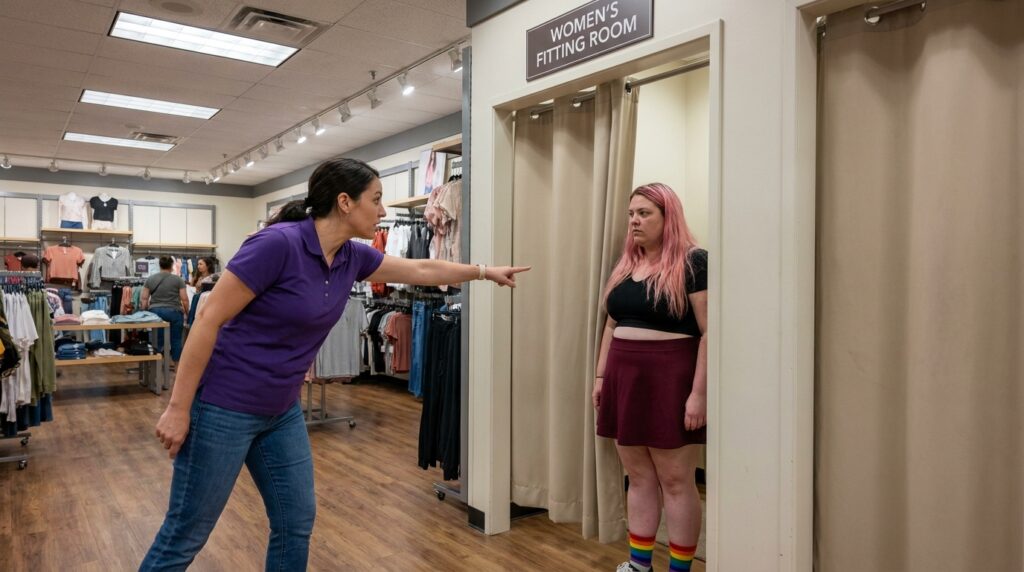
The beige canvas curtain behind me was still warm from the dead air of stall three. Above our heads, the black plastic letters of the sign—WOMEN’S FITTING ROOM—buzzed under a faulty ballast, casting a pale, greenish flicker across the threshold. The clerk was barely two feet away, her dark ponytail pulled back so hard the skin at her temples looked white. She had a wooden clipboard pressed against her ribs like a shield, the corner of the masonite chewed down to gray fiber. Her right index finger remained locked in the air between us, aimed squarely at the collar of my black knit top.
“I said step away,” she repeated. Her voice had the flat, practiced cadence of someone used to clearing teenagers out of the juniors aisle after four o’clock. “We don’t need this getting any worse.”
Around us, the floor went quiet in that sudden, suffocating way department stores do when authority raises its chin. Two women browsing a carousel of discounted corduroy skirts stopped turning the wire racks. The clack-clack-clack of chrome hangers died instantly.
I kept both feet planted inside my heavy boots. My hands stayed low, thumbs resting over the strap of my canvas tote, deliberately clear of the single burgundy skirt draped over my forearm. Beneath my hemline, the bright horizontal stripes of my rainbow socks felt loud against the gray floor, but I didn’t shift my weight. In places like this, shifting your weight is the first thing they write down as hesitation.
“I have one item to purchase,” I said. My voice was level, scrubbed of every drop of heat. “The other three are hanging on the return bar inside that stall, exactly where your rules say they belong.”
“That’s not what the sheet says,” she snapped, tapping the flat of her pen against the wood. “Five went in. You’re holding one. Where are the other four?”
“Three,” I said. “Count them.”
She didn’t turn around. She didn’t look at the curtain. Her gaze stayed fixed on the shock of dyed pink hair falling across my shoulder, her eyes narrowing as if the color itself were probable cause.
Before the silence could stretch into a shove, the heavy tread of rubber-soled work shoes cut in from the right. A man in a dark corporate polo with asset protection embroidery stepped smoothly into the gap. He was mid-thirties, his posture loose but calculated, hands open at waist height, angled to keep his body between mine and the clerk’s rigid elbow. He didn’t look angry; he looked exhausted, the way men look when they’ve spent eight hours separating coupon disputers from tired cashiers.
“Alright,” the guard said, his voice dropping an octave below the room’s ambient hum. “Let’s just step outside and talk.”
He extended an arm—not grabbing, but establishing a moving boundary that directed me toward the wide center concourse.
“She needs to open her bag right here, Mark,” the clerk pushed, stepping forward with the clipboard raised. “She’s concealing.”
The guard’s jaw tightened, his fingers grazing the air near my shoulder to maintain the escort lane. “I said we’re moving to the counter, Denise. Now.”
I let myself take one slow, deliberate step forward into the main lane, my screen illuminating in my palm. The retailer’s app was open to the loyalty tab, the digital clock ticking at the top right. But as my eyes caught the corner of the clipboard Denise was clutching against her chest, my stomach turned cold.
The fifth tally mark beside stall three wasn’t written in ballpoint ink like the others. It was drawn in thick, purplish dry-erase marker—and the ink was already beginning to bead against an oily smudge on the paper.