
CHAPTER 3: THE PAPER TRAIL OF GRIEVANCES
The paper rattled in the night air like dry leaves against concrete.
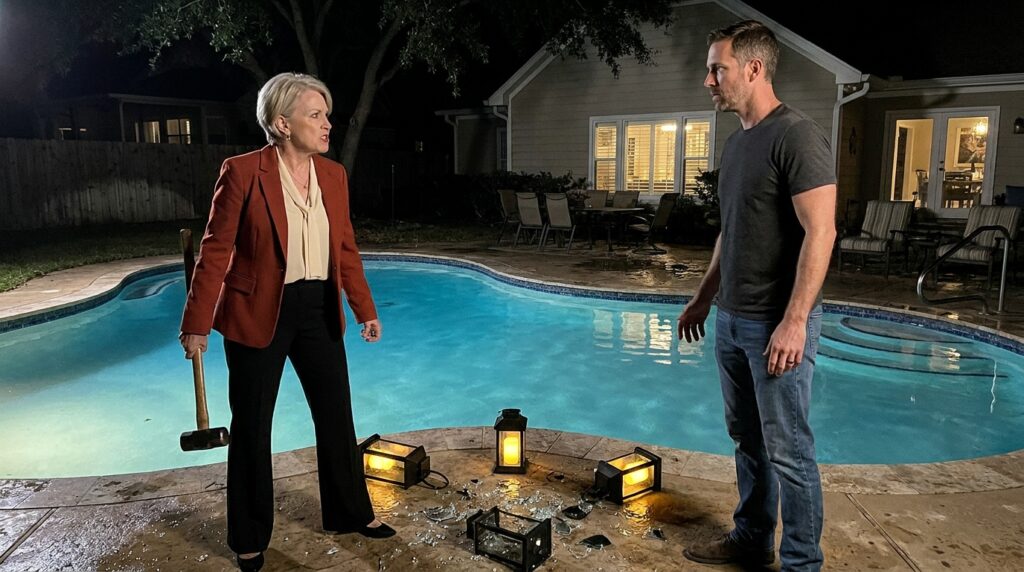
Mark didn’t reach for the packet. He didn’t flinch, and he didn’t drop his thumb from the emergency dispatch interface. His eyes tracked the crisp white sheets Evelyn held aloft in her left hand—the stark contrast between her tailored, immaculate posture and the brute eight-pound demolition hammer resting against her right ankle.
“Forty-two signatures,” Evelyn repeated, her tone hardening into a triumph that tasted like vinegar. “Every household from the entrance archway to the cul-de-sac. An emergency declaration of collective easement violation. You think you can buy a corner lot, pour forty tons of reinforced gunite, install an offshore drilling rig’s worth of illumination, and hide behind a building inspector’s rubber stamp? In this county, a certified public nuisance grants immediate self-help abatement rights.”
“There are only twenty-eight houses on Whispering Pines Lane,” Mark said.
The silence that followed was heavy and sharp, filled only by the rhythmic, mechanical pulse of the pool filtration unit.
Evelyn’s smile remained fixed, but the tendons along her throat corded tight against the silk of her cream blouse. “The adjacent parcels on Blackwood Ridge are included. We share an ambient watershed and a sightline corridor.”
“Self-help abatement applies to overhanging tree limbs and blocked sewer laterals,” Mark said, his voice flat, razor-sharp, and devoid of the panic she was fishing for. “It doesn’t grant private citizens the right to scale a six-foot privacy gate after midnight, trespass on deeded land, and swing a sledgehammer into low-voltage circuits. And county emergency injunctions don’t get issued at eight o’clock on a Thursday night without an adversarial hearing.”
He stepped half an inch sideways, aligning his sightline with the paper she held. The top sheet bore a laser-printed municipal heading, but the resolution was soft around the county crest—the telltale artifact of an upscaled PDF scan pulled from a public records portal. Below it, the lines of signatures were rendered in identical blue rollerball ink, identical stroke weights, and hurried, uniform slant.
It was an amateur forgery. A desperate piece of theater manufactured on a home desktop printer to intimidate a man she assumed would fold the second authority was mimicked.
“You’ve been manufacturing paper for six weeks, Evelyn,” Mark said softly.
He didn’t need to look at his phone to remember the timeline. He had documented every single piece of it in a synchronized digital archive.
“June fourteenth,” Mark cataloged, the cadence of his voice as methodical as a compiler log. “An unsigned index card in my mailbox claiming low-voltage path markers violate subdivision setback rules. June twenty-second: a typed notice taped to my gate post, purporting to be from a ‘Whispering Pines Environmental Committee’ that hasn’t existed since the developer went bankrupt in nineteen ninety-eight. July third: an anonymous complaint filed with the township zoning board alleging commercial drainage violations.”
Evelyn’s chin lifted another fraction, her knuckles white on the sledgehammer’s hickory shaft. “Those were legitimate civic interventions.”
“The zoning inspector came out on July ninth,” Mark continued relentlessly, holding her cold, pale gaze. “He brought the county parcel survey. He checked the runoff grade, tested the breaker panel, measured the light depression angle, and signed the final occupancy certificate on the spot. He told me the complaint was filed by a caller who refused to give her legal name but left a return number registered to the landline at forty-four Whispering Pines.”
Evelyn didn’t deny it. Her eyes narrowed into slits, catching the faint amber reflection of the patio’s single surviving lantern. “That inspector was an incompetent boy who didn’t understand historical character. He looked at blueprints; he didn’t look at reality.”
“No,” Mark said. “He looked at the iron survey pins. The ones driven eighteen inches into the limestone bed thirty years ago.”
At the mention of the pins, Evelyn’s breath caught—a tiny, sharp hitch in her chest that she tried to smother beneath an arrogant scoff.
Mark noticed the tell. It was the same microscopic fracture in her composure that had occurred when she dropped the yellowed county clerk document behind her heels. The lights weren’t the provocation; they were the distraction. When the excavation crew had dug the perimeter trench for the pool’s underground electrical conduit four weeks ago, the trenching machine had struck something solid three feet inside Mark’s cedar fence—an old, buried iron rebar marker capped in red surveyor’s plastic, directly beneath the roots of Evelyn’s decorative fieldstone retaining wall.
Evelyn had watched that excavation from her sunroom window every single day with binoculars pressed to her face.
“You think you’re very clever, don’t you?” Evelyn murmured. Her voice lost its theatrical projection, dropping into a harsh, intimate venom. “You come in here with your software money, your permits, your digital files. You think life is a spreadsheet where you can push numbers around and erase twenty years of established boundaries. This lane had an order before you bought this lot out of probate. It will have that order long after you realize you don’t belong here.”
“The order is defined by the county register of deeds,” Mark said. “Not your garden shed.”
“We’ll see what the deputy says about your deed when he reads this petition,” she hissed, shaking the forged packet again.
“He won’t have to wait long to read it,” Mark said, turning his phone screen toward her.
The screen no longer showed the dispatch dialer. The call was active, the timer reading 01:42, and from the tiny speaker at the top of the handset, a calm, tinny voice cut through the backyard air:
“Whispering Pines caller, unit two-four is turning onto your street now. Keep your distance from the subject.”