Chapter 3: The Stretcher
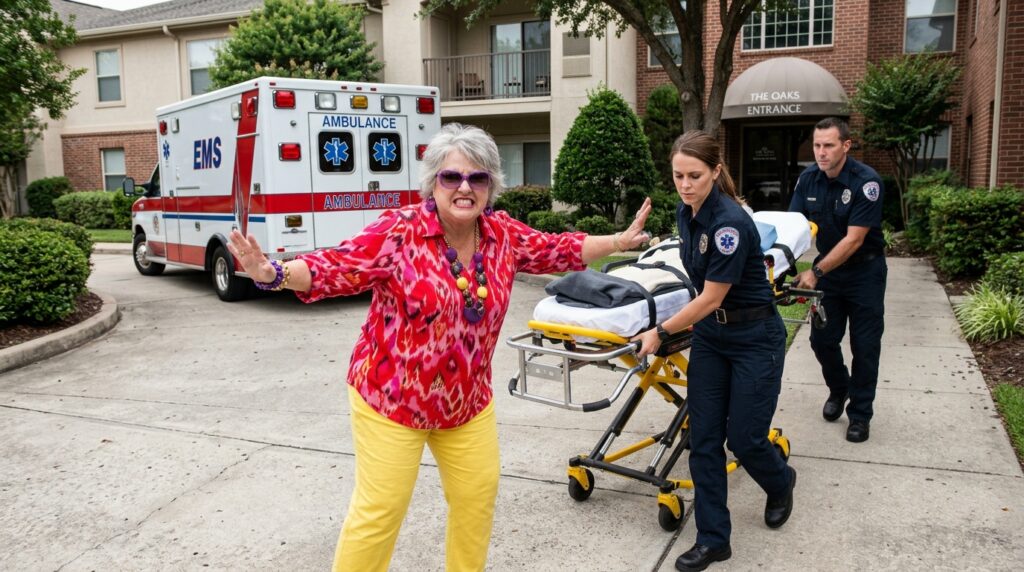
The stretcher rolled toward the side entrance.
Karen moved with it.
The paramedics tried to pass on her left.
She shifted left.
They tried the right.
Karen shifted right.
She wasn’t touching the stretcher, but her body was creating the same problem as the locked SUV.
A human roadblock.
The female paramedic’s expression tightened.
“Please step aside.”
Karen leaned forward.
“I live here.”
The paramedic didn’t answer.
She simply changed direction.
The male paramedic took the rear of the stretcher and guided it toward a narrower corridor.
Karen followed again.
By now, the residents watching from their balconies had begun to understand what was happening.
One elderly man shook his head.
A woman standing near a doorway quietly stepped back, as though embarrassed to be associated with the scene.
Karen noticed none of it.
Or perhaps she noticed and refused to acknowledge it.
She had built an identity around being the person who knew the rules.
But the emergency crew was operating under a different principle.
When someone’s life might depend on a few minutes, the most important rule was simple:
Get there.
The paramedics disappeared around the corner with the stretcher.
Karen remained in the driveway.
For several seconds, she stood alone.
Then the female paramedic returned.
Her face was controlled, but her voice was firmer.
“You need to stay clear of the entrance.”
Karen’s forced smile vanished.
“I told you, this is my area.”
“No,” the paramedic replied. “It’s an emergency access route.”
That distinction cut deeper than Karen expected.
The fire captain approached from behind.
He had already coordinated with the second engine.
The vehicles were still trapped, but the crew had found another possible route.
He looked at Karen.
Then at the SUV.
Then at the wheel lock.
“Who put that on the vehicle?”
Karen lifted her chin.
“I did.”
“Why?”
“Because it was parked where it shouldn’t be.”
The captain looked at the lock again.
“That’s your vehicle?”
Karen hesitated.
“Yes.”
“And you locked your own vehicle?”
Her expression hardened.
“That’s right.”
He nodded slowly.
He didn’t argue.
He simply turned away.
Karen watched him walk back toward the engines.
For the first time, she sensed that the situation was moving beyond the kind of neighborhood dispute she was accustomed to controlling.
A resident named Frank approached from across the lawn.
Frank was seventy-one, retired, and normally the sort of man who avoided conflict whenever possible.
Today he didn’t.
He looked at Karen’s SUV.
Then at the emergency vehicles.
“Karen,” he said quietly, “you need to move it.”
Her eyes narrowed.
“Don’t get involved.”
Frank glanced toward the building.
“My wife uses that entrance.”
Karen stared at him.
Frank continued.
“So does everyone else.”
He walked away before she could answer.
That left Karen standing beside her locked SUV while the emergency crews worked around her.
She had expected people to defend the rules.
Instead, they were beginning to defend the people those rules were supposed to serve.