
CHAPTER 4: THE METICULOUS PAPERWORK
“Go ahead and call him, Brenda,” Deputy Bowen said, his voice dropping into a dry, dangerous register that made the junior deputy freeze near the patrol car. “Call Sheriff Miller. Tell him I’m standing in the sun in a public loading lane doing my job. But while you’re dialing, I’m going to finish checking this man’s credentials.”
Lucas didn’t wait for Brenda to answer. He turned smoothly, reached through the open driver-side window of his F-350, and unlatched the heavy glove compartment. From inside, he retrieved a thick, clear vinyl sleeve fitted with heavy brass grommets. Inside sat a thick sheet of high-gloss stock bearing the metallic gold-leaf seal of the State Department of Transportation alongside the blue emblem of the Municipal Traffic Engineering Division.
He stepped back toward Bowen, holding the sleeve by its reinforced edge. “Officer.”
Bowen took the sleeve. His thumb ran across the heavy plastic before he held it up against the blinding glare of the morning sun. The golden seal caught the light, throwing a sharp reflection onto the brick wall behind them.
“Municipal Commercial Access and Public Utility Service Permit,” Bowen read aloud, his voice carrying clearly down the alley and up to the courtyard balcony where twenty onlookers now leaned against the iron railing. “Issued to Brody Mechanical Solutions. Valid countywide for all designated blue-line curb zones, service corridors, and dedicated municipal easements.”
“It’s a fake,” Vance said instantly, stepping out from behind Brenda, his polished leather shoes crunching on the loose grit. “Deputy, anyone with a laser printer and a thermal laminator can manufacture a bogus municipal seal. The merchants management association holds an unrecorded private covenant that overrides broad county permits.”
“Is that right?” Lucas asked. He pulled a compact ruggedized tablet from his canvas jacket pocket. “If the permit’s fake, Mr. Vance, maybe you can explain why the city clerk’s digital registry returns an active verification code when you scan that QR seal in the bottom right corner.”
Bowen pulled a heavy ruggedized department smartphone from his duty belt, opened the official county scanner application, and held the camera lens over the corner of Lucas’s sleeve. A sharp, high-pitched chime sounded from the speaker. The screen flashed bright green.
RECORD VERIFIED: PERMIT #M-88402. HOLDER: BRODY MECHANICAL SOLUTIONS. CLASSIFICATION: CLASS-A COMMERCIAL UTILITY DEDICATION.
“The system doesn’t lie, Vance,” Bowen said quietly, his eyes drifting over the top of the screen toward the attorney.
“That’s only half the equation,” Brenda spat, her composure cracking like dry glass as she stepped into the gap between Vance and the deputy. She pointed a manicured finger directly at the front of Lucas’s van. “A commercial permit allows you to pause in a public loading zone, Mr. Brody. It does not allow you to block a private access lane or park an industrial vehicle in a restricted residential easement. This alleyway was privatized under the 2018 municipal land transfer!”
“Read the second sheet inside that sleeve, Deputy,” Lucas said smoothly, his eyes fixed on Brenda’s sunglasses.
Bowen unzipped the top seal of the vinyl pouch and pulled out a second document—a high-resolution topographical survey map stamped by the County Registrar of Deeds. Attached to the corner was a translucent overlay showing the exact parcel boundaries of Laurel Heights Plaza.
“Section Four, Quadrant B,” Bowen read, his finger tracing a heavy red dotted line across the blue-tinted grid. “Dedicated Municipal Utility Corridor. City of Laurel Heights retains perpetual right-of-way for public utilities, infrastructure repair, and licensed commercial service operations. Width: twenty-four feet from the rear building foundation to the eastern boundary wall.”
Bowen stopped. He looked at the map, then looked up at the physical space between the bakery’s brick wall and the massive concrete planters Brenda’s crew had dropped onto the pavement.
“Twenty-four feet,” Bowen repeated. He turned slowly toward Vance. “Which means this entire alleyway—from the brick wall to the concrete planters—is a public municipal easement. It was never privatized. The 2018 covenant you’re holding only applies to the interior pedestrian courtyard.”
A ripple of quiet whispers passed through the crowd gathered on the balcony above. A bakery worker in a white flour apron took a step out into the alley, leaning against the doorframe with a wide, open grin.
“That… that is an outdated parcel boundary!” Brenda shouted, her voice rising into an unsteady screech. “My husband personally reviewed the boundary reclassification! This alleyway is private property!”
“Then your husband failed to read the deed registry,” Lucas said quietly, tapping the glass face of his tablet. “Because two weeks ago, when I pulled the title history for my business insurance, the county clerk confirmed that no private covenant can extinguish a municipal utility easement without a unanimous public vote by the county commissioners. Which never happened.”
Vance shifted his weight, his eyes darting down toward the legal papers in his hand. For the first time, his smooth corporate smile was completely gone. He took a subtle step back, placing three inches of space between himself and Brenda.
“Deputy,” Lucas continued, stepping forward so he stood directly beside Bowen, “I have a legal right to occupy this easement under state trade law while servicing a licensed tenant. But right now, my vehicle is pinned by six hundred pounds of concrete placed here by Mrs. Caldwell’s direction.”
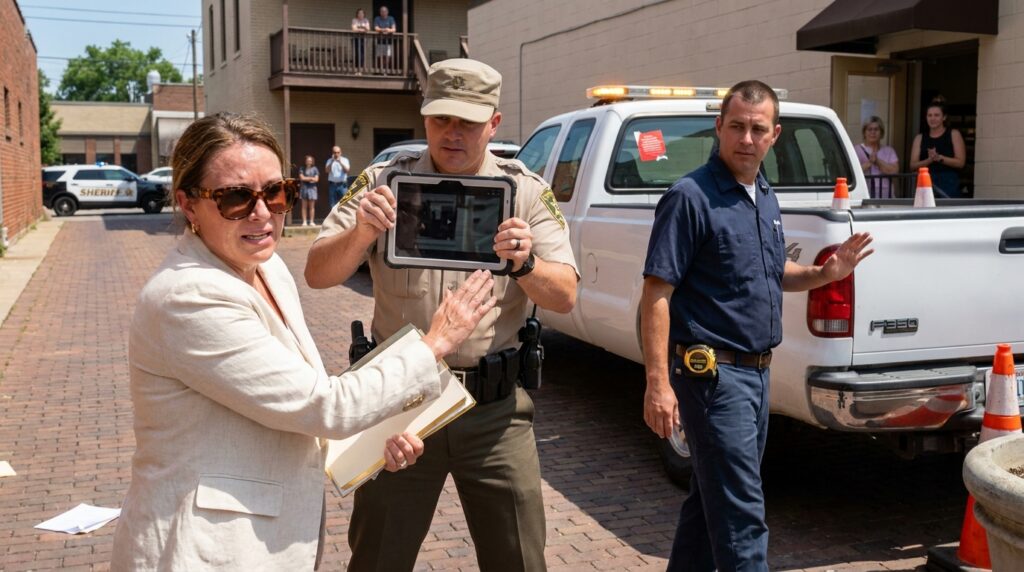
Lucas raised his tablet, the screen lit up with a crisp live dashboard displaying a dual-camera video preview.
“And before Mrs. Caldwell claims she was just enforcing neighborhood rules,” Lucas added, his voice cold, steady, carrying the razor-sharp edge of a trap being sprung, “she might want to explain what her clipboard was blocking when my rear roof camera recorded her half an hour ago.”
Brenda froze. Her hands, still holding her leather folder, trembled once, violently, against the cream linen of her jacket.