CHAPTER 2: CONCRETE AND CLAUSES
“Set ’em down right behind the dual tires. If he tries to back out, he tears his own differential off.”
Brenda’s voice carried through the open transom window above the bakery’s walk-in cooler, sharp and brittle over the heavy thrum of the compressor. Lucas didn’t stop turning his brass ratchet. He kept his eye on the low-pressure gauge, watching the needle flicker at twenty-two PSI. Freon bled into the copper line with a faint, icy hiss that frosted the brass fittings under his oil-stained knuckles.
Clara stood by the stainless-steel prep table, her hands coated in flour, staring toward the alley door. Her flour-dusted face was pale in the harsh fluorescent light. “Lucas,” she whispered, her voice trembling slightly. “That’s the groundskeeping crew. They’re moving the decorative planters from the main courtyard.”
“Let ’em move,” Lucas said softly. He tightened the service valve half a turn, checking the temperature probe jammed into the evaporator coils. Thirty-nine degrees. Dropping. “Compressor’s pulling down. You’ll keep your butter from melting.”
“You don’t understand,” Clara said, stepping closer, her fingers clutching her apron. “She did this to the florist last autumn. Claimed his delivery van was leaking transmission fluid, blocked him in with those three-hundred-pound concrete pots, and called the city marshal to write a daily abandonment citation. Cost him four thousand dollars in legal fees just to get his vehicle off the bricks. He sold his lease two months later.”
Lucas wiped his thumb across the gauge face. “A delivery van on a private lease is one thing, Clara. A licensed utility contractor on an active municipal service call is another.”
He capped the service valves, torqued the brass caps until they seated flush, and wiped down the copper lines with a rag. He picked up his tool tote, its steel frame heavy in his grip, and walked toward the heavy rear door.
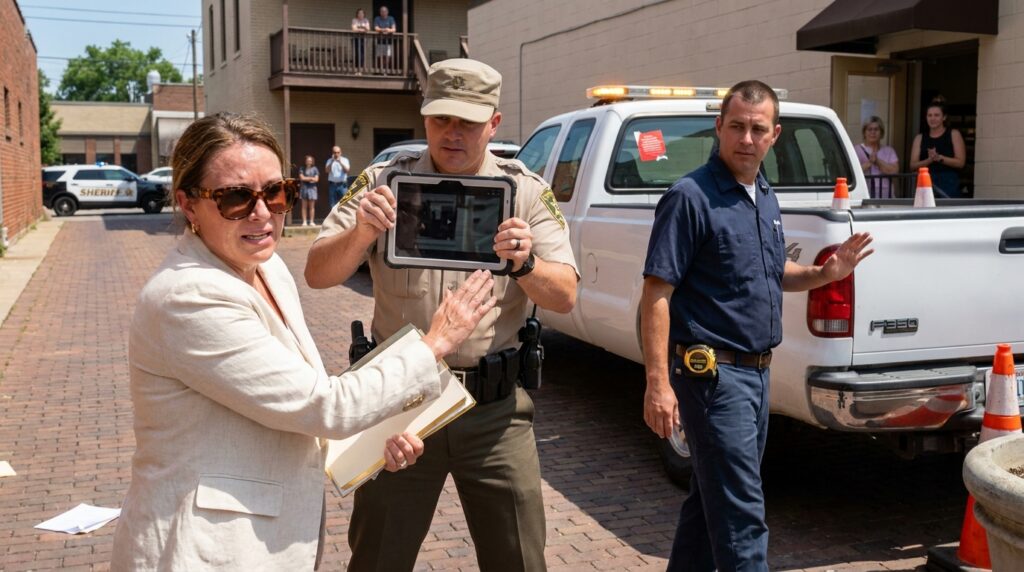
When he pushed the steel door open, the bright mid-morning light hit him like a physical blow. The alley air was thick with the smell of sun-baked brick, diesel fumes, and the sweet, heavy aroma ofproofing dough. Ten feet behind his F-350, two young men in high-visibility vests were lowering a massive, square concrete planter using a hydraulic pallet jack. The planter was filled with compacted soil and heavy ornamental shrubs, sitting less than four inches from his rear bumper. A second planter sat already positioned near his left rear tire.
Brenda stood by the alley wall, her leather-bound folder tucked beneath her arm. She was adjusting her sunglasses with one manicured hand while pointing her phone camera at his license plate with the other. Beside her stood a man in a rumpled navy blazer holding a sheaf of printed legal documents.
As the hydraulic jack hissed and dropped the second planter onto the pavers with a dull, ground-shaking thud, something bright glinted in the dust near the planter’s base. Lucas’s eyes caught it instantly—a heavy brass key attached to a stamped oval brass tag bearing the digits 302. It had slipped from the blazer pocket of the man beside Brenda as he bent to check the planter’s alignment. Neither of them noticed it fall into the dirt.
Lucas didn’t look at the key. He kept his eyes level as he set his tool tote down on his tailgate.
“You’ve got about three inches of clearance behind your hitch, Mr. Brody,” Brenda said, stepping forward. Her voice was cool, measured, perfectly pitched for the audio recording on her phone. “Since you refused to comply with our commercial access standards, the Merchants Association has exercised its right under Section Twelve of the Plaza Covenant to secure the premises against unauthorized commercial trespass.”
The man in the blazer stepped forward, offering a thin, rehearsed smile. “Frank Vance, legal counsel for Laurel Heights Merchants Management. Mr. Brody, under the master deed filed with the county in 2018, this utility corridor is classified as a private service precinct. We’ve issued a formal nuisance lien. Until the administrative assessment of five hundred dollars is settled, these grounds improvements will remain in position.”
Vance tapped a thick staple-bound document in his hands—a polished piece of legal printing complete with a raised corporate seal.
Lucas leaned his hip against the van’s rear quarter panel. His shadow stretched long across the sunlit brickwork. “A private covenant doesn’t overwrite a county access easement, Mr. Vance.”
“It does when the easement was formally dedicated to the association during the Phase Two development,” Vance replied smoothly, holding up the document so the header was visible: AMENDED DECLARATION OF PRIVATE UTILITY RIGHTS. “The city transferred maintenance authority six years ago. You’re parked on private property without a vendor permit issued by Mrs. Caldwell’s office.”
“That’s a very pretty document,” Lucas said, his voice flat, unhurried. He didn’t reach for his tablet yet. He let his eyes drift down to the brass tag sitting in the dust three feet away, then back up to Vance’s tailored collar. “Did the city council vote on that transfer, or did your firm just file an administrative amendment with the registrar?”
Vance’s smile twitched slightly at the corner. “The public record speaks for itself. Mrs. Caldwell has already contacted the sheriff’s department. Deputy Bowen is en route to enforce the trespass order.”
“Good,” Lucas said. He picked up his tool tote, placed it neatly inside the rear cargo bay, and reached for the door handles. “I like dealing with people who carry a state badge instead of a clipboard.”
Brenda took a sharp step forward, her confidence flaring into visible irritation at his lack of reaction. “You think you’re clever, Brody? You think a greasy shirt and a set of wrenches gives you the right to ruin the atmosphere of a ten-million-dollar development? When Bowen gets here, you’ll be leaving in the back of his cruiser while a flatbed hauls this junk pile to the impound lot.”
“We’ll see,” Lucas said quietly.
He pulled his rear cargo doors shut. The heavy steel latches clicked into place with a sharp, mechanical snap that echoed down the brick corridor, while the hidden roof camera above his head silently recorded Vance stepping back, his polished shoe landing less than two inches from the lost brass key in the dust.