
CHAPTER 2: THE PAPERWORK PARADOX
“Stolen inventory,” Brenda repeated, her voice dropping all pretense of professional restraint as she let the words echo off the corrugated steel ceiling.
A heavy silence settled over Gate Four. The contractor who had been idling with his sheetrock cart froze, his thumb hovering over his phone screen. Across the register bay, two cashiers stopped scanning items, the sharp red beams of their laser readers painting silent crimson lines across conveyor belts.
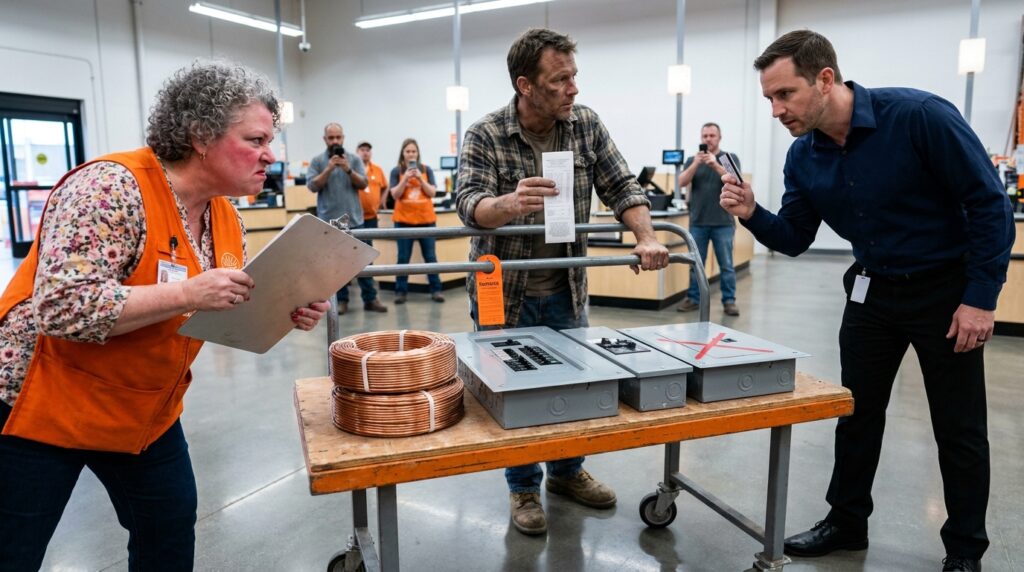
Marcus did not pull his hand back from the thermal paper. He kept his grip steady, his knuckles white against the folded edge of the receipt. Through the thick soles of his scuffed work boots, he could feel the low vibration of the air conditioning units humming high above the timber racks.
“Stolen inventory,” Marcus said, his tone flat, devoid of the panic Brenda was clearly waiting to see. He looked down at the top breaker box on his flatbed. The factory shrink-wrap was still intact, but on the bottom right corner of the gray sheet metal, half-hidden beneath the plastic wrap, a faint red mark caught his eye—a small, handwritten cross made with a red grease pencil. It was fresh. The wax hadn’t even gathered dust yet. “These panels came off the high-bay pallet in aisle fourteen ten minutes ago. Tyler cut the banding himself.”
“I don’t care if you saw them drop from heaven, Holloway,” Brenda said, stepping forward until her orange vest was mere inches from the cart’s front rail. She held her clipboard like a shield, tapping a thick thumb against the top latch. “The regional loss-prevention server pushed an automated flag at one o’clock today. Three 200-amp main breaker units, matching those exact model numbers, were reported missing from the regional distribution hub in Columbus. When Tyler scanned them at register four, the system logged the serial numbers and triggered a silent hold.”
“If the system triggered a hold,” Marcus said, leaning in slightly, his eyes locked on her face, “Tyler’s terminal would have locked out. The drawer wouldn’t have opened. The payment wouldn’t have cleared.”
“Tyler bypassed it,” Brenda declared, her chest swelling as she raised her voice for the benefit of the three contractors now standing in a quiet semicircle behind Marcus. “He used a standard department override because he was lazy, or because you talked him into rushing the order through. But the flag is in the system. And until Asset Protection clears those serial numbers, this cart doesn’t cross the threshold.”
Marcus looked past her shoulder, toward the customer service desk twenty feet away. Behind the high laminate counter, a single computer monitor faced the interior of the desk. Its screen was dark, energy-saver mode blanking the display. Beside the keyboard sat a thick leather binder and a red grease pencil, its tip flattened from recent pressure.
“Call Derek,” Marcus said.
Brenda laughed—a short, sharp bark that lacked any real humor. “The general manager doesn’t handle floor-level inventory holds, Holloway. I do.”
“Call Derek,” Marcus repeated, his voice dropping another register, carrying the weight of an iron beam settling onto a footing. “Because if Tyler bypassed an LP flag, his login credentials are on that transaction receipt. And if Tyler didn’t bypass an LP flag, then somebody manually flagged those serial numbers after they were brought down from the high-bay shelf.”
Brenda’s fingers twitched against the edge of her clipboard. For a fraction of a second, her posture stiffened, her eyes darting toward the dark screen at the customer service desk before snapping back to Marcus’s face.
“Are you accusing store management of falsifying loss-prevention records?” she asked, her voice tight, attempting to regain the high ground.
“I’m not accusing anyone of anything yet,” Marcus said. He unfolded the thermal receipt slowly, holding it up so the crisp black print of the barcode was visible to the contractor standing nearby. “I’m saying I paid twelve hundred and forty-two dollars for goods sitting on a cart tagged by your cashier. If this inventory is stolen, then your register just processed the sale of stolen property. That’s not a floor-level hold, Brenda. That’s a corporate audit.”
The heavy double doors behind Brenda slid open with a soft pneumatic hiss, admitting a gust of humid summer air and the heavy footfalls of two men moving with deliberate speed across the concrete entrance.
It was Derek Simmons, the general store manager, flanked by the lead Asset Protection officer, a tall man in a plain black polo shirt with a radio clipped to his belt. Derek’s eyes swept the bay—taking in the blocked cart, the gathering crowd of customers with their phones raised, Marcus’s motionless stance, and Brenda’s rigid posture.
“What’s the hold-up at Gate Four?” Derek asked, his voice crisp, authority instantly flattening the ambient noise of the lobby. “Brenda, why is there a security call on a cleared commercial exit?”
Brenda turned instantly, her clipboard raised like an offering as she stepped toward the manager. “Derek, we have a critical LP violation. Serial numbers on this commercial load match a stolen distribution flag from Columbus. The customer is refusing to yield the cart for impound.”
Marcus didn’t move from his position behind the handle. He simply turned the paper in his hand so the red grease-pencil mark on the panel box was fully exposed to the bright overhead lights.
“The receipt cleared at 4:12 PM, Mr. Simmons,” Marcus said, his voice cutting through Brenda’s rapid-fire explanation. “And the grease mark on these panels was put on them after they left the rack.”