
CHAPTER 1: THE BARRIER AT GATE FOUR
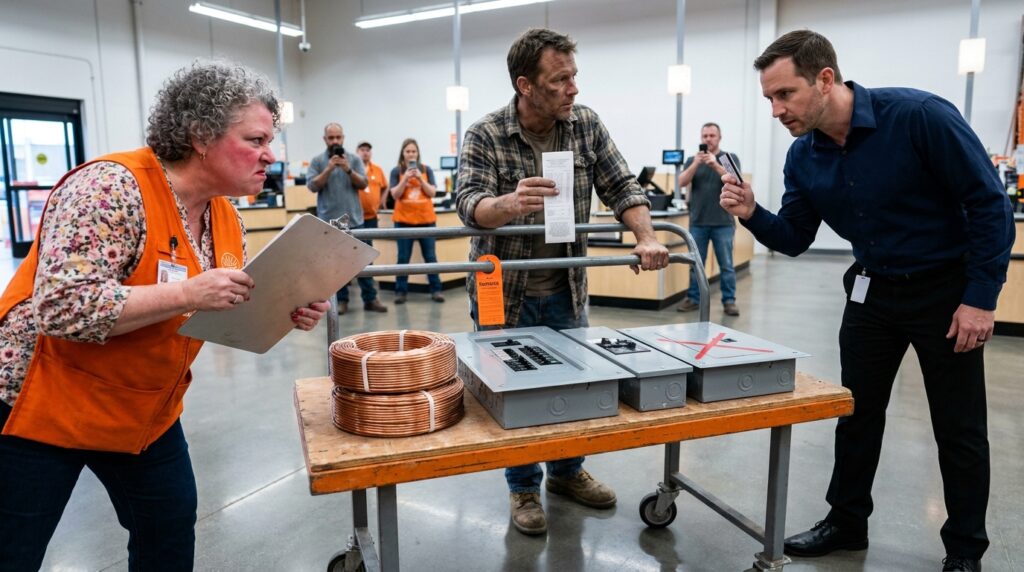
“Stop the cart right there, Holloway,” Brenda’s voice sliced through the heavy rumble of the exit lobby, her bright orange supervisor vest pulled taut over her chest as she slammed her aluminum clipboard down against the steel guide rail.
The flatbed cart ground to a halt, its heavy iron casters squealing against the polished concrete floor. Marcus Holloway didn’t flinch. His hands, rough and calloused from fifteen years of pulling thick copper wire through metal conduit, remained resting on the cart’s cold steel handle. He looked at Brenda Lawson. Her tight gray curls were framed by the harsh glare of the overhead fluorescent bays, her eyes narrowed with a sharp, rehearsed authority that had terrorized floor cashiers for six years.
On the flatbed sat three industrial three-phase breaker panels, their gray sheet-metal housings gleaming under the store lights, stacked beside two heavy coils of ten-gauge wire. Twelve hundred and forty-two dollars of commercial gear.
“Step away from the load,” Brenda said, her voice dropping an octave into the loud, deliberate tone reserved for public corrections. She didn’t look at his eyes; she looked at the drywall dust coating the knees of his denim jeans and the scuffed toes of his work boots. “Bypassing the commercial verification desk with high-value electrical is a direct violation of store policy.”
Around them, the Saturday morning rush choked the exit bay. A contractor pushing a stack of sheetrock slowed down, his eyes darting between Brenda’s raised hand and Marcus’s quiet frame. A family holding cans of porch paint drifted toward the sliding glass doors, turning their heads as the tension pooled in the doorway.
“The transaction was completed two minutes ago,” Marcus said. His voice was low, steady, carrying the slow rhythm of a man who spent his days measuring tolerances in thousandths of an inch. “Register four. Tyler scanned the panels, checked the serial numbers, and stapled the bypass tag to the handle.”
He didn’t reach into his pocket aggressively. He simply pointed a blunt index finger at the bright neon orange paper strip looped through the cart’s wire frame. It hung there, fresh and unbent, stamped with the black ink of the register terminal.
Brenda didn’t even glance at the tag. She stepped closer, her chest almost touching the front edge of the heavy panels, using her body to form a physical wall between the cart and the double glass doors opening to the parking lot. The smell of cut pine and fertilizer drifted through the doorway, cold against the warm, stale heat of the retail floor.
“Tyler is a nineteen-year-old floor associate who doesn’t have asset clearance for three-phase commercial equipment,” Brenda snapped, her fingers tapping a rhythm against the hard aluminum back of her clipboard. She raised her left hand, which held a high-visibility two-way radio, and pressed the talk button with her thumb. The radio hissed with static. “Any paper tag leaving this bay without my secondary signature is an unverified roll-out. You know how this store operates, Holloway. Or at least, you should.”
“I know the store policy written on the commercial counter board,” Marcus said softly, his thumbs tracing the smooth steel handle beneath his palms. “Bypass tags over one thousand dollars require cashier verification and terminal logging. It was logged. Look at your desk screen.”
“I don’t need to look at my screen to know when a load hasn’t been cleared by management,” she countered, her lip curling slightly as she raised the radio to her mouth. “Asset Protection to Gate Four. I have an uncooperative contractor attempting an unverified commercial roll-out. Repeat, Gate Four.”
The static spat back a brief confirmation. Across the front registers, the rhythmic beep-beep-beep of barcode scanners seemed to stutter. Cashiers at registers two and three leaned out from their plastic wells, watching the standoff. The contractor with the sheetrock stopped completely, pulling his cell phone from his canvas vest pocket with a thumb sliding across the glass screen.
Marcus reached into his breast pocket. His fingers brushed against the crisp, narrow strip of thermal paper. It was still warm from the printer head at register four. He pulled it out, folded it once so the bold black timestamp faced outward, and held it in the air between them.
“4:12 PM,” Marcus said, reading the dark text printed above the itemized barcode. “The terminal cleared the card. The transaction is closed.”
Brenda didn’t take the receipt. Instead, a thin, tight smile spread across her face as she leaned in over the cart rail, her voice dropping so only Marcus and the closest watching cashier could hear her next words.
“That paper doesn’t mean a damn thing, Marcus,” she whispered, her eyes flashing with a cold, triumphant light. “Because three hours ago, those exact serial numbers were flagged as stolen inventory in our regional database.”