Chapter 3: What the Residents Knew
Walter survived the first crisis.
The paramedics stabilized him enough to transport him to the hospital.
By the time they brought him downstairs, the lobby was nearly empty.
Karen was still there.
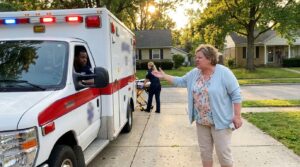
She stood near the entrance with her arms folded, watching the stretcher emerge from the side corridor.
For the first time that afternoon, she said nothing.
Walter’s eyes were closed.
Emily and Marcus moved quickly.
The stretcher rolled past Karen.
She stepped aside.
Nobody asked her permission.
Nobody waited for her approval.
The ambulance doors closed.
Then it drove away.
Karen watched the red lights disappear beyond the entrance.
That should have been the end of it.
Instead, the next morning, an email went out to every resident.
It wasn’t from Karen.
It was from the condo association president, Harold Gaines.
Harold was seventy-one, soft-spoken, and usually reluctant to get involved in disagreements.
His message was short.
He wrote that an emergency vehicle had experienced an obstruction while responding to a medical call and that the board would be reviewing emergency-access procedures.
Karen read the message twice.
Then she slammed her laptop shut.
She called Harold.
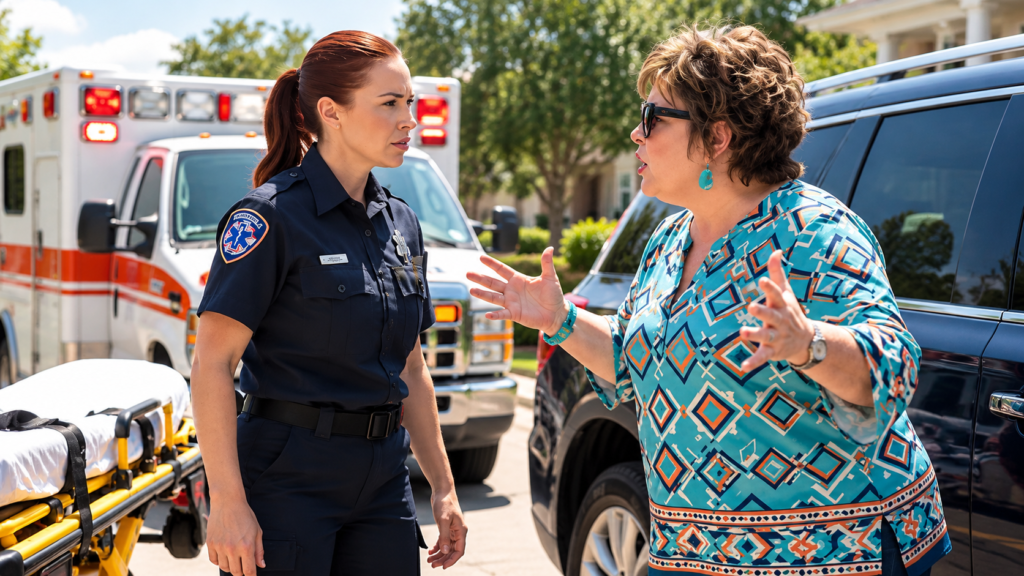
“You’re making this sound like I did something wrong.”
Harold sighed.
“Karen, you stood in front of the stretcher.”
“I was protecting the property.”
“You struck the ambulance window.”
“I was trying to get their attention.”
“You told the paramedic you ran the place.”
Karen went silent.
“How do you know what I said?”
“People heard you.”
That answer irritated her more than anything else.
People heard her.
People saw her.
And now people were talking.
That afternoon, Harold called a board meeting.
Karen arrived prepared for battle.
But something unexpected happened.
The residents were not angry in the way she expected.
They were disappointed.
One woman spoke about her husband, who had died several years earlier after an emergency call.
Another resident explained that his daughter was a nurse and that every minute mattered during a cardiac emergency.
Frank said nothing until the end.
Then he placed a folded document on the table.
It was the community’s emergency-access plan.
The side entrance was specifically designated as an emergency access point.
Karen stared at it.
“I’ve never seen this.”
Harold looked at her.
“It was approved before you joined the board.”
Karen’s face reddened.
“So what? That doesn’t mean paramedics can just drive wherever they want.”
“They weren’t driving wherever they wanted.”
Harold paused.
“They were trying to reach Walter.”
Karen pushed back from the table.
“This whole thing is being exaggerated.”
“No one is exaggerating what happened,” Harold said quietly.
Karen looked around the room.
For the first time, she noticed something uncomfortable.
Nobody was afraid of her anymore.
She had spent years believing people respected her authority.
Maybe they had simply been avoiding her.
The distinction was difficult to face.
But the meeting became even more uncomfortable when Harold mentioned one additional fact.
The ambulance crew had documented the obstruction.
And the association’s insurer had requested a copy of the incident report.
Karen’s stomach tightened.
Suddenly, this wasn’t just a neighborhood argument.
There could be consequences.