Chapter 2: The Door Behind the Building
The patient was in Unit 214.
Emily and Marcus knew only the essentials as they rushed through the side corridor: an older man, severe shortness of breath, possible cardiac emergency, uncertain medical history.
They did not know his name.
They did not know what had happened.
They only knew they were losing time.
A resident named Frank Morales had called 911 after hearing pounding from the unit next door. Frank was seventy-two and had lived in the building for eleven years. He had initially tried the hallway entrance, but Karen had been standing there, arguing with the ambulance crew.
So Frank had run to the side entrance and waved the paramedics through.
“Second floor,” he said breathlessly. “214. I left the door unlocked.”
Emily nodded.
“Thank you.”
They hurried upstairs.
Behind them, the building had begun to stir.
Doors opened.
People stepped into hallways.
Word traveled quickly through a retirement community.
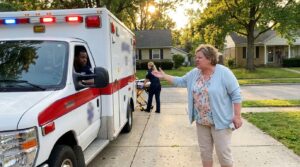
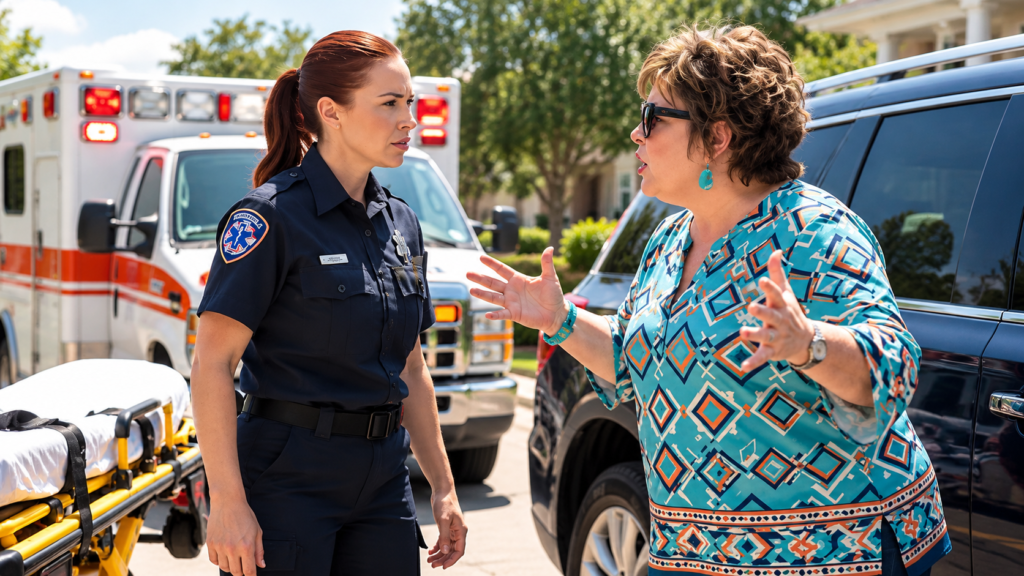
Karen had stopped an ambulance.
Karen had hit the ambulance window.
Karen had tried to block the stretcher.
But nobody yet knew what had happened inside Unit 214.
At the top of the stairs, Emily and Marcus found Frank waiting.
“He’s in the bedroom,” Frank said.
They entered.
The patient was an elderly man named Walter Bennett, seventy-nine years old.
He was sitting on the edge of his bed, pale and sweating, struggling to breathe.
Emily immediately knelt beside him.
“Mr. Bennett, we’re going to help you.”
Walter nodded weakly.
His oxygen level was dangerously low.
Within seconds, the room became organized chaos.
Equipment came out.
Questions were asked.
Numbers were checked.
Marcus prepared the stretcher while Emily worked with Walter.
Downstairs, Karen remained near the main entrance.
She told herself she had done the right thing.
She had rules.
She had responsibilities.
She was on the condo board, and in her mind, that meant people were supposed to respect her.
For years, Karen had taken that role further than anyone expected.
She complained about trash cans.
She challenged delivery drivers.
She confronted residents over parking.
She had once demanded that a family remove a child’s bicycle from a common hallway because it was “visually disruptive.”
Most people simply avoided her.
That had allowed her sense of authority to grow.
But now something was different.
People had seen her block an ambulance.
And unlike a parking argument or a trash-bin dispute, this involved something nobody could dismiss as a minor disagreement.
Frank came downstairs twenty minutes later.
Karen approached him immediately.
“What exactly happened?”
Frank looked at her.
“What do you mean?”
“The ambulance.”
“He needed help.”
Karen crossed her arms.
“And you thought it was appropriate to bring them through the side entrance?”
Frank’s expression hardened.
“I thought it was appropriate to get them to Walter.”
Karen blinked.
She had expected agreement.
Instead, Frank walked past her.
At the far end of the lobby, two residents were talking quietly.
Karen caught one sentence.
“She could have cost him his life.”
Karen turned sharply.
“What did you say?”
The women fell silent.
Nobody wanted another confrontation.
Karen stood alone in the lobby, surrounded by people who suddenly seemed to be looking at her differently.
Upstairs, the paramedics continued working.
And Walter Bennett was fighting for his life.