
CHAPTER 4: THE COUNTERFEIT COVENANT
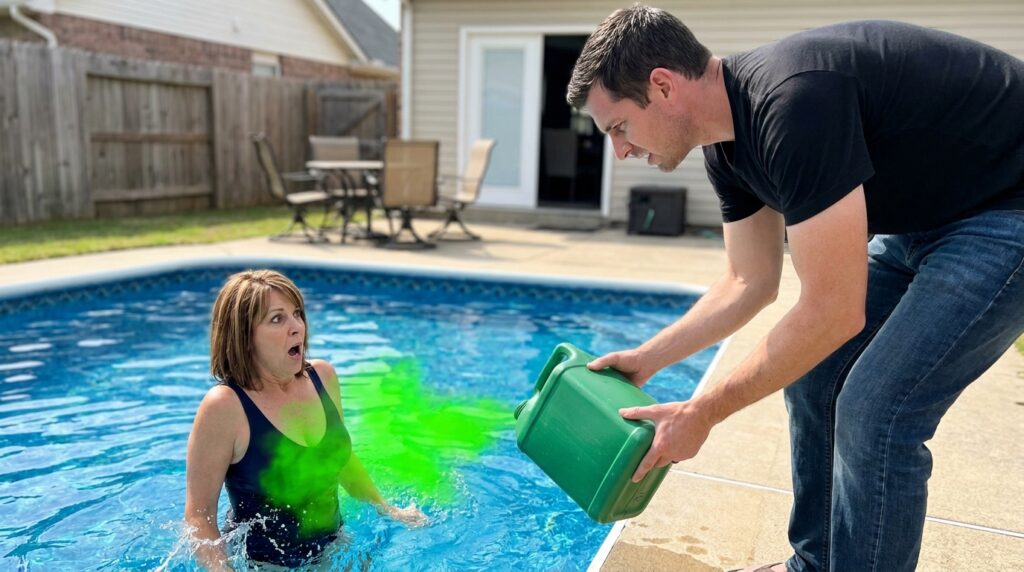
Deputy Miller did not look away from Brenda. The silence that settled over the patio was heavy, broken only by the rhythmic hum of the pool pump churning green-tinted water through its sand filter.
“A kitchen deadbolt,” Miller said, his tone dropping an octave. “Ma’am, does this key belong to you?”
“I told you,” Brenda replied, her chin tilted at an angle that defied the neon stains running down her bare arms. “Arthur gave the neighborhood association full custodial keys when his mobility deteriorated. We had an agreement. We maintained the property, we monitored the pool chemistry, and in exchange, the pool remained an open community asset. If the lock was changed without notification to the block committee, testing the cylinder is standard procedure to ensure access isn’t compromised.”
“You don’t test a cylinder while the homeowner is at work unless you’re crossing a threshold,” I said, stepping between Miller and the pool edge. “And you didn’t test it for community upkeep.”
I tapped the screen of my phone, bringing up the high-definition security playback from Tuesday afternoon. I rotated the device toward Miller.
The screen showed the covered back patio at 1:42 PM. The sunlight sliced diagonally across the sliding glass door. On screen, Brenda appeared in a floral sun hat and oversized sunglasses, carrying a red plastic tote. She walked directly up to the back door, inserted the stamped brass key into the lower cylinder, unlocked it, and stepped across the threshold into my house. Four minutes later, she emerged holding two industrial canisters of pool shock and a digital water-testing wand, locking the door behind her before proceeding to the pool shed.
Miller watched the playback twice. His jaw hardened. “Ma’am, that is an occupied residence.”
“I was retrieving the water balancer!” Brenda snapped, her voice tightening with indignant friction. “Arthur stored the pool supplies in the utility closet off the kitchen. It has been that way since two thousand fifteen. You cannot expect a volunteer block trustee to purchase five-hundred-dollar chemical buckets out of pocket when the homeowner refuses to maintain the water balance!”
“Let’s talk about that volunteer work,” I said.
I picked up the fallen canvas tote from the lounger by its nylon strap and emptied the remaining pockets onto the glass patio table.
Along with the duplicate gate keys and the yellowed 1998 easement document, three thick manila envelopes slid across the glass. One was stuffed with carbon-copy bank deposit slips totaling over four thousand dollars from the past six weeks alone, all endorsed to Oakridge Aquatics LLC. The second contained printed parental liability waivers, each bearing the address of my backyard pool as the registered facility location.
The third envelope contained the original deed records from 1998 that Brenda had attempted to pass off as a perpetual easement.
Miller reached out and pulled the yellowed paper under his flashlight. He examined the bottom margin where the shaky signature of Arthur Vance sat beneath the handwritten paragraph.
“Look at the ink on the signature line, Deputy,” I said quietly. “Arthur signed a revocable permission slip for his immediate next-door neighbors to use the diving board during the summer of ninety-eight. That original paragraph ended at line twelve. Lines thirteen through twenty-two—the part about perpetual community right-of-way, block trusteeship, and transfer of access to subsequent owners—were typed on a mechanical ribbon machine with mismatched pitch, added twenty years after Arthur had his stroke.”
Miller leaned in, his thumb tracing the physical indentation where the typewritten font visibly overlapped the top loop of Arthur’s aged ink signature.
“This isn’t a recorded covenant,” Miller said, his eyes coming up to fix squarely on Brenda’s face. “This is an altered personal document.”
“It represents his intent!” Brenda shouted, taking a hard step toward the table, her wet feet slapping violently against the flagstones. “Arthur wanted this neighborhood to have a pool! He built it for the families on this street! You bought this house on a foreclosure short-sale and immediately threw up six-foot fences like you own an embassy! You locked out thirty families who have been swimming here every summer for a quarter of a century!”
“I bought a single-family home with a private yard,” I said, meeting her gaze without flinching. “I didn’t buy a municipal recreation center. And I certainly didn’t agree to provide free commercial overhead for your private swim academy.”
Brenda’s chest rose and fell in shallow, rapid surges. Her hands knotted into fists at her sides, green dye still clinging to the cuticles of her fingernails. “You don’t understand how this community works. The HOA board will hear this on Tuesday. We will file for an emergency easement by prescription. We will have this fence torn down by court order.”
“The board won’t be hearing anything on Tuesday, Brenda,” Miller said, reaching down toward the heavy leather cuffs clipped to the back of his duty belt. “Because right now, you’re not speaking as an HOA trustee. You’re speaking as an uninvited individual standing in an enclosed backyard with a forced latch, an unauthorized key, and a commercial ledger on private residential property.”