
CHAPTER 3: THE FRACTURED LATCH
The footsteps slowed as the heavy cedar gate swung inward with a dry, protesting groan.
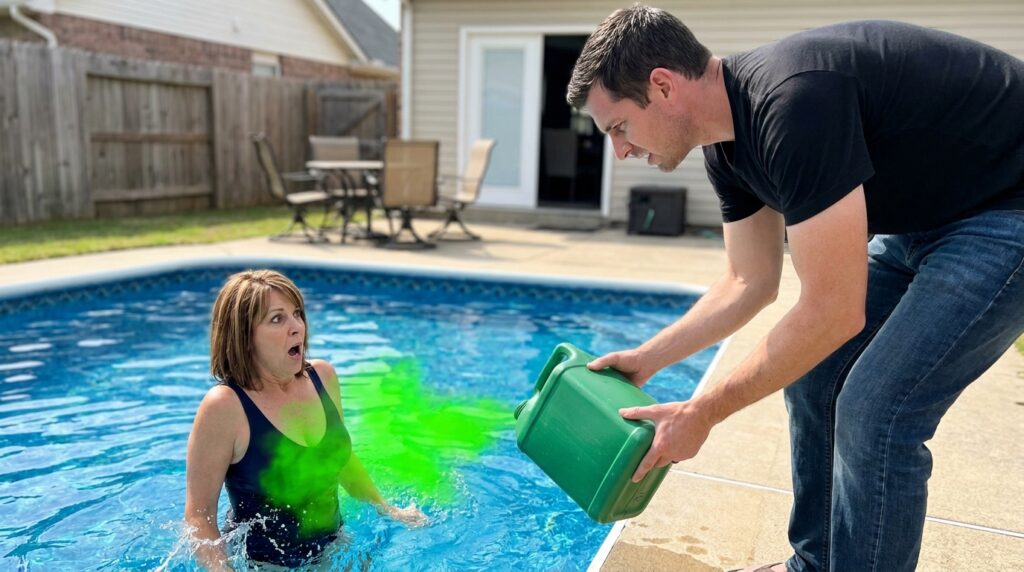
Deputy Miller stepped into the pool enclosure, his peaked duty cap casting a sharp diagonal shadow across his weathered jawline. His hand rested lightly over his utility belt, not on the holster, but near the radio pouch—an officer reading the room before committing his weight. His gaze swept the yard with practiced economy: the six-foot solid privacy pickets, the empty chemical jug resting against my leg, the vivid emerald swirl choking the pool’s deep end, and finally Brenda, standing shivering on the concrete in a soaking charcoal one-piece, water the color of radiator fluid dripping off her collarbones.
“Dispatch had this flagged as an active property dispute with hazardous material involvement,” Miller said, his boots grinding against the crushed gravel at the breezeway threshold. “Someone want to tell me why the water looks like antifreeze?”
“He ambushed me, Officer,” Brenda cut in immediately, taking two rapid, squelching steps forward. Her voice had shed its earlier tremor, replacing it with the sharp, clipped authority of someone used to running municipal planning sessions. “I was conducting authorized recreational maintenance. He came through that back door and dumped industrial chemicals directly onto my person. I am covered in it. It’s an unprovoked toxic assault.”
Miller’s eyes flicked to the neon puddles around her bare feet, then shifted to me. “Sir?”
“The chemical is hydrological tracing dye, Deputy,” I said, holding out the laminated manufacturer safety data sheet I had pulled from my back pocket. “Food-grade, non-toxic sodium fluorescein. Used by the county water authority and licensed pool contractors. The SDS is right here. Zero skin toxicity, zero inhalation risk. It’s a visual tracer.”
Miller took the sheet, squinted at the OSHA compliance stamp, and handed it back without a change in expression. “And why is it in your pool?”
“Because it doesn’t belong to him,” Brenda interjected smoothly, extending the folded, yellowed legal document she had retrieved from her tote. “This parcel is subject to an irrevocable private recreational covenant. Arthur Vance deeded pool and patio access to the contiguous block members in nineteen ninety-eight. I am the designated block trustee. When this gentleman bought the parcel last year, he unlawfully obstructed an established community right-of-way by erecting that privacy fence.”
Miller took the yellowed paper, his leather gloves creaking as he unfolded it against his clipboard.
I watched the deputy’s eyes scan the faded ink. The document was dated July 14, 1998, written in a tight cursive script that bore the shaky signature of Arthur Vance, witnessed by two former neighbors whose houses had been sold a decade ago. It outlined an agreement: in exchange for shared seasonal maintenance costs and pump upkeep, designated neighbors held permissive, perpetual entry to the pool deck via the side breezeway.
Miller looked up, his brow furrowed. “Mr. Mercer, were you aware of this agreement when you took title?”
“There is no agreement recorded with the county, Deputy,” I replied calmly. “My deed is fee simple. Title is free and clear of any covenant, easement, or encumbrance. But more importantly—that piece of paper isn’t how Brenda got into this yard today.”
Brenda’s chin lifted. “I used my authorized key.”
“Show the deputy the latch, Miller,” I said, pointing toward the gate entrance.
Miller turned, his eyes dropping to the heavy-duty slide bolt mounted on the inside framing of the cedar gate.
The lock was a four-inch hardened steel slide, secured by a solid brass master padlock. But the brass shackle wasn’t unlocked. The padlock was still clicked shut, hanging uselessly from a distorted iron eyelet. The zinc-plated screws securing the strike plate to the cedar post were stripped, gouged, and backed out half an inch. On the ground directly beneath the latch lay a small puddle of fresh WD-40, a handful of raw cedar wood shavings, and a flattened steel pry-bar shim coated in silver metallic transfer paint.
Miller knelt down. He didn’t touch the metal; he simply leaned in, his flashlight beam cutting through the midday glare to illuminate the fresh, jagged gouges etched into the strike plate.
“Fresh metal filings,” Miller muttered, running a gloved fingertip along the splintered wood. “Screws were forced from the exterior side with a leverage shim.”
“That latch was stuck from the humidity,” Brenda said, her voice rising half an octave, though her posture remained rigid. “As trustee of the covenant, I have the legal right to clear access obstructions to an established community asset. Arthur gave me the original gate key thirty years ago. If the current resident modifies the locking mechanism without HOA committee approval, the covenant permits reasonable physical remedy to maintain the easement.”
“There is no HOA committee for this block, Brenda,” I said, stepping past the pool edge toward the gate. “The HOA dissolved in two thousand twelve. You know that. And Arthur Vance didn’t give you a master key to my deadbolts.”
I reached down and picked up the stamped brass key lying on the patio concrete, holding it up so the sun caught the factory code.
Miller took the key from my hand, turned it over, and looked at the five digits stamped into the flange: 4-1-8-8-2.
“That’s the cylinder code for my back kitchen door,” I said, looking directly at Brenda. “Not the gate. The house.”
Brenda’s eyes narrowed, but her jaw remained locked. “Arthur gave me a full emergency ring when his health began to fail. I kept it in the neighborhood safety lockbox. I have never entered your house.”
“Then why,” I asked, pulling my phone from my pocket and tapping the screen, “did my perimeter sensors log that exact key turning the lock on my back door three days ago while I was forty miles away in court?”