CHAPTER 4: THE OFFICIAL VERIFICATION
The heavy oak door of the township building administration lobby slammed shut behind Marcus, the glass pane rattling in its metal frame. Outside, dusk was settling over the county seat, turning the sky the color of cold iron.
Marcus held his leather work folder against his ribs. Five minutes ago, the zoning clerk had handed him a stamped stop-work notice—not from the HOA, but printed on official township letterhead. A formal municipal hold had been slapped onto his building permit, citing an “unresolved public infrastructure easement dispute” raised directly by the office of Township Councilor Miller.
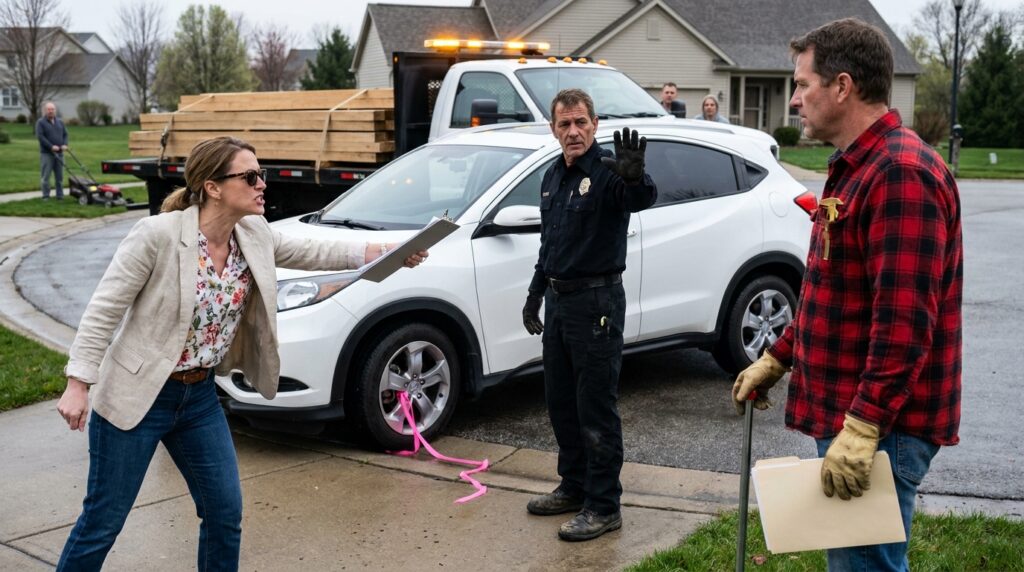
Brenda Hollings hadn’t backed down after the police standoff at his driveway. She had bypassed local law enforcement entirely and leveraged higher political ground.
Marcus walked back out to his pickup truck, his boots crunching on the dry asphalt of the municipal lot. He opened the driver’s door, set the manila folder on the cracked vinyl seat, and pulled out the stop-work order. Behind it was a copy of the filing Brenda had submitted to the township planning committee that morning. Attached to her petition was a folded draft map from 2014—the very document Tom Chandler had mentioned.
He unfolded the draft under the cab’s overhead dome light.
The paper was thin, smelling of damp cellar mold and blue toner. It showed a proposed public turnout lane and pedestrian archway for the adjacent park expansion, drawn in thick black ink. Highlighting in faded yellow marker swept directly across the ten-foot strip of Marcus’s front lawn, cutting straight through the spot where his oak timbers currently sat beneath the canvas tarp.
Marcus’s thumb dragged across the bottom margin of the map. There was no county recorder’s stamp. No municipal engineer’s signature. But penciled lightly in the corner, in fine, hurried cursive, were two initials and a handwritten note: Approved for park grant funding—pending quiet title clearance from lot 14.
Lot 14 was Marcus’s property.
The realization hit with the cold, sudden weight of a dropped hammer. The 2014 “beautification resolution” wasn’t just a fake board rule used to intimidate neighbors into removing lawn ornaments. It was a cover story designed to hide a backroom agreement. Brenda had spent twelve years promising a municipal councilor that she could deliver a piece of Marcus’s private land for a high-visibility township park project—a project that would secure her political legacy and pull hundreds of thousands of dollars in regional grant money into her committee. Marcus’s purchase of the deed, accompanied by his unyielding surveyor stakes, threatened to expose that the promised park land had never belonged to the HOA or the township at all.
Marcus sat back against the headrest, the vinyl creaking under his weight. He reached into his shirt pocket and pulled out his father’s brass caliper, feeling the cold metal against his thumb.
This was no longer a petty suburban feud over an apron or a set of delivery tire marks. If the township committee upheld the temporary hold at tomorrow morning’s emergency board hearing, his workshop permit would be revoked, his oak framing would sit rotting under the tarp, and his boundary line would be tied up in administrative probate for years. Brenda wasn’t fighting for a rule; she was fighting to keep a multi-year political land deal from collapsing on her head.
He turned the key in the ignition. The V8 engine roared to life, its exhaust rumbling through the quiet lot.
Marcus didn’t drive home. He turned the truck toward the Delaware County Records Annex on Third Street. The archives closed at seven, giving him exactly forty minutes to pull the original 1992 municipal road dedication rolls and the township council’s grant application files before tomorrow’s public hearing.
He pulled out his phone, dialed Officer Lawson’s direct line on speaker, and set the phone on the dashboard as he pulled onto the highway.
“Lawson,” the officer answered on the second ring.
“Officer Lawson, this is Marcus Vance,” Marcus said, his eyes fixed on the rain-slicked highway ahead. “Brenda Hollings just filed a municipal hold on my shop permit using an unrecorded 2014 park grant map.”
There was a long beat of silence on the other end, punctuated by the faint rustle of radio chatter.
“I heard,” Lawson said quietly. “Councilor Miller’s office called our chief an hour ago asking for a copy of my incident report from this morning.”
“Did you give it to them?”
“I gave them the official transcript,” Lawson replied, his tone hard and unreadable. “Including the part where I verified your county survey stamps on site. But Marcus… if the council freezes your permit at the hearing tomorrow, my hands are tied on enforcement. A township hold overrides a standard residential building permit until the land title is cleared in court.”
“They won’t freeze it,” Marcus said, his voice dropping into the steady, unyielding register he used when leveling a foundation. “Not when I bring the original county grant ledger to the table.”
Marcus cut the call, hit the gas, and felt the truck accelerate into the dark.