CHAPTER 3: THE WEIGHT OF OAK
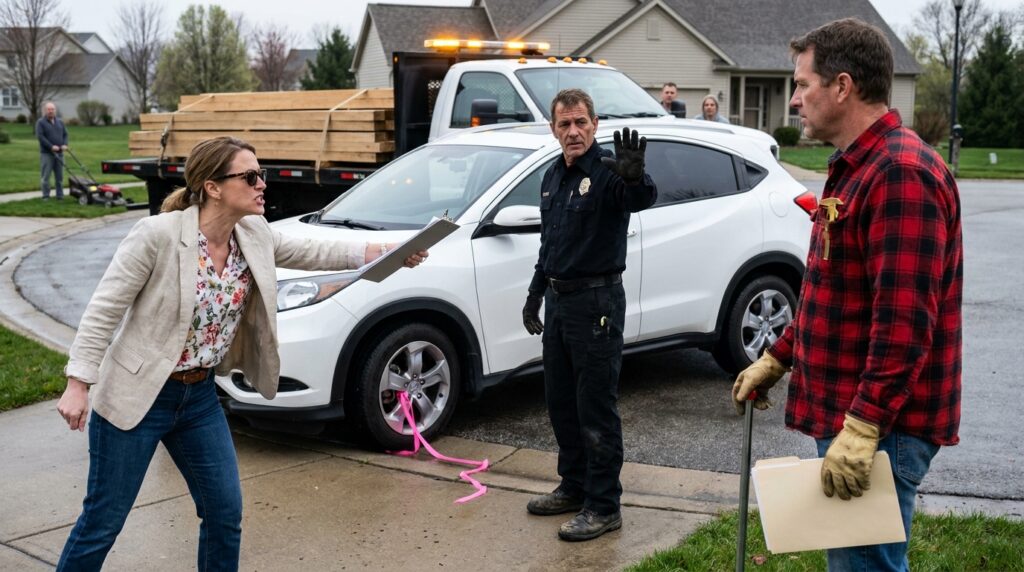
The yellow steel boom of the flatbed’s crane groaned under tension, the hydraulic fluid whistling through narrow valves as a six-hundred-pound white oak timber swung across the boundary line. Marcus stood in the crushed stone bed of his side yard, his work gloves gripping the rough, unplaned grain of the wood. The coarse fibers caught against his leather palms, leaving faint smears of damp tannic acid across his wrists.
“Lower slow!” Marcus called up to the driver, his voice steady against the rhythmic thrum of the rig’s auxiliary pump. “Set it down on the three-by-three dunnage!”
The timber settled into the gravel with a heavy, dull thud that sent a vibration straight through the soles of Marcus’s boots. Dust drifted off the oak, smelling of wet forest floor and old iron.
Twenty feet away, beyond the pink surveyor flags driven into the curb line, the cul-de-sac was still. Brenda Hollings’s white crossover sat parked in her wide concrete driveway at the head of the street, its tinted windows dark. But the front blinds of her second-story window were parted half an inch, the thin slats catching the hard glare of the midday sun.
The flatbed driver killed the crane engine and hopped down from the running board, wiping grease off his hands with a red rag. “That’s the last of the six, pal. Signing the bill of lading or what?”
Marcus pulled his father’s brass caliper from his pocket, checked the end-grain depth of the final joist out of habit—four and a half inches clean—and signed the digital pad mounted on the truck’s door. He watched the driver pull out onto Maplecrest Lane, the rig’s tires leaving faint black scuffs on the dry asphalt where Brenda had tried to hold her line.
When the truck’s tail lights faded past the entrance of the subdivision, Marcus turned back to his yard. Standing beside the fence line was Tom Chandler. Tom held a rusted pair of garden shears in one hand, his faded chambray shirt stained with grass juice at the elbows. He didn’t step over the property line; he stood precisely on his side of the low boxwood hedge.
“You’ve got more nerve than the last guy who lived here,” Tom said, his eyes trailing the long, straight lines of the oak beams. “Miller had a boat he parked in the side yard back in ’18. Brenda had two tow trucks here by six o’clock Monday morning. Claimed the HOA bylaws gave her authority to impound anything stored past the front elevation line.”
Marcus walked over to the stack, pulling a tarp across the raw timber to shield the grain from the afternoon heat. “Officer Lawson checked the county deed book, Tom. The association’s authority ends where my property line begins.”
Tom let out a dry, rasping laugh that sounded like iron filing against iron. “You think she cares about the county deed book? Brenda’s got three members on that five-person board who owe her signatures. Back in 2014, when the township widened the drainage ditch along the south corridor, she drafted up a neighborhood improvement mandate. Signed it herself as board chair, had her vice president second it, and filed it right in the neighborhood clubhouse records.”
Marcus stopped, his hands tightening on the edge of the canvas tarp. “Clubhouse records aren’t municipal filings.”
“Tell that to the residents who paid twelve hundred bucks a head for ‘apron maintenance’ that year,” Tom said, leaning his hip against the hedge. “She told everybody the township turned over the easement rights to the HOA to keep taxes down. We all thought it was official. She even had blue-ink township stamps on the meeting handouts.”
Marcus remembered the faded rubber stamp on the back of his violation notice—Maplecrest Special Improvement District, 2014. It was a decoy, a carefully constructed illusion of municipal backing designed to force compliance before anyone bothered to walk down to the Delaware County Courthouse. Brenda hadn’t just made up a rule; she had manufactured an entire paper history to make homeowners believe the dirt beneath their driveway aprons wasn’t theirs.
“She kept those files locked in the board office behind the pool,” Tom added, lowering his voice as a neighbor’s sedan rolled slowly down the cul-de-sac, its driver craning their neck to look at the oak stack. “Claimed it was ‘confidential governance records.’ Nobody ever questioned it because nobody wanted their grass measured with a ruler every Tuesday.”
Marcus didn’t answer right away. He reached down and smoothed the corner of the tarp, tucking a heavy river stone over the grommet to hold it against the rising wind. The decoy secret was clear now: Brenda had been using an unrecorded, legally hollow board resolution from 2014 to bully the neighborhood into surrendering their property lines. It gave her the appearance of absolute jurisdiction.
Path 3 Pragmatism Logic: But a fake board resolution didn’t explain the urgency. A woman didn’t park her luxury car in front of a flatbed truck and risk a police summons just to protect an unrecorded ten-year-old bluff over a few feet of grass. There was a deeper weight behind her desperation—something tied to that land that the fake 2014 resolution was meant to cover up.
Marcus looked back toward the end of the street, where Brenda’s blinds snapped shut.
“Where does the board keep the physical archives for those 2014 improvement files?” Marcus asked, his voice low and deliberate.
Tom paused, adjusting the garden shears in his hand. “In the metal filing cabinet inside the maintenance shed behind the tennis courts. Why?”
Marcus smoothed the canvas over the white oak, his fingers catching on the rough edge of a metal grommet. “Because if she’s using a fake municipal stamp to enforce association fines, she’s not just violating my boundary. She’s committing fraud.”
He turned and walked toward his house, the brass caliper heavy in his shirt pocket, leaving Tom standing at the hedge under the darkening sky.