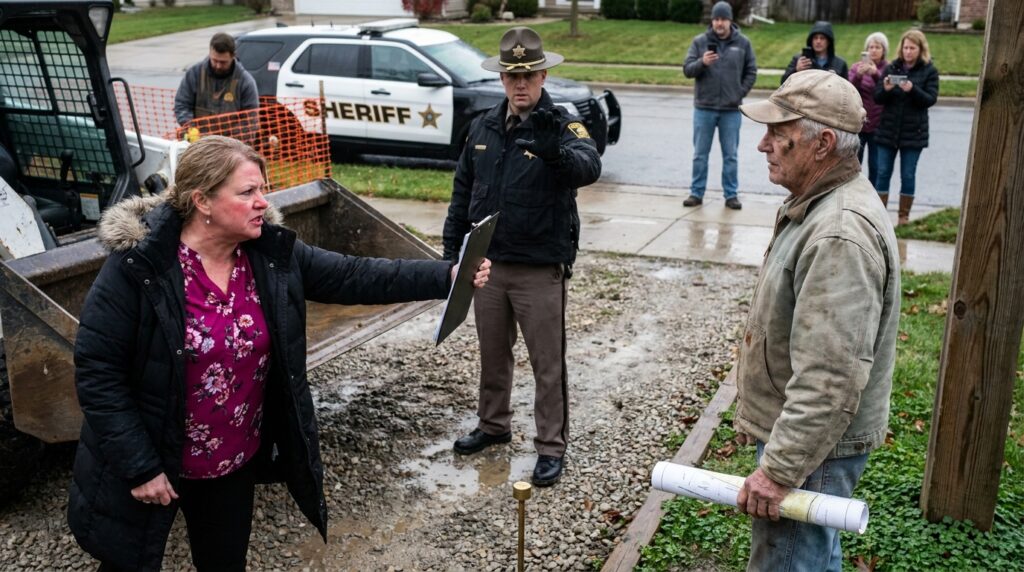
CHAPTER 4: THE PUBLIC BOARD INTERRUPTION
“—and as you can see from the certified 1991 municipal draft, the driveway corridor was dedicated for regional drainage access thirty-three years ago,” Gordon Lyle announced, his voice smooth, resonant, and amplified by a portable sound system that hummed against the crisp evening air.
Arthur sat in the back row of folding lawn chairs set up on the manicured turf beside the Crestview Estates clubhouse. His canvas jacket was zipped to his chin against the October chill, his hands folded motionless over a yellow legal pad resting on his knees. Around him, forty homeowners in puffy vests and rainjackets leaned forward, their eyes fixed on the illuminated cloth screen tripod-mounted beside the podium.
On the screen was a high-resolution scan of page one of his father’s 1991 ledger sheet. The signature in blue ballpoint ink stood out sharp and thick under the halogen floodlights clamped to the clubhouse eaves.
Brenda Vance-Giles stood three feet to the lawyer’s left, her hands clasped at her waist, her magenta blouse covered by a sleek black trench coat. She wore a tight, triumphant smile as she scanned the crowd, her gaze sliding right over Arthur in the last row without stopping.
“This board,” Lyle continued, tapping a laser pointer’s red dot against the projected signature line, “is simply executing a long-deferred civil right-of-way. The $450 compliance assessment issued to Mr. Pendelton is a standard administrative mechanism to ensure clearing of commercial equipment from this municipal corridor prior to paving.”
A low murmur rippled through the front rows. A young father two seats down from Arthur leaned over to his wife and muttered, “So the guy’s been blocking a public drainage route for thirty years?”
Arthur didn’t flinch. He reached down into his coat pocket, pulled out his black ink pen, and uncapped it with a soft click. On his legal pad, he wrote down the exact exhibit label printed at the bottom of the projected image: Exhibit B-2: Caldwell County Municipal Infrastructure Agreement (1991).
Beside the label, printed in tiny red ink on the scan’s margin, was a filing code: M-91-0412-A.
“Under Section 8 of our community governance charter,” Lyle said, stepping around the podium to face the residents directly, “the executive committee requires a simple procedural vote tonight to allocate fourteen thousand dollars from our infrastructure reserve fund to lay asphalt over the designated strip.”
“Hold on a second, Gordon,” a man in the third row called out, standing up and zipping his windbreaker. It was Tom Miller, a resident whose lawn bordered Arthur’s south timber line. “If this document is from ninety-one, why are we seeing it for the first time three days after Brenda brought a skid-steer onto Art’s gravel?”
Brenda stepped immediately to the microphone, her rings glinting under the halogens. “Tom, as we explained in our community notice, these historical records were uncovered during our routine quarterly perimeter audit. Mr. Pendelton has chosen to treat a routine civil alignment as a personal dispute, but the paperwork speaks for itself.”
“Does it?” Arthur said.
His voice wasn’t loud, but years of shouting over tractor engines and wind in the timber gave it a deep, carrying weight that cut through the speaker hum.
The entire back two rows turned in their folding chairs. Brenda’s smile froze. Gordon Lyle lowered his laser pointer, his brow furrowing as his eyes adjusted to the darkness beyond the floodlight perimeter.
Arthur didn’t stand up. He remained seated, his legal pad resting on his thigh, his pen held loosely between two calloused fingers.
“Mr. Pendelton,” Lyle said, adjusting his glasses and adopting a measured, professional cadence. “This is an internal executive board proceeding for Crestview Estates residents. If you have legal counsel, they are welcome to submit written briefs to our office during business hours.”
“You’re showing them page one, Mr. Lyle,” Arthur said calmly. “I’m looking at your projection screen right now. You’ve got my father’s signature on the screen, and you’ve got filing code M-91-0412-A listed at the bottom.”
Lyle hesitated for a fraction of a second, his eyes darting to Brenda before returning to the back row. “That is the official municipal index record, Mr. Pendelton.”
“Then show them page two,” Arthur said.
The silence on the lawn stretched thin. A cold wind blew off the timber lot, rattling the dry oak leaves along the perimeter fence and rustling the papers clipped to Lyle’s podium.
Brenda stepped back to the microphone, her voice rising an octave. “Mr. Pendelton, this board is under no obligation to entertain bad-faith disruptions from non-members! Page two contains standard municipal indemnification clauses that have no bearing on the title authorization!”
“Page two contains the condition,” Arthur said, his tone entirely level. He leaned forward slightly, resting his elbows on his knees. “My father signed a draft for a drainage ditch on the condition that the township paved his entry drive within twelve months at municipal expense. The township rejected the condition in November of ninety-one. The draft was voided, and the easement was never recorded.”
A sharp whisper broke out in the middle row. Tom Miller turned around completely, looking from Arthur back to the podium. “Is that true, Gordon? Is there a rejection page?”
Lyle’s jaw tightened. He didn’t look at Brenda. He adjusted his papers on the wooden stand, his fingers brushing against a blue sub-folder sitting under his legal pad. “The board is relying on the certified copy provided by municipal records,” Lyle stated, though the smooth resonance in his tone had flattened into a rigid, defensive clip. “Any formal challenge to the instrument’s validity must be filed in Caldwell County Circuit Court.”
“It was filed at four o’clock this afternoon,” Arthur said quietly.
He reached into his canvas coat, pulled out a white manila envelope stamped with a red clock-in mark from the county clerk’s desk, and laid it across his knees. He didn’t open it. He didn’t throw it at the stage. He just let the red ink of the clerk’s stamp sit visible under the edge of the lawn floodlights.
“Terrence O’Beay pulled the complete file from the county vault at two PM,” Arthur continued into the quiet crowd. “The full record includes the board of commissioners’ rejection letter from November twenty-fourth, 1991. Signed by the county engineer. Stamped as null and void.”
Brenda’s face drained of color. She grabbed the edge of the podium with both hands, her knuckles turning white. “This is a misrepresentation of ongoing administrative review! Gordon, call the vote!”
“Brenda, shut up for a second,” Tom Miller snapped from the third row. He turned back toward Arthur, his face dark in the halogen glow. “Art… if that document is void, why did the board spend four thousand dollars of our dues on a contractor deposit yesterday?”
Arthur looked at Tom, then looked at Brenda, whose eyes were wide, fixed on the manila envelope resting on his lap.
“That’s a question for your president, Tom,” Arthur said softly. He capped his pen, slid his legal pad into his coat pocket, and stood up from the metal folding chair. “I just came to make sure everybody saw the whole page before somebody brought another machine onto my dirt.”
He turned and walked away into the dark toward his gravel drive, the crunch of his work boots on the turf echoing behind him long after the lawn had fallen completely silent.