CHAPTER 2: PAPER IN THE CABINET
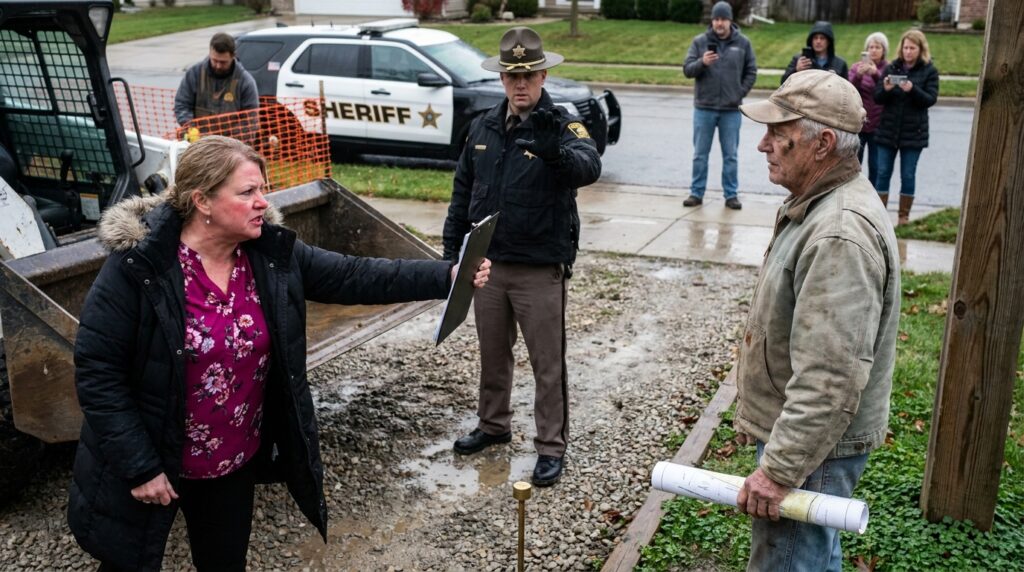
The smell of raw diesel exhaust still clung to the screen door when Arthur let it latch behind him. His hand was stiff on the brass handle, the skin around his knuckles pale from where he’d gripped his phone. Through the kitchen glass, the white flatbed was already idling down the asphalt of Crestview Estates, its yellow hazard lights winking out as it rounded the turn toward the subdivision clubhouse.
Arthur didn’t take off his coat. The house was cold—the furnace hadn’t kicked on yet—and the air inside carried the dry, papery scent of undisturbed pine framing.
He walked past the kitchen table, where his mug of coffee had gone tepid, and stopped in front of the tall oak filing cabinet set against the back wall. The timber for the cabinet had been quarter-sawn in his grandfather’s shop in fifty-six, the drawer fronts thick enough to stop a caliber round. When Arthur pulled the brass handle of the bottom drawer, the heavy steel sliders gave a low, metallic rasp that echoed in the quiet kitchen.
He bypassed the red folders labeled TAX ASSESSMENTS (1982–2005) and the blue tabs for NURSERY PERMITS. He reached all the way to the back, where the original canvas-bound ledgers lay flat.
He lifted out a heavy leather binder marked PARCEL 4B – DRAINAGE & PERIMETER (1988–1995).
The brass lock on the ledger was cold against his thumb. Arthur carried it to the kitchen table, cleared away his mug, and opened the cover. The first twelve pages were written in his father’s dense, sloping cursive—entry after entry recording loads of crushed limestone, oak fence posts cut from the ridge, and county tax receipts stapled neatly to the margins.
On page fourteen, under an entry dated October 12, 1991, Arthur stopped.
Stapled to the rag paper was a carbon copy of a legal document titled CONDITIONAL DRAINAGE AND ACCESS DRAFT – MUNICIPALITY OF CALDWELL. The top page bore his father’s signature in blue ballpoint ink, granting the township temporary rights to divert rainwater runoff from the newly proposed residential access road.
Arthur ran his thumb over the raised seal. He knew about the drainage agreement—he’d maintained the culvert himself for thirty years. But as he turned the page, his pulse gave a single, hard thud against his collarbone.
The staple on the top left corner had been pulled and reset. The paper around the iron wire was creased, thin tears radiating outward like dry leaves. Page two—the page that outlined the terms, termination dates, and boundary restrictions—was gone. In its place was a blank sheet of gray ledger stock, bearing only a faint pencil notation in a handwriting that wasn’t his father’s: Copy requested by C.E. Board, Sept 2023.
Arthur sat still. The kitchen was entirely quiet except for the slow, steady tick of the wall clock over the stove.
He reached into his canvas jacket, pulled out the folded paper Brenda had slapped against his chest, and laid it beside the binder. He unfolded her citation, smoothing the crisp white bond with his palm.
In the second paragraph of Brenda’s printed notice, buried under three lines of boiler-plate HOA jargon, was a single specific reference: Pursuant to the Recorded Drainage and Access Covenant of 1991, the subject property driveway is recognized as a shared municipal corridor.
They didn’t just guess, Arthur realized. She’d been in the county records office. Or worse, someone had handed her a piece of his father’s ledger before the ink on her board presidency was even dry.
He reached for his phone, his fingers steady, and cleared the dispatch screen. He didn’t call the sheriff this time. He dialed a number he hadn’t used since his father’s estate was probated twelve years ago.
The line rang four times before a dry, gravelly voice answered.
“O’Beay.”
“Terrence,” Arthur said, his eyes fixed on the pulled staple in the ledger paper. “It’s Art Pendelton. Brenda Vance-Giles was on my driveway forty minutes ago with a skid-steer and a piece of paper referencing ninety-one.”
There was a brief pause on the line, followed by the faint rustle of paper being shifted across an oak desk three miles away in town.
“Did she lay stone?” O’Beay asked.
“No,” Arthur said. “The driver had more sense than she did. But I’m looking at my father’s 1991 binder right now, Terrence. Someone pulled the second page of the drainage draft.”
O’Beay let out a low, whistling breath through his teeth. “Don’t touch that paper with your bare fingers any more than you have to, Art. I’m pulling the county register’s microfiche right now. If there’s an unrecorded draft floating around with your father’s name on it, Brenda’s going to try to present it at the municipal zoning board hearing on Thursday.”
“There is no easement, Terrence,” Arthur said flatly. “My father never signed away the drive.”
“I know what your father signed, Art,” O’Beay replied. “The problem isn’t what he signed. The problem is what Brenda’s telling thirty families in Crestview he signed. You need to come into the office before noon. Bring the ledger, bring that citation, and bring a pair of boots you don’t mind getting mud on.”
Arthur looked back out the window. Down at the boundary line, where the gravel met the green clover, a red passenger car had pulled up to the curb. Through the glass, he saw Brenda sitting in the front seat, a pair of binoculars pressed to her face, watching his barn.
Arthur folded the ledger shut, the brass lock clicking into place.
“I’ll be there in twenty minutes, Terrence,” Arthur said. “And tell your clerk to print two copies of the 1994 survey. I think we’re going to need to mark the earth again.”