Chapter 5: The Line on the Pavement
The final hearing took place at the community center the following Saturday.
Nearly everyone involved in the original dispute was there.
Marcus arrived early.
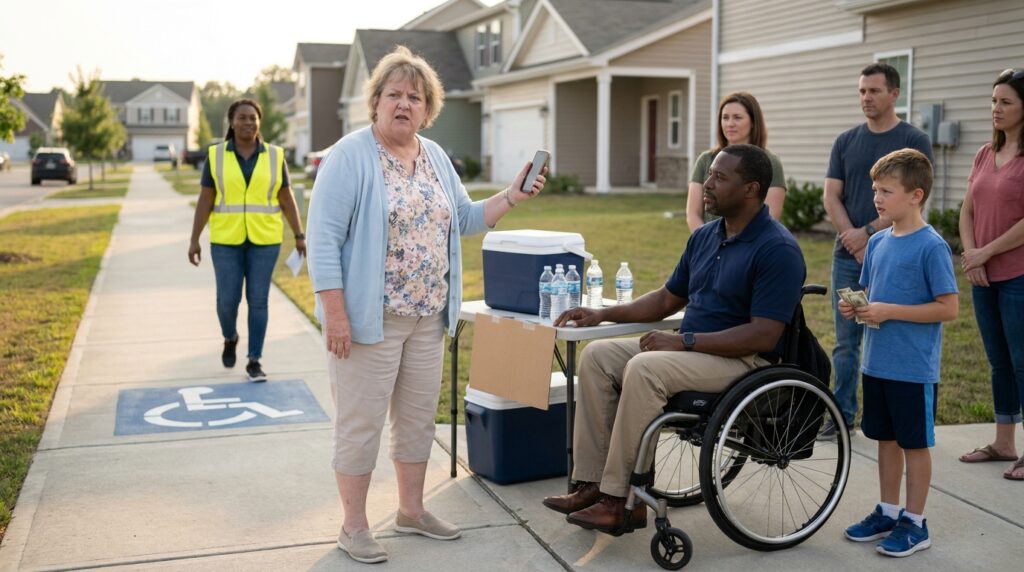
He positioned his wheelchair beside the newly designated vendor area.
A fresh painted line marked the accessible route.
The distance between the route and the table had been measured and documented.
There was no ambiguity.
Karen arrived ten minutes later.
She looked at the new markings.
Her expression hardened.
The board president asked whether she had any new evidence.
Karen placed another folder on the table.
Marcus recognized the strategy immediately.
She was not interested in proving that he had violated the rules.
She wanted the rules to change.
She argued that vendors should not be allowed near the walkway at all.
The board asked why.
Karen said it would be safer.
Marcus listened.
Then George spoke.
He had not planned to say anything.
But he stood and explained that he had been the person Karen blocked.
He described how he had stopped his wheelchair because he did not want to cause a confrontation.
Then Denise described what she had seen.
Then Tom presented the original vendor approval.
Finally, Marcus played the recording.
Only the relevant portion.
Karen’s voice filled the room.
“I live here, and I make the rules!”
Nobody spoke for several seconds.
Marcus didn’t look at Karen.
He looked at the board.
“I don’t need special treatment,” he said. “I need the same rules everyone else follows.”
That was the heart of the matter.
Not whether Marcus could sell water.
Not whether Karen liked his table.
Not whether the neighborhood looked better with fewer vendors.
It was whether a private resident could personally decide who was allowed to use a shared community space.
The board voted to keep the vendor program.
They also adopted a written accessibility requirement and a formal complaint process.
Karen’s petition was rejected.
Her original complaint was closed.
But the consequences did not end there.
The board also determined that she had knowingly misrepresented several circumstances in the petition.
She was barred from acting as an event compliance volunteer for the remainder of the year.
Karen sat completely still.
Marcus expected anger.
Instead, she looked down at the table.
For the first time since the confrontation, she seemed to have run out of arguments.
Then George approached Marcus.
“Can I buy that water now?”
Marcus smiled.
“Sure.”
George rolled toward the table.
This time, nobody blocked him.
The following Saturday, Marcus returned to the event.
The new accessible route was clearly marked.
The drink table was in the approved position.
And beside it stood a small laminated notice explaining the vendor rules.
Marcus didn’t put his name on it.
He didn’t need to.
The rules applied to everyone.
But as he handed George a bottle of water, Marcus noticed something across the lawn.
Karen was watching.
She wasn’t approaching.
She was standing beside the community center doors, holding an envelope.
And when Marcus looked up, she started walking toward him.