Chapter 3: The Meeting Room
By Monday morning, the story had traveled farther than Marcus expected.
Not through gossip alone.
Through emails.
Several people who had witnessed the confrontation had contacted Tom independently.
One elderly couple said they had seen Karen block the wheelchair route.
Another resident said Marcus had been selling water there for years.
The adult customer Karen had stopped had also provided a statement.
He was a retired mechanic named George Ellis.
George remembered the confrontation clearly.
“I wasn’t looking for trouble,” he told Tom. “I just wanted water.”
That sentence stayed with Marcus.
It was such a small request.
Yet somehow it had become a dispute about authority, rules, dignity, and who was allowed to belong in a shared community space.
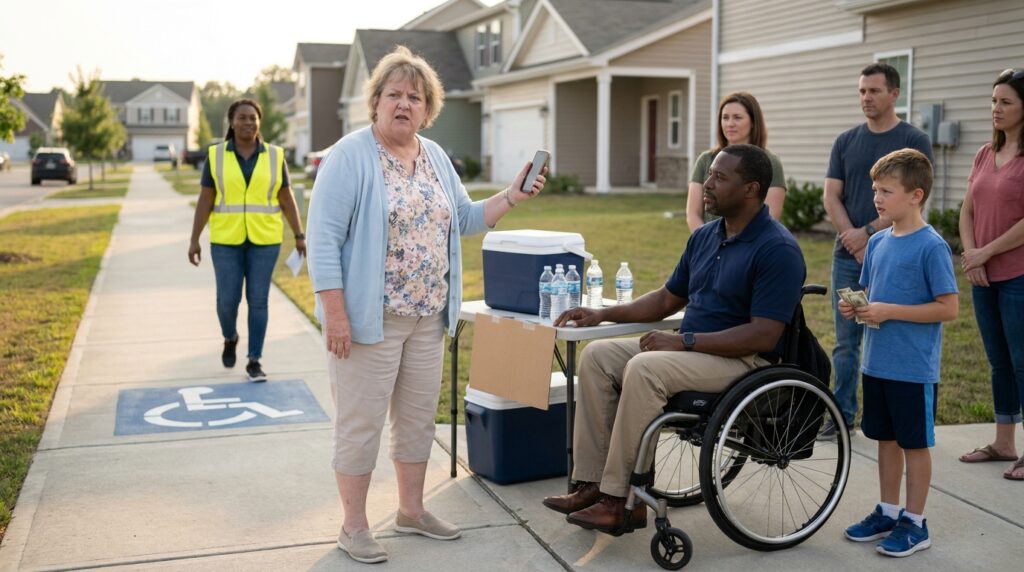
At the meeting, Karen arrived carrying a thick folder.
Marcus noticed that immediately.
She had prepared for battle.
The association president began by asking everyone to remain calm.
Karen spoke first.
She described herself as someone who had been “protecting the neighborhood.”
She said Marcus’s table was unsightly.
She said customers were gathering too close to the sidewalk.
She said she had repeatedly asked him to move.
Marcus listened without interrupting.
Then Tom presented the signed vendor approval.
Karen stared at it.
“I was never told about that.”
“You were at the planning meeting,” Tom said.
Karen’s expression changed.
“I don’t remember that.”
Tom turned another page.
“You signed the attendance sheet.”
Silence settled over the room.
Karen shifted in her chair.
But she wasn’t finished.
She claimed Marcus had intentionally placed his table where it would attract attention.
Denise brought out photographs taken before the event began.
In every photograph, the access lane was completely clear.
Then George provided his statement.
Then another witness.
Then another.
The complaint was beginning to collapse.
But Marcus noticed something else.
Karen wasn’t defending the original incident anymore.
She was trying to redirect the meeting toward the general appearance of the neighborhood.
She talked about standards.
Rules.
Property values.
Community image.
Anything except the moment she had stood in front of two wheelchair users and blocked the route.
Then she made a new accusation.
She claimed Marcus had been recording private conversations without permission.
Marcus almost laughed.
Instead, he calmly explained that the recording had been made in a public event area after Karen confronted him.
Tom asked Karen whether she had evidence of a private conversation being recorded.
She had none.
The meeting appeared ready to end.
Then Karen placed one final document on the table.
“I have a petition.”
Everyone looked down.
Twenty-three signatures.
The petition demanded that Marcus be permanently prohibited from selling at neighborhood events.
Marcus felt the room change.
This was no longer about Saturday.
If the association accepted the petition, he could lose his place at future community events.
His small business depended on those events.
More importantly, he had spent years building a reputation for being reliable.
Karen had found a way to make the original confrontation about his entire presence in the neighborhood.
Marcus reached for the petition.
He studied the names.
Then his eyes stopped.
One signature belonged to someone he knew.
Someone who had not attended Saturday’s event.
Marcus looked up.
“Tom,” he said quietly, “before you accept this petition, I think we need to verify every signature.”
Tom nodded.
Karen immediately objected.
But the room had already changed.
For the first time, the burden was no longer on Marcus to prove that he belonged.
The association was going to examine how the complaint had been built.