
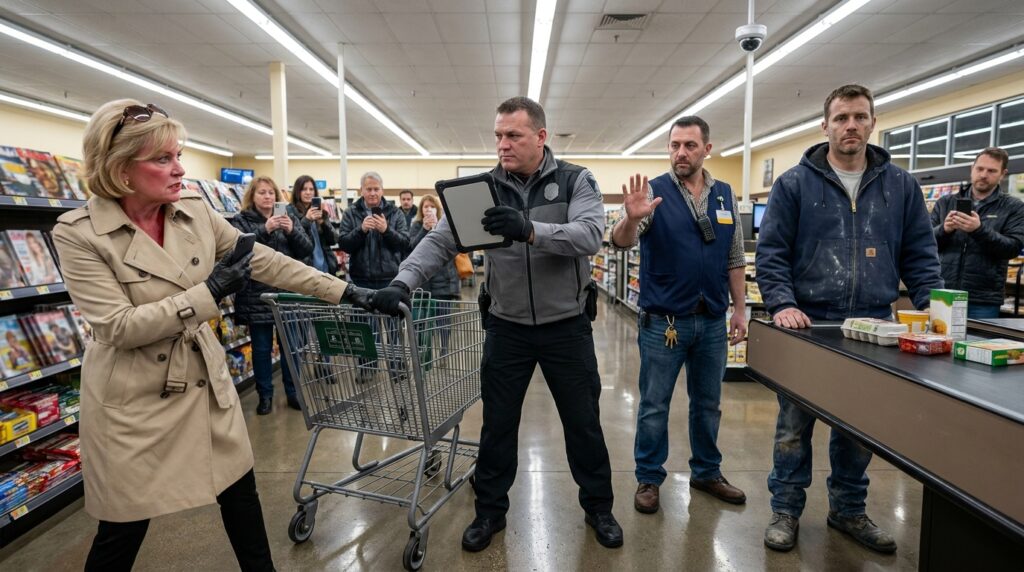
CHAPTER 5: PUBLIC DEPARTURE AND RESTORED DIGNITY
The front wheels of Evelyn’s double-wide cart shrieked against the polished floor as she dragged it backward out of Lane Four. The rubber casters, binding under the weight of imported olive oils and artisan produce, swung wildly, threatening to tip a display stack of seasonal magazines. She didn’t look up to fix them. She kept her chin stiff, her eyes fixed strictly on the glowing red exit sign past the sliding glass doors, but the flush creeping up from the collar of her beige trench coat reached the roots of her spray-hardened hair.
Behind her, the crowd in the main thoroughfare didn’t disperse. They parted just enough to let her pass, a gauntlet of quiet, unyielding faces holding smartphones aloft. A few lingering murmurs followed her—short, dry remarks about line cutters and fake rules—before fading into the dull background hum of the store’s HVAC system.
Daniel Mercer didn’t watch her reach the outer vestibule. He stayed rooted at the head of the belt, his hands unclasped, resting loosely at his sides. The old, familiar heat that had flared in his chest ten minutes ago had cooled into something solid and quiet—the calm equilibrium of a man who had stood his ground against a bad storm and come out the other side dry.
“Sorry about the delay, sir,” the cashier said, her voice still trembling slightly as she picked up her barcode scanner. She swiped his bottle of iced tea across the glass reader, the sharp beep echoing through the now-quiet lane. “That’s six items. Your total is eighteen forty-five.”
Daniel slid his twenty-dollar bill across the counter. “No need to apologize. You were just doing your job.”
Marcus Brooks stepped up beside the register terminal, tapping his tablet to clear the administrative security hold. He looked at Daniel, his eyes taking in the faint white drywall powder clinging to Daniel’s canvas sleeves and the scuffed steel toes of his boots. There was no theatrical gratitude in the shift manager’s posture, only the quiet, mutual recognition between two working men who had both spent a long evening managing someone else’s mess.
“Thanks for holding steady, Mr. Mercer,” Marcus said softly, tearing the fresh paper receipt from the printer and handing it over along with a silver dollar in change. “Most people would have shouted. Shouting just gives them an excuse to call it a scene.”
“Shouting doesn’t fix a broken line,” Daniel said, folding the paper receipt once and tucking it securely into the breast pocket of his work jacket. He picked up his single brown paper bag, the weight of the milk and bread settling comfortably against his forearm. “Facts do.”
Hank, the security officer, stood by the end of the belt, watching through the floor-to-ceiling windows as Evelyn pushed her loaded cart out into the dark, rain-swept parking lot without buying a single item. She loaded nothing into her vehicle, instead leaving the heavy, double-wide cart stranded beside a light pole in the downpour before climbing into her luxury SUV and speeding out toward the township thoroughfare.
“She won’t be back on this shift,” Hank noted, turning back to Daniel with a brief, approving nod. “Have a good night, sir.”
Daniel nodded back, stepped past the register divider, and walked out into the cool evening air.
The rain had softened into a fine mist, coating the black asphalt of the parking lot with a shimmering film that reflected the bright amber neon of the supermarket sign. He walked at an unhurried pace toward his old Ford pickup, his work boots leaving damp, clean tracks on the pavement. The air smelled of wet pine, exhaust, and cold earth—a clean break from the stale, wax-scented air of the crowded aisles.
He reached his truck, placed his grocery bag on the bench seat, and climbed inside. Before turning the key in the ignition, he reached into his jacket pocket and pulled out the small brass key tag he used for his job-site toolboxes. He laid it flat on the dashboard alongside his store receipt.
He looked at his reflection in the rearview mirror: the dark smudges under his eyes from ten hours of pulling copper, the dust on his collar, the faint lines etched around his mouth by years of hard labor. He didn’t look like an executive tier member, and he didn’t look like a neighborhood board officer. He looked like what he was—a man who worked with his hands, paid for what he carried, and knew exactly where the line was drawn.
Daniel turned the key. The V8 engine turned over with a deep, throaty rumble, the headlights cutting two clean beams of white light through the rain as he backed out of his space and headed home.