CHAPTER 2: PAPERWORK AND ESCALATION
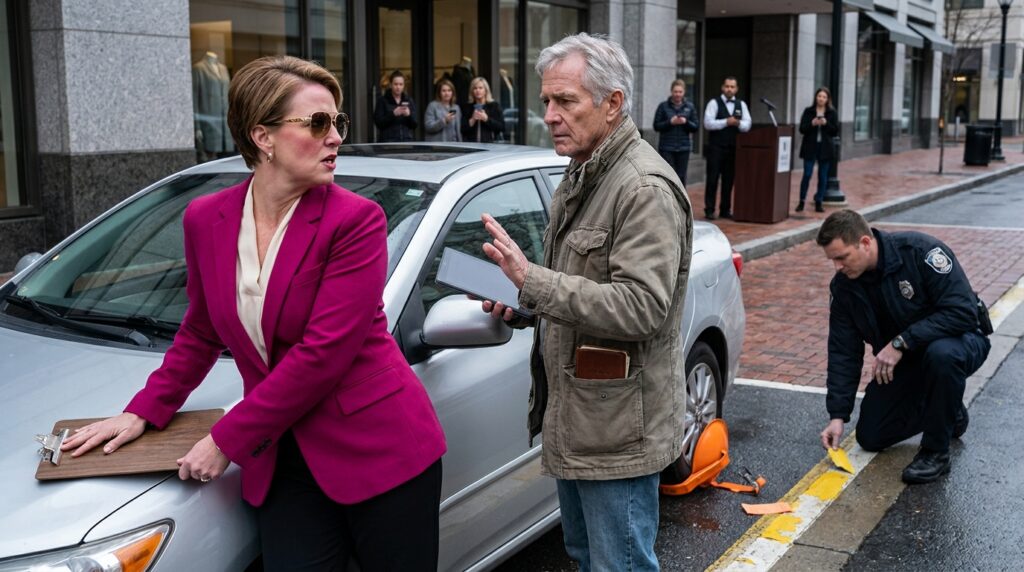
“I’m giving you sixty seconds before I upload your plate to the regional commercial enforcement network,” Brenda called out, her voice sharpening as she paced the concrete edge of the curb. Her phone camera remained aimed like a weapon at Arthur’s windshield, the glass catching the dull reflection of her manicured knuckles. “You think an old sedan belongs in front of flagship retail? I run this plaza, and you’re moving now.”
Arthur didn’t answer with anger. He leaned across the passenger seat, his canvas coat rustling softly against the vinyl upholstery, and opened the glove compartment. The latch gave a familiar metallic click. From inside, he retrieved a sleek, dark gray digital tablet and his battered leather field book. The book’s leather cover was soft, stained dark around the edges from years of sweat, rain, and graphite dust. Tucked inside its back sleeve was a folded, yellowed sheet of paper bearing a faint blue-ink stamp—a rejected municipal docket number from two years ago that he had archived during his final month before retirement.
He powered on the tablet. The screen bloomed with soft white light, illuminating the fine lines around his eyes as he tapped into his offline drive.
Outside, Brenda’s heels clacked aggressively against the brick pavers as she marched toward the pharmacy entrance. “Steve! Janine!” she called out to the boutique owners watching from their doorways. “Take a look at this. This is what happens when people think public courtesy is optional. He’s blocking our morning deliveries!”
A young valet attendant in a black vest shifted uncomfortably by his podium, looking between Brenda’s flushed face and Arthur’s serene expression. The smell of fresh espresso drifted heavy from the cafe nearby, mingled with the damp scent of decaying leaves trapped in the drainage grates.
Arthur unbuckled his seatbelt, pushed his door open, and stepped out into the crisp morning air. The wind caught his silver hair, blowing it across his forehead as he stood near the driver’s side rear quarter panel. He didn’t approach Brenda, nor did he raise his hands. He simply set the tablet flat on the roof of his car, the screen displaying a high-resolution, color-coded plat map of Grandview Galleria’s perimeter.
“Section 4-B,” Arthur said calmly, his voice easily carrying over the hum of a passing delivery truck on the main avenue. “Deeded in 2012 as a public utility and access easement. The city retains full ownership of the asphalt six feet outward from the building foundations.”
Brenda turned on her heel, her magenta blazer flaring as she strode back toward him. She snapped a picture of the tablet screen, though her eyes barely registered the intricate blue and red boundary lines displayed on it. “That map is ancient history, old man. The board signed an internal master lease agreement with property management six months ago. We control all curb access, parking allocation, and commercial loading. We issued a formal notice on the plaza’s business portal last week.”
She reached into her heavy wooden clipboard and pulled out a pre-printed, neon-orange paper slip marked COMMERCIAL PROPERTY ACCESS VIOLATION. With a swift, practiced movement, she slapped it beneath his windshield wiper.
“One hundred and fifty dollars,” Brenda declared, her chest heaving slightly under her blazer. “And if this vehicle is still occupying space four in ten minutes, the private towing service we retain will remove it. I’ve already logged your vehicle into the system.”
Arthur looked at the orange paper beneath his wiper blade. The print was crisp, bearing the official-looking crest of the Grandview Galleria Commercial Property Owners Association. It looked authoritative, expensive, and imposing—the kind of document designed to intimidate average citizens into paying without question.
He didn’t touch the citation. Instead, he reached out with one finger and scrolled down on his tablet screen, opening a sub-folder labeled 2024-Zoning-Submissions. Beneath a list of approved utility permits lay a single document with a red digital flag next to it. It was an official city council transcript showing that the association’s formal request to acquire or lease Municipal Sector 4-B had been flatly denied by the zoning board due to public access requirements.
Brenda had lied—or worse, she genuinely believed the board’s internal resolution carried legal weight over a municipal denial.
“A board resolution isn’t a property transfer, ma’am,” Arthur said softly, his voice steady as the steady ticking of his cooling engine. “You can print all the orange slips you want. You can’t lease what you don’t own.”
Brenda’s eyes narrowed behind her gold sunglasses. She pulled her phone close to her face and tapped the screen furiously. “We’ll see how much your little speech matters when the tow truck gets here. I’m calling private security to boot your tire right now.”
She turned away, holding the phone to her ear as she began barking instructions to the plaza’s security control office. Arthur watched her walk toward the main concourse, her voice echoing off the polished granite walls as she demanded immediate enforcement.
Quietly, Arthur reached up, took the orange citation from his windshield, folded it neatly in half, and tucked it into the back pocket of his field jacket alongside his survey notes. He pulled out his phone, dialed a direct line he had memorized over three decades of public service, and waited for the tone.
“City Public Works, Traffic and Records Division,” a familiar voice answered on the third ring.
“Hello, Sarah,” Arthur said, looking down at the freshly painted yellow curb line beneath his boots. “It’s Arthur Pendelton. I need you to pulled up the active easement registry for Sector 4-B at the Galleria. And Sarah… check if there’s an open work order for curb repainting.”