
CHAPTER 5: THE FINAL CONSEQUENCE
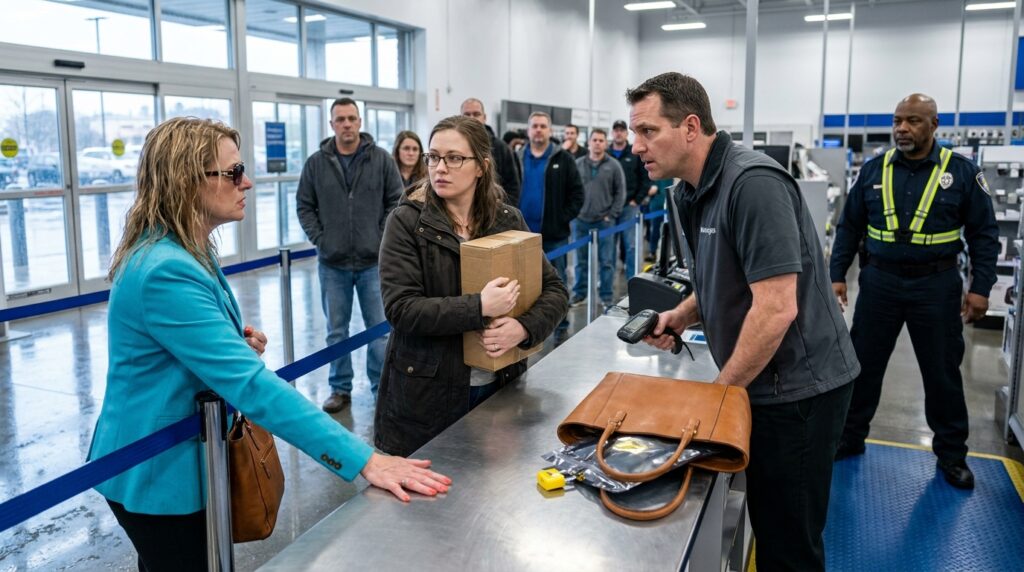
Brenda’s turquoise jacket was a blur of aggressive color against the muted gray of the customer service corridor, but her boots had no traction on the wet, polished slab floor.
She took three panicked, heavy strides toward the double glass doors before Officer Carver shifted his weight. It was not a violent motion; it was the practiced, economical intercept of a man who had spent twenty years cutting off angles in tight spaces. He didn’t reach for his belt or raise his voice. He simply stepped into the central aisle, his broad shoulder catching the edge of Brenda’s leather purse.
The impact was short, heavy, and resonant.
The heavy tote bag slipped from Brenda’s fingers, hitting the gray tile with a dull, metallic thud that echoed all the way to the checkout registers. The anti-static foil pouch slid free, skittering across the floor until it tapped the rubber toe of Carver’s boot. The yellow RFID tag caught the overhead LED lights, its barcoded surface gleaming without a scratch.
Brenda stumbled backward, her heels skidding two feet before her spine met the rigid aluminum frame of the main queue stanchion. The chrome post swayed, its heavy cast-iron base scraping against the concrete with a long, shrill screech that made half the line wince.
“Hands where I can see them, ma’am,” Carver said. His voice was low, devoid of anger, carrying the flat, unyielding authority of a judicial decree. “Do not reach into your coat.”
“This is an outrage!” Brenda gasped, her chest heaving as she pressed her back against the chrome post, her manicured fingers digging into the blue webbing belt. Her sunglasses had slipped crooked across her nose, one lens reflecting the ceiling light while the other exposed her wide, bloodshot eye. “You are physically detaining me! I demand to see the store general manager! I am a preferred cardholder!”
Marcus Vance didn’t answer her. He stepped out from behind the counter, carrying a black-bound clipboard and a high-resolution handheld scanner. He knelt calmly, picked up the anti-static pouch by its reinforced edges, and passed the laser over the yellow clip.
The scanner emitted three sharp, consecutive double-beeps—the universal store code for an unbilled asset breach.
“Item six-zero-nine,” Marcus said, his eyes rising to meet Brenda’s frantic gaze. “Unassigned to any transaction log. Removed from aisle four display without a floor associate sign-off.” He stood up, turning to the two asset-protection officers who had taken positions behind Carver. “Log the serial number into the incident system. Contact county dispatch.”
“You can’t do this to me!” Brenda screamed, her voice cracking as the first edge of real terror broke through her outrage. She looked past Carver at the general return line, searching for a single sympathetic face among the thirty people watching her. “Tell them! Someone tell them! I was standing in line! I was just holding the item!”
No one spoke. The man in the grease-stained jacket raised his phone higher, his thumb tapping the screen to ensure the camera was locked onto Brenda’s trembling hands. Beside him, a young mother holding a toddler turned her shoulder, shielding her child while openly staring at the collapsed authority figure against the post.
“Ma’am,” Carver said, pulling a yellow cardstock folder from his inner vest pocket. “Under state retail code section four-twelve, you are being served with an immediate notice of criminal trespass. You are barred from all TechDepot commercial properties effective immediately. If you set foot on this lot again, you will be arrested without warning.”
He handed the yellow folder toward her. Brenda didn’t take it; her hands stayed frozen against the chrome post. Carver calmly tucked the paper into the side pocket of her turquoise blazer.
“Our secondary team will escort you to the security office to wait for the deputy,” Carver added, gesturing toward the back hallway. “Walk on your own, or you will be restrained.”
Brenda’s mouth worked silently. The loud, theatrical volume that had dominated the store ten minutes earlier had completely evaporated, leaving behind a small, disheveled woman clutching a crooked pair of sunglasses. She looked down at the yellow paper sticking out of her pocket, then at the two asset-protection officers stepping to her flanks.
Without another word, her head bowed, her heels clicking a quiet, uneven rhythm against the wet tile, Brenda was led past the blue velvet ropes and vanished into the administration corridor.
The silence that remained in the front vestibule lasted for three full seconds before the low hum of the store resumed.
Marcus Vance turned back to Register Two. He didn’t look flustered, nor did he offer a grand speech to the crowd. He stepped behind the counter, cleared the alarm status on his monitor, and wiped the laminate surface where Brenda’s purse had rested with a clean microfiber cloth.
He looked at Maya, who remained standing squarely on the blue anti-fatigue mat. Her canvas coat sleeves were still damp, her fingers rested calmly on her cardboard box, and her wire-rimmed glasses reflected the clear, steady light of the terminal screen.
“Ticket four-twelve,” Marcus said, his tone returning to the crisp, professional standard of a store manager. “750-watt modular power unit warranty exchange.”
“Yes,” Maya said.
Marcus reached into the lower secure cabinet beneath the counter, pulling out a factory-sealed, shrink-wrapped black box containing the identical replacement model. He scanned the new unit’s serial code, attached it to Maya’s original invoice, and printed a fresh thermal receipt.
He slid the new box across the counter, placing the receipt neatly on top.
“We apologize for the delay and the disruption, Ms. Lin,” Marcus said, making direct eye contact for the first time. “Your warranty replacement is fully processed and covered for another three years.”
Maya picked up the receipt, checking the timestamp at the bottom: 10:28 AM. She tucked the paper into her inner coat pocket, gathered the heavy new box into her arms, and adjusted her grip.
“Thank you, Marcus,” she said quietly.
She turned and walked toward the automatic sliding doors. As she passed the head of the main return line, the man in the grease-stained jacket stepped back six inches, giving her a small, respectful nod as he held the blue rope clear of her path.
Maya stepped through the glass doors into the cool, rain-washed air of the plaza. The storm had begun to lighten, the heavy gravel-like downpour giving way to a soft, steady mist that smelled of wet pavement and clean sky. She carried the heavy box to her car, unlocked the door, and set the power supply securely on the passenger seat.
She didn’t look back at the store windows. She sat behind the wheel, started the engine, and listened to the steady, rhythmic sweep of the wiper blades clearing the glass.