
CHAPTER 2: ESCALATION AT THE CURB
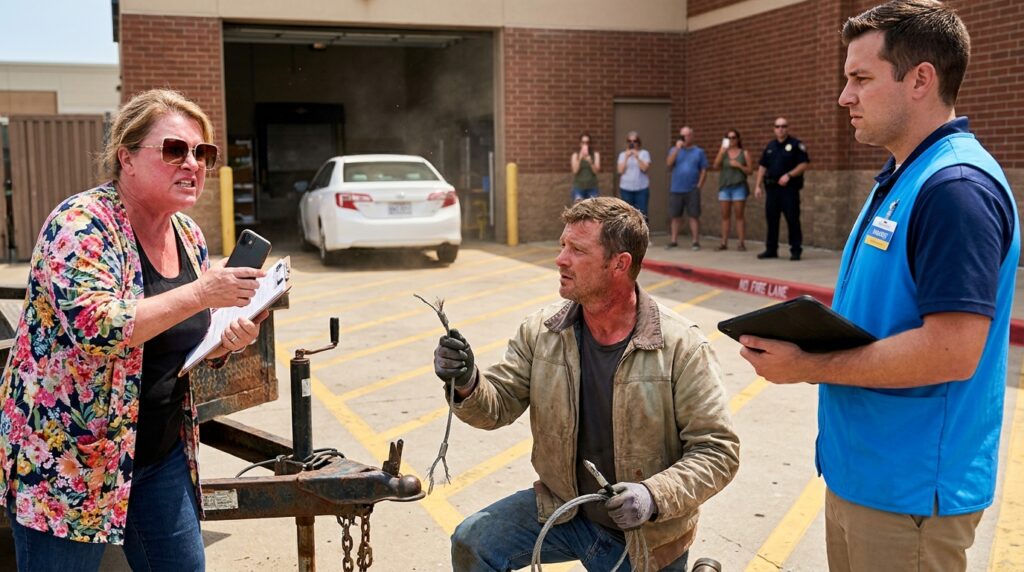
The hydraulic hiss of the lifting forklift echoed off the sun-baked brick facade, but Brenda didn’t shift an inch. She remained planted on the yellow hatch marks, her back turned to the open loading bay, her bright floral cardigan flapping against the hot breeze radiating off the asphalt.
“You think bringing a commercial rig into a retail lane makes you immune to safety protocol?” Brenda’s voice climbed higher, a shrill, grating trumpet designed to reach the shoppers loading paper bags into SUVs twenty yards away. She pointed her phone camera directly over the hood of David’s truck, getting as close to the windshield as the front bull-bar allowed. “Look at him, folks! Sitting in a running diesel, refusing to yield the fire lane!”
David stayed in the driver’s seat, his hands resting loose and flat on the vinyl wheel. He didn’t turn off the engine. In the heat of an August afternoon, turning off the ignition meant letting the cabin turn into an oven within two minutes, and he knew enough about public standoffs to know that the moment you sweat, you look guilty.
Through the two-inch gap in the glass, the smell of hot asphalt and diesel exhaust mixed with the faint, metallic tang of iron from his trailer’s rusted frame. His gaze dropped from Brenda’s sunglasses to the breast pocket of her cardigan. The laminated red card was half-tucked, but as she gestured wildly toward the gathering crowd, the card flipped. Across the red plastic, written in faded permanent marker, was a six-digit code and a crossed-out serial number—the exact style of internal tag used by the plaza’s third-party parking enforcement contractors to mark abandoned vehicles before towing.
David’s jaw tightened. That tag wasn’t a civilian visitor badge. It was a salvage marker.
“Ma’am, you’re standing in an active workspace,” David said. His tone remained low, dry, and stripped of heat, carrying barely past the hood of his truck. “The forklift operator cannot clear the bay doors while you are in the drop line.”
“Don’t you tell me where I can stand!” Brenda stepped closer, her hip pressing against the steel crossbar of his front bumper. The impact rattled the rusted license plate bracket, sending a flake of dry paint flaking off onto the hot pavement. “I have been documenting safety infractions in this lot for three years! You think I don’t know the municipal code for commercial vehicles in pedestrian corridors? Your trailer tongue extends three feet past the painted boundary!”
A middle-aged man pushing a cart loaded with bags of mulch stopped near the edge of the sidewalk, adjusting his baseball cap as he watched. Two teenagers carrying cans of paint paused by the automatic doors, their phones already pulled out, screens lit up to capture the scene.
“He’s been sitting there at least ten minutes,” a woman in a sunhat murmured from the sidewalk, her voice carrying over the idle of David’s engine. “You really shouldn’t park a trailer in front of the main doors.”
Brenda heard the murmur and seized it instantly. She turned half-profile to the sidewalk, raising her free hand to address the onlookers like a court advocate. “You see? The community knows! It’s a hazard! If an ambulance needed this curb right now, this unvetted commercial vehicle would block the entire access ramp!”
David didn’t argue. He didn’t raise his voice to explain that the designated fire lane was forty yards to the west, clearly painted in red rather than the commercial yellow he was currently occupying. He knew how public momentum worked in a parking lot. Logic didn’t travel as fast as outrage, and the moment you start defending yourself against a loud accusation, the crowd assumes there must be fire behind the smoke.
Instead, David reached over to the passenger seat and picked up his clipboard. Tucked behind his store pickup receipt was a printed copy of the plaza’s commercial access map—a document he kept in his truck for logistics deliveries. He unfolded it deliberately against the steering wheel, making sure the bold black lines of the site layout were visible through the glass.
Brenda saw the movement and leaned toward the glass, her nose almost touching the window pane. “What’s that? You printing out fake permits now? You think some piece of paper overrides the plaza owner’s safety directives?”
“The plaza layout was updated in March,” David said quietly, pointing a gloved finger at the map’s legend through the glass. “This bay was re-zoned specifically for trailer loading to keep heavy cargo away from the main pedestrian crosswalk. It’s marked Zone C-2.”
Brenda’s mouth twisted into a tight, pale line. For a fraction of a second, her phone hand dropped an inch, her eyes flicking down toward the map. But instead of backing down, her posture hardened. She slapped her palm against the glass right above the map, leaving a greasy smudge on the dusty window.
“I know what the zoning is!” she hissed, her voice dropping into a sharp, venomous whisper intended only for him. “And I know what kind of drivers bring uninspected, rusted-out rigs into this plaza to dump commercial waste in the back bins. I filed a formal complaint log on this exact plate three weeks ago when a trailer matching this description scraped a sedan by the garden center!”
David froze. His fingers tightened slightly against the edge of the clipboard. Three weeks ago, his truck had been parked in his own driveway forty miles away while he was on an interstate transport run.
“A hit-and-run log?” David asked, his eyes locking onto hers through the dark lenses of her sunglasses.
“That’s right,” Brenda declared loudly, turning back to the crowd with renewed momentum. “This vehicle is flagged in the regional registry! He’s an unauthorized operator trying to evade store security before the police arrive!”
The crowd on the sidewalk shifted again, the murmurs sharpening into distinct, suspicious glances. The teenager with the paint cans stepped back toward the store entrance, while the man with the mulch pulled his cart further onto the curb.
Inside the warehouse bay, the forklift operator set the machine’s parking brake with a loud, metallic clack. A young store employee in a blue vest with a radio clipped to his collar stepped out from behind the steel door frame, his eyes wide as he took in the scene at the bumper.
David looked from the nervous associate back to the red tag peeking out of Brenda’s cardigan pocket. The numbers handwritten on the plastic weren’t a hit-and-run file number—they matched the format of a private towing dispatch code.
Brenda wasn’t just trying to move his truck out of a lane. She was building a public case to have his vehicle impounded on the spot.
David took a slow breath, letting the steady, rhythmic vibration of his idling engine anchor his pulse. He leaned toward his vent-mounted phone, tapped the screen twice to bring up the store manager’s direct line listed on his digital receipt, and pressed call.
“Mr. Mercer?” the associate in the blue vest called out, his voice cracking slightly as he took a hesitant step toward the front bumper. “Store manager’s coming out now. Please just stay in your vehicle.”
“I’m not going anywhere,” David said, his voice flat as granite. “My order is in that bay, and my truck is in the right lane.”