CHAPTER 2: THE BLUE SLIP AND THE BURNT ENAMEL
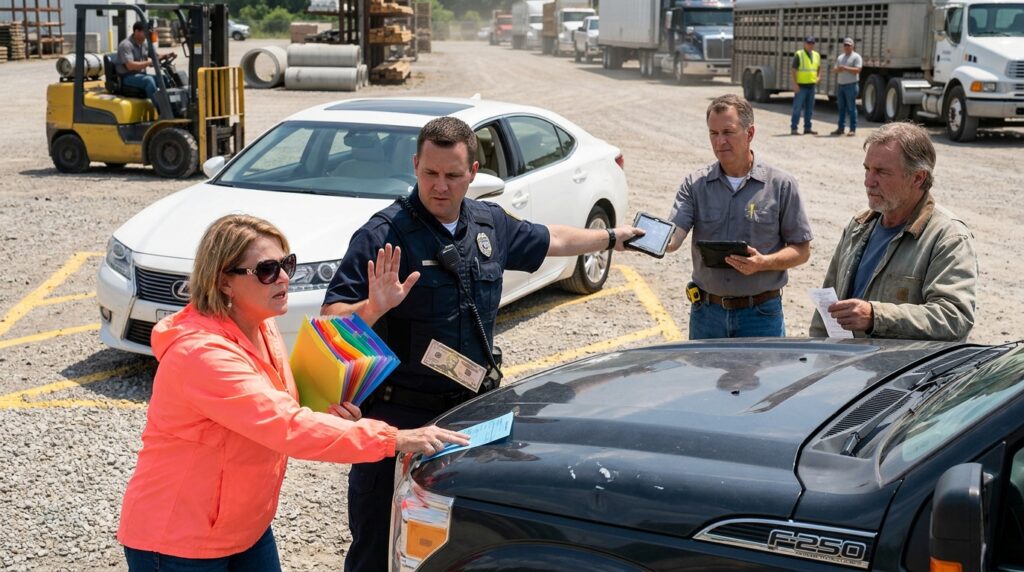
“Look at the tag on that ring,” Brenda hissed, her phone camera dropping three inches until the lens was level with Marcus’s chest. “It’s a Tier-One Commercial Override. Issued at the desk inside ten minutes ago. You think your little paper receipt from a garden register beats an executive priority tag?”
Marcus didn’t look at the phone screen. His eyes stayed on the small rectangle of bright orange plastic hooked into the silver binder ring of her folder. It was freshly stamped—the edges still bore the tiny, jagged plastic nibs from where it had been snapped off a master mold—but there was no barcode printed across its face. Just a handwritten set of digits in thick permanent marker: 04-PRIORITY.
The air between the two vehicles had turned thick enough to taste. The F-250’s radiator fan kicked on with a heavy, metallic roar, blowing a wave of dry, hundred-and-forty-degree heat across the space between the bumpers. The heat carried the smell of scorching dust, old transmission oil, and the sharp, mineral tang of hot iron. Brenda didn’t back up. The synthetic fabric of her windbreaker rippled against her shins in the hot blast, her dark glasses glinting like beetle shells in the overhead glare.
“I’m not moving,” Marcus said. He didn’t say it loud, but the words sat heavy in the space between the trucks, plain as a split oak log.
“We’ll see about that,” Brenda said. She tapped her phone screen twice, her thumb flicking with a sharp, practiced rhythm. She pressed the speaker icon, holding the device flat like a saucer under her chin. “I’m standing in Bay 4 right now. I have an uncooperative driver in an unregistered commercial vehicle blocking a priority pickup. He’s aggressive, he’s refusal-to-comply, and he’s damaging the staging area.”
From the phone’s tiny speaker came the crackle of a store intercom, followed by the dry, exhausted voice of a desk clerk. “Mrs. Vance, we’re checking the queue. Please stay clear of the active forklift path.”
“He is the path!” Brenda shouted into the microphone, her voice rising half an octave, sharp enough to make a pair of grackles scatter from the store’s metal gutters. “I have the blue slip right here! Desk-authorized! Send Greg out with the master key or I’m calling the county sheriff on the non-emergency line to report a public safety hazard!”
Marcus took his left hand off the paper receipt, letting his arm drop to his side. His knuckles were dry, the skin around the nails stained with dark lines of pine resin that no soap ever fully lifted. He turned his head toward the yard gate.
The Hyster forklift had stopped its rhythmic beep-beep-beep. Its three-ton steel frame sat idling forty feet away near the covered timber racks, the twin steel forks tilted back, holding a three-thousand-pound sling of green six-by-six framing timbers. The driver—a kid no older than twenty in a high-visibility yellow vest that looked three sizes too big—was leaning his elbows on the steering wheel, his jaw working slowly on a wad of gum. He was looking at Marcus, then at the white Lexus, then back at his staging screen.
Behind the Lexus, the line of waiting vehicles had grown to six. A diesel dually hauling a livestock trailer had pulled up behind the station wagon, its engine chugging with a rhythmic thud-thud-thud that shook the loose gravel under the curb. The driver of the livestock trailer, a man with a sun-bleached felt hat pulled low over his eyes, opened his door and leaned out, resting one arm on his side mirror.
“Hey!” the man in the hat yelled, his voice cutting cleanly through the idling engines. “Some of us have stock in the back! Get that white car out of the chute or let the truck load!”
Brenda didn’t even turn her head. She thrust her right hip out, her left hand snapping the accordion folder open with a loud, paper-dry crack. She pulled out a bright blue sheet of paper—heavier than the thermal receipt, crisp, uncreased, and stamped with the blue ink logo of the Apex Commercial Services Desk.
“You see this?” she said, waving the paper two inches from Marcus’s chin. The breeze caught the corner, fluttering it against his coat sleeve. “This is a Regional Director’s Override Pass. Signed off inside. Your little paper slip is three levels below this. You don’t own this bay, mister. You don’t own anything in this county if you can’t read an organizational chart.”
Marcus looked down at the blue paper. The ink of the signature at the bottom was still wet enough to smudge—a dark, purple-black scrawl across the line marked AUTHORIZED AGENT. But right above the signature line, the space reserved for the TRANSACTION REFERENCE NUMBER was blank. Just a line of grey dot-matrix print that read: MANUAL ENTRY – SEE DESK.
He knew the building center’s system. He’d bought three thousand dollars worth of pressure-treated joists and subfloor plywood here during the spring build on the Miller barn. The system didn’t generate manual entries unless a desk manager bypassed the central server’s inventory lock with a physical key.
“Where’s the register stamp?” Marcus asked quietly.
Brenda’s fingers tightened on the paper, crumpling the top edge slightly. “It’s an executive override, you idiot. It doesn’t need a register stamp. It comes from the front office.”
“Front office doesn’t handle Bay 4,” a new voice said from the shadow of the canopy.
Greg, the yard manager, walked out from between two stacks of asphalt shingles. He was a broad-shouldered man in his fifties with a grey-streaked beard, a grease-stained leather belt carrying a heavy tape measure, and a ruggedized, rubber-armored tablet strapped to his left forearm. He didn’t run. He walked with the heavy, deliberate gait of a man who spent ten hours a day on wet concrete, his boots crunching methodically through the gravel.
He stopped three feet from Brenda’s Lexus, looking first at the luxury car’s front bumper wedged against the Ford’s steel frame, then at the orange priority tag hanging from her binder.
“Mrs. Vance,” Greg said, his voice flat, dry, and completely devoid of pitch. “You drove through the outbound gate again.”
“I have an executive override, Greg!” Brenda declared, thrusting the blue paper toward his chest. “Your desk clerk gave me priority access for Bay 4. This man is refusing to yield the lane, he’s verbally aggressive, and he’s blocking my transport crew!”
Greg didn’t take the paper. He reached down to his forearm, tapped the screen of the rubberized tablet with a thick, calloused index finger, and swiped twice. The screen flickered, casting a faint blue glow against his grey shirt in the bright sunlight.
“Bay 4 was locked out by the central server at two-twelve,” Greg said, not looking up from the screen. “System assigned it to Order 884-A. That’s Mr. Holloway’s timber order. Paid in full at Register 3.”
“I don’t care about your register!” Brenda snapped, her windbreaker rustling as her arms flew up. “Look at the signature on that blue slip! That’s an official store document!”
Greg finally looked at the paper in her hand. His eyes narrowed slightly, tracking the purple-black ink of the scrawl across the bottom line. He reached out, took the corner of the blue slip between two fingers, and pulled it closer to his face.
“This is a manual bypass slip,” Greg said softly. “The only person with a key to the bypass drawer today is the assistant desk supervisor.” He paused, his thumb rubbing over the wet ink of the signature. “And he’s been on his break for twenty minutes.”
Brenda’s jaw tightened. For a fraction of a second, her posture shifted—her shoulders drawn up, her chin dipping an inch as her eyes darted toward the store’s main exit doors. But the freeze lasted only a moment. She immediately pulled her phone back up, her finger slamming against the screen with enough force to click the glass.
“Fine!” she spat, her voice trembling with an icy, razor-thin fury. “If your local staff can’t enforce corporate priority, I’ll have the county do it. Officer Carver is right across the boulevard on traffic duty. We’ll see how long your little friend stays in this bay when a sworn deputy checks his commercial transport permits!”
Marcus didn’t move. He stood beside his idling Ford, his hand resting on the cool paper receipt in his pocket, as the siren from a municipal cruiser gave a short, sharp yip-yip from the main road outside the gate.