CHAPTER 3: The Paper Trail
“You’re tracking mud onto the linoleum, Mr. Vance.”
The voice belongs to Martha Geller, though everyone in the municipal service annex calls her the Clerk of Record simply because she has outlasted four mayors and every elected township supervisor since the Reagan administration. She sits behind a knee-high partition of scarred birch veneer, her bifocals sliding down the bridge of a nose that looks like it has been broken and reset by an amateur carpenter.
Marcus does not look down at his boots. He places a heavy brown cardboard folder flat on the melamine counter. The sound is dry—the soft slap of compressed wood pulp meeting hard plastic.
“I’m here to file a formal addendum to parcel 44-B,” Marcus says. His voice carries the flat, unhurried cadence of a man who has spent twelve hours debugging server racks and has no patience left for bureaucratic static. “An addendum regarding willful property defacement and ongoing boundary harassment.”
Martha doesn’t open the folder. She reaches for a half-filled styrofoam cup of lukewarm decaf, her paper-thin wrist rattling inside a silver expansion bracelet that hums against the rim. “We don’t handle local neighbor tiffs down here, Marcus. That’s what the constable’s non-emergency line is for. Or better yet, you take it to the Pine Ridge Homeowners Association architectural committee. Brenda Higgins sits as the secondary architectural liaison. If there’s an issue with your fencing line or your driveway drop, she’s the one who signs off on the arbitration paperwork first.”
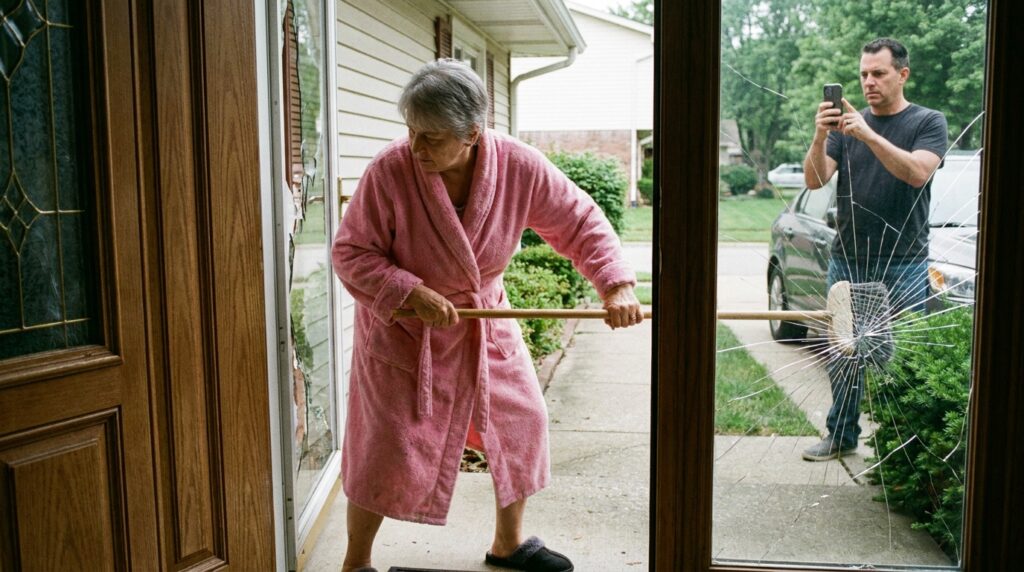
“She’s the one who swung a garden mattock into my front door this morning at seven o’clock,” Marcus says. He doesn’t raise his voice. He simply shifts his weight onto his left boot, his shoulders squaring against the glare of the flickering fluorescent tube overhead. “I have forty seconds of continuous 4K video showing her crossing the property line, lifting the tool, and shattering the right-side glass pane. I’m not here for an HOA mediation. I’m here to register a formal civil complaint and check the active zoning deed for the communal drainage easement.”
Martha’s hand stops halfway to her mouth. The yellowed foam cup hovers over the desk, droplets of gray coffee clinging to the bottom rim. Her eyes rise slowly over the top of her wire-rimmed lenses, locking onto Marcus with a cold, appraising squint that has seen every kind of suburban warfare this zip code has ever manufactured.
“Brenda Higgins has lived on that cul-de-sac since the lots were cut out of the dairy farm,” Martha says softly, her tone shifting from dismissive to something guarded, almost procedural. “Her late husband, Arthur, drafted the original layout maps with the county surveyor before the township even had a zoning board. When the developer went bankrupt in eighty-two, Arthur kept the association afloat out of his own checking account. The board doesn’t process complaints against Brenda. The board is Brenda’s filing cabinet.”
Marcus feels a cold knot tighten in his chest, but his face remains an unreadable mask. He leans forward two inches, resting his palms flat on the scuffed counter. “So the covenants are rigged.”
“The covenants are grandfathered,” Martha corrects sharply, setting the coffee cup down with a sharp clack. “And if you pull the master ledger from the basement archive—which you can’t, because public access requires a formal written petition endorsed by two sitting board members—you’ll see that the 1978 master covenant grants the primary property holder administrative veto over any curb-line modifications within twenty feet of the drainage ditch. Your driveway extension touches that twenty-foot buffer, Mr. Vance. Technically, according to the unrevoked papers filed forty years ago, Brenda has the legal right to inspect any structure that alters the watershed runoff.”
“A right to inspect,” Marcus says, his voice dropping an octave, cold as winter steel. “Not a right to shatter glass with a mattock.”
Martha doesn’t answer immediately. She reaches into the drawer beneath her desk, pulling out a heavy, cloth-bound ledger with frayed edges and water-stained corners. She doesn’t slide it across to him; she keeps it anchored on her side of the partition, her thumb resting heavily on the binding as if guarding an old, dangerous secret.
“She’s losing him, Marcus,” Martha says, her voice dropping to a dry, raspy murmur that barely carries over the hum of the ceiling vent. “Arthur hasn’t left the front bedroom in six months. The medical bills from the county facility are eating their pension faster than the mortgage cleared. Brenda sits on that porch every morning staring at your truck, at the new sod, at the way you just walked into this neighborhood like you own the sunlight, because she’s terrified that the moment she blinks, forty years of her life will be bulldozed into a retention pond and paved over by people who don’t even know her name.”
Marcus looks at the old woman’s hand on the ledger. He thinks of the video in his pocket—the pink robe, the wild, desperate swing of the iron head, the jagged star of green-tinted glass shattering onto his welcome mat. Pity and pragmatism grind against each other in his mind like dry gears.
“That doesn’t give her the key to my front door,” Marcus says quietly.
“No,” Martha says, finally pushing a single, pink carbon-copy slip across the counter toward him. “It doesn’t. But if you file that criminal destruction report today, Deputy Miller is going to come out, write a ticket, and the board will retaliate by slapping a municipal lien on your driveway extension for drainage non-compliance. They’ll bleed you in permit fees until you pack up your trailers and leave.”
Marcus looks down at the blank form. He picks up a ballpoint pen from the counter, its plastic casing cracked and taped together near the clicker.
“Let them bleed,” Marcus says, and begins to write.