CHAPTER 2: THE ZIPPER AND THE SHIELD
The silence didn’t shatter; it dissolved under the mid-afternoon glare. The hum of the Suburban’s cooling fan ran on in rhythmic cycles, cycling hot air across the perimeter fence where the bougainvillea had begun to brown in the August heat.
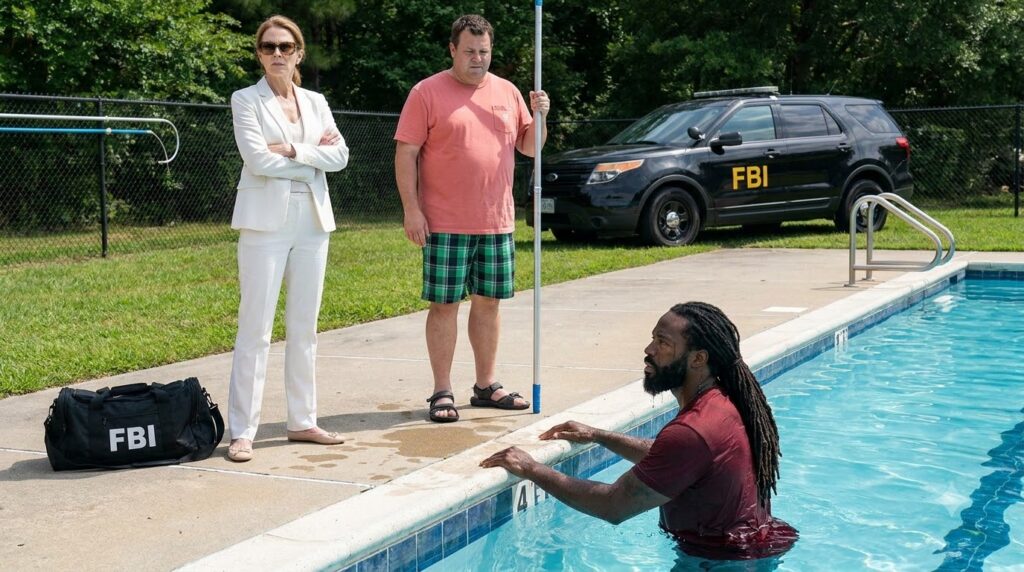
Carl didn’t lower the skimmer pole so much as allow gravity to claim it. The aluminum tip clipped the edge of a plastic lounger with a hollow clatter, the netting trailing limply across the damp stone. His gaze remained hitched to the black tailgate, where the subdued gold emblem seemed to absorb the white sun rather than reflect it.
“Evelyn,” Carl whispered again, this time barely moving his mouth, as if raised volume might invite whatever authority was parked fifteen yards away. “Is that… whose plate is that?”
Evelyn didn’t answer. The clipboard she carried under her left arm had slipped down against her hip. Her hand remained poised near her collar, her fingers curled slightly inward, touching the thin chain of a pendant tucked beneath her lapel. Her sunglasses hid her eyes, but the faint tremor in her lower jaw showed the rapid recalculation taking place behind the tinted lenses. In this subdivision, every disturbance had a procedure: an incident report, a polite citation left tucked behind a screen door, an escalation to the security desk at the main gate. There was no procedure in the association bylaws for an idling government transport parked across the manicured berm.
In the pool, Marcus exhaled. The water around his chest rippled softly, disturbing the reflection of the bleached sky. He shifted his weight, bringing his right foot up to rest against the submerged ceramic step.
“I’m coming out,” Marcus stated, keeping his tone even, shorn of triumph or antagonism. He said it with the quiet matter-of-factness of a man giving notice of an approaching weather change. “Nobody needs to move.”
Carl backed up two paces instantly, his sandals scuffing against the pitted concrete. “We’re not—nobody was trying to cause a problem here. We just have the tag protocol, you understand. People come through from the county road sometimes.”
“Carl,” Evelyn snapped, though the command was thin, stripped of its previous polish. She didn’t move away, but she stepped back from the edge, yielding the coping line.
Marcus placed both palms flat against the warm aggregate. With a fluid, practiced push that barely stirred the surface, he lifted himself out of the deep end. The dark burgundy cotton of his shirt plastered instantly to his torso, heavy with chlorinated water that cascaded in sheets down his dark legs and dripped from his dreadlocks onto the stone. He did not rush. He stood six-foot-one, barefoot, water pooling around his arches, his breath steady and slow.
He walked past them toward the stanchion.
Neither Carl nor Evelyn spoke as he crossed the lane of sun. Marcus knelt on one knee beside the ballistic nylon bag, the hot concrete pressing into his shins. He unclipped the brass ring that held the remote fob. The metallic click echoed against the side of the pool house.
“You’re not supposed to leave federal property unattended,” Evelyn said. Her voice had found a register of defensive formality, though it wavered at the edges like water on glass. “If that’s what that is. You can’t just leave it running on private common ground.”
“I was within line of sight, ma’am,” Marcus replied softly, not looking up. His fingers pulled the heavy zipper of the main compartment back six inches.
He reached inside, his movements deliberately slow and visible. He bypassed the holster anchored within the internal retention loop—leaving the sidearm completely concealed and undisturbed—and pulled out a bi-fold credential case wrapped in dark leather, alongside a laminated vehicle slip.
When he stood, he held the wallet open at chest height.
The Department of Justice shield gleamed with a dull, matte finish, surrounding the embossed seal of the Federal Bureau of Investigation. Beside it, Marcus’s face stared out from behind the laminated window beneath the title of Supervisory Special Agent Marcus Vance, Dallas Field Division.
Carl made a faint clicking sound in the back of his throat and looked down at his own sandals, suddenly deeply interested in the pattern of the pool drains.
Evelyn peered through her sunglasses, leaning forward just enough to verify the typography without appearing to bow. “An agent.” She tried to reassemble her posture, drawing her shoulders back within the cut of her white linen blazer, but the fabric was creased from the afternoon heat, the perfection slightly ruined. “This is an active residential neighborhood. Why is an agent sitting in our pool in street clothes while an official car sits on our lawn?”
“I’ve been on a six-hour stationary watch since four this morning, Mrs. Vance,” Marcus said.
The deck went completely motionless.
The name hung in the heavy, humid air between them like a dropped weight. Carl blinked, looking from Marcus to Evelyn and back again, his brow furrowing as he tried to trace a line between the two of them.
Evelyn froze. The hand at her throat dropped slowly to her side. “What did you say?”
“I said Mrs. Vance,” Marcus repeated, his voice lowering, gentle enough that Carl had to strain to hear. He reached back into the open corner of the duffel, his wet thumb brushing against a worn, silver-link medical tag tied to the inner zipper pull—scratched and faded, bearing an engraved blood type and an emergency contact number with the same local exchange as this street. He didn’t pull the tag out, but his fingers lingered on it before he closed the flap.
“You’re on the association board under your maiden name, Evelyn Cross,” Marcus continued quietly, stepping half a foot closer, allowing the distance between them to shrink to that of a family parlor rather than a public square. “I know who you are. And I know whose house is at the end of the cul-de-sac on Heron’s Rest.”
Evelyn took a sharp, shallow breath. Her sunglasses seemed suddenly too dark for her face, hiding whatever panic was tightening the corners of her eyes. “She told you not to come here.”
“No,” Marcus said, slipping the credentials into his back pocket and picking up the heavy nylon duffel by its webbed handles. “She told me you’d be the first person to notice the truck.”