
CHAPTER 2: THE PAPERWORK PARADOX
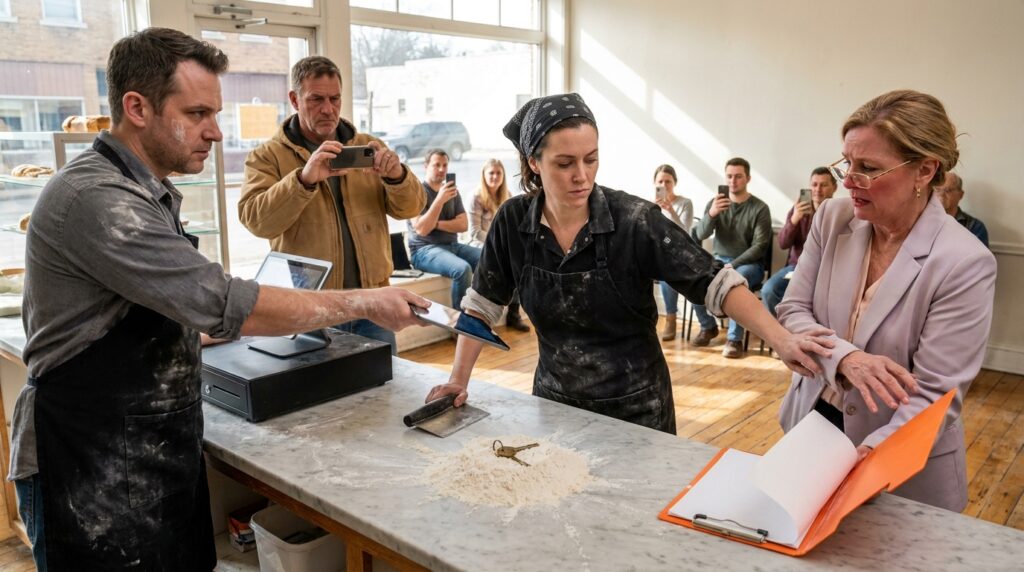
“Zoning Board doesn’t print on twenty-pound bond paper with an inkjet printer, Patty,” Marcus said. His voice was gravel-dry, perfectly level, carrying across the quieted shop with the practiced ease of a man who spent four years on an engine crew before managing a commercial line.
He didn’t raise his arm, but his body blocked the four-inch gap between the marble countertop and the wooden partition. His thumb swiped across the dark glass of the POS screen, pulling up the store’s administrative backend with a series of quiet, rhythmic taps.
Patty’s hand twitched on the orange plastic. The blue-backed document remained pinned beneath her manicured fingers, the seal at the top stamped in dark indigo ink that bled slightly into the wood-pulp fiber.
“You don’t know the first thing about municipal code, Vance,” Patty spat, her chest heaving against the stiff lapels of her pastel blazer. She didn’t look at Marcus. Her eyes stayed locked on Clara, trying to force a flinch, trying to find the crack in the floor-dusted apron where fifteen years of early mornings might yield to sudden panic. “This is an official Notice of Hearing regarding your commercial occupancy permit. Section 4, Sub-clause C. Structural non-compliance, unpermitted alterations to a historical storefront, and failure to maintain adequate public ingress.”
A murmur drifted from the table near the front window, where two town clerks were sitting with half-eaten breakfast rolls. One of them squinted, setting her coffee mug down with a soft clink against the ceramic saucer.
Clara didn’t flinch. She picked up the bench knife from the marble slab, the heavy steel blade catching the morning light as she scraped a fine layer of dry dough off the zinc edge. She laid the knife down, flat and deliberate, two inches from Patty’s resting clipboard.
“Sub-clause C was repealed eight years ago when the county unified the building registry,” Clara said. Her voice didn’t carry anger; it carried the flat, unyielding weight of someone who had spent four months memorizing every line of the town’s commercial code just to satisfy the bank’s underwriting risk officer. “And my occupancy permit isn’t issued by the Zoning Board. It’s issued by the District Building Inspector. His signature is framed on the wall right behind you, next to the health department rating.”
Patty’s jaw tightened. She adjusted her footing, the heel of her shoe grinding against a loose pine board in the floor. “This isn’t about a wall frame, Clara. This is about a pattern of negligence. You’re running an illegal catering operation out of a retail kitchen, you’re blocking the alley with morning deliveries, and the town board has had enough. We are exercising our right as a merchant coalition to demand a management audit.”
“Show me the coalition signatures,” Marcus said quietly.
He turned the tablet screen outward. The high-contrast display flickered under the fluorescent counter lights, showing the clear, green-checked status lights of the state’s digital commercial ledger. At the top of the interface, in crisp white sans-serif lettering, read the primary business entity name: BENNETT PROVISIONS LLC — STATUS: ACTIVE / GOOD STANDING.
“Page three,” Patty demanded, her voice rising an octave, taking on the shrill, theatrical tone she used at town hall budget hearings. “It’s all documented right here. The grievances from local property owners, the inspection logs, the official notice to surrender administrative access to a designated receiver.”
She fanned the blue-backed document open with a flick of her thumb.
As the top sheet lifted, the morning sun streaming through the front window caught the white edge of the paper beneath it. Clara leaned in just a fraction of an inch, her sharp eyes catching a subtle discrepancy: the municipal seal on the cover sheet bore a date line, but the ink wasn’t fresh indigo. It was faded, browned at the margins, the signature line bearing the faint, ghostly impression of an old wet-ink stamp that had been run through a flatbed scanner.
Tucked into the clear plastic sleeve on the back of the orange clipboard, hidden beneath the lip of the metal spring clamp, sat a second object—not a document, but a small, tarnished brass key with a notched barrel, the kind used for old commercial utility boxes or private safe-deposit drawers. It rattled once against the plastic as Patty’s hand trembled.
“You brought a scanner copy of a five-year-old zoning inquiry from the previous building owner,” Clara said, her voice dropping into a low, deadly register that cut straight through Patty’s performative outrage. “And you pasted a header over the text.”
The room went completely dead.
In the back, near the sugar station, a local contractor named Hank lowered his paper cup. “Patty,” he called out, his broad voice echoing off the tin ceiling, “what are you talking about, an audit? Clara’s the only one on this block who pays her alley maintenance fee on time.”
Patty turned her head half an inch, her tinted sunglasses reflecting the roomful of eyes now shifting toward her position at the counter. Her daughter, Chloe, stepped another foot away, her fingers still moving over her phone screen, but her head tilted slightly downward, her shoulders rising in a silent gesture of absolute detachment.
“This is an official matter under review!” Patty declared, though the authority in her stance was beginning to fray around the edges, her hand pressing harder against the clipboard to keep the sheets from shifting. “The paper trail is legal, and the board will enforce it whether you cooperate today or not!”
“Then let’s look at the paper trail together,” Marcus said. He reached across the marble counter, his long fingers stopping less than an inch from the clipboard’s metal latch. “Right here. On camera.”
He pointed his thumb toward the black glass dome mounted directly into the oak beam above the register line—its red LED indicator blinking in a steady, silent cadence.