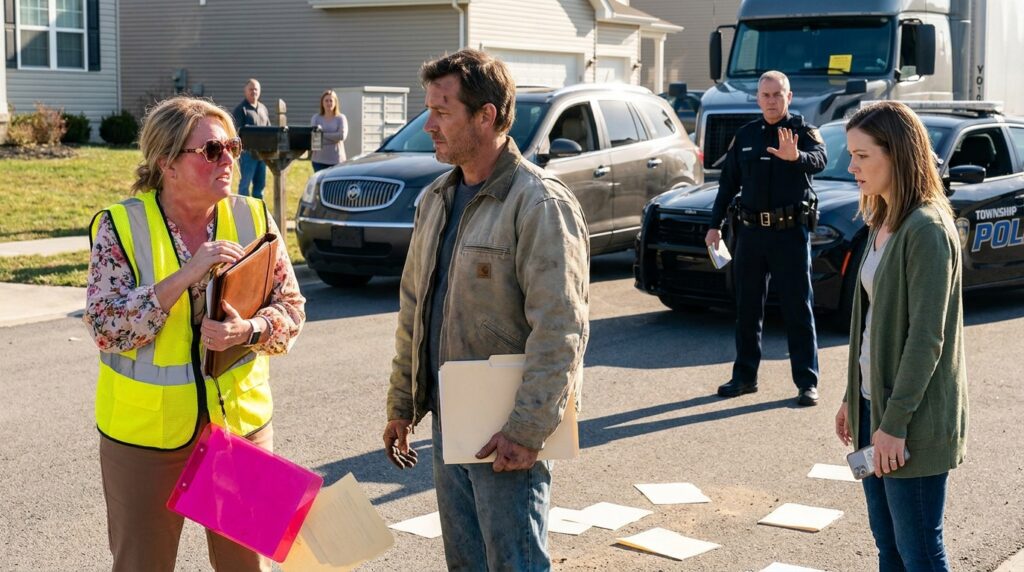
CHAPTER 2: PAPERWORK AND ESCALATING THREATS
“I don’t need to look at a colored marker on a piece of paper you printed in your living room, Marcus,” Brenda said, her voice carrying across the lawn like the rasp of a dry hedge trimmer. She didn’t lower her phone. If anything, her arm locked straighter, the lens focused on the red county seal at the bottom of the page. “That stamp doesn’t override the safety of twenty-four households.”
Marcus didn’t pull the folder back. He held the map steady in the still, humid air, feeling the paper absorb the slight dampness of his palms. The golden ink tracking the utility easement gleamed against the matte off-white stock—an official document, signed by the township recorder twelve years ago when the subdivision was nothing more than surveyed dirt and pine scrub.
“It’s not a printout, Brenda,” Marcus replied, his tone remaining flat, measured, stripped of any rising emotion. “It’s a certified copy of the original plat. The county right-of-way extends forty feet from the centerline of Oakridge Drive, straight down this gravel approach. The HOA doesn’t own the dirt under these tires.”
Behind Brenda, the luxury SUV’s hazard lights threw amber flashes across the dusty chrome of the transport truck’s radiator grille. The transport driver let out a heavy breath, reaching over to turn off the ignition. The deep, rhythmic thrum of the diesel engine died, leaving behind the ticking of hot iron, the faint hum of a cicada in the high oak branches, and the distinct, rustling silence of six neighbors listening from their fence lines.
Darren shifted his weight on the footplate of his mower, pretending to clean grass clippings off the deck with the toe of his boot, though his eyes stayed glued to the laminated folder in Marcus’s hands. Further down the sidewalk, Hannah walked off her porch steps, taking three deliberate paces onto the turf of her front lawn, her arms crossed tight against her chest.
“You can cite state codes all day long,” Brenda said, stepping around the corner of Marcus’s map to narrow the distance between them. She tapped the edge of her clipboard twice against her hip, a hollow clack-clack that sounded like a dry branch snapping. “The board passed an emergency resolution last Tuesday. No commercial vehicles over five tons are permitted to use adjacent access points during morning peak hours. It’s a matter of child safety and road maintenance.”
Marcus looked past her shoulder to the SUV’s rear tires, which sat firmly across the center seam of the street, completely cutting off the turning radius the transport needed to reverse.
“Where is the written notice?” Marcus asked. “An emergency board meeting requires seventy-two hours of public posting on the community board by the mailboxes. I checked the glass this morning at six. There was nothing posted except the pool maintenance schedule.”
Brenda’s manicured fingers tightened on the edge of her neon-pink clipboard, the bright acrylic nails leaving tiny indentations in the plastic. Her eyes flicked toward Darren, then back to Marcus, a micro-shift in her posture that lasted no longer than a heartbeat.
“The notice was delivered digitally to all verified board members and property owners in good standing,” she said smoothly, her voice rising an octave to ensure the words reached the sidewalk. “If your email filter caught it, that’s a personal administrative failure, not an HOA omission. Regardless, the penalty for unauthorized commercial passage is five hundred dollars per day, retroactive to the moment this rig crossed the curb.”
She reached into the outer pocket of her high-visibility vest and pulled out a pad of fluorescent yellow violation notices. With a quick, practiced motion of her pen, she began scribbling across the top line, the tip pressing so hard the carbon paper underneath squeaked against the cardboard backing.
“Five hundred dollars,” Marcus repeated quietly. “Issued by a committee of one, standing in the middle of a public street.”
“Issued by the treasurer of this association,” Brenda corrected, tearing the top sheet off with a sharp rip. She didn’t hand it to Marcus. Instead, she stepped past him, her vest brushing against the faded canvas of his sleeve, and slapped the bright yellow paper directly onto the driver’s side window of the transport truck, pressing the adhesive strip firmly against the glass. “And until that fine is settled with the management company, this vehicle stays right where it is.”
The transport driver didn’t roll down the glass. He just stared at the yellow rectangle, then down at Marcus with a subtle, incredulous turn of his mouth.
“You can’t fine a commercial carrier who isn’t a party to your covenants, Brenda,” Marcus said, turning around to face her back. He stayed five feet away, his hands resting naturally at his sides, the folder tucked under his arm. “And you certainly can’t block a vehicle from exiting onto a township road.”
Brenda turned back to him, a tight, artificial smile stretching across her face, completely devoid of warmth. She raised her phone again, capturing the transport, the yellow slip on the glass, and Marcus standing silently on the gravel edge.
“I’m not blocking him, Marcus,” she said, her voice dripping with calculated sweetness. “I’m protecting our pavement. If he wants to leave, he can back all the way out to the county highway—if he can manage that without mounting the curb or tearing up the drainage swale. But he isn’t pulling that trailer into this lane.”
She pivoted on her heel, marched back to her SUV, and pulled the key fob from her vest pocket. With a high-pitched beep-beep, the doors locked. Brenda opened the driver’s door, slid into the leather seat, and pulled the door shut, leaving the vehicle idling diagonally across the lane, its emergency lights continuing their steady, amber pulse.
Hannah walked fast across the grass, her sneakers making a soft swishing sound in the lawn as she reached the edge of Marcus’s driveway. She kept her voice down, looking nervously at the tinted windshield of Brenda’s SUV.
“Marcus,” Hannah whispered, leaning in slightly. “She’s been on the phone since seven this morning. I heard her talking to her brother down at the hardware store. She told him your lot was finally going to open up because you couldn’t afford the commercial permits.”
Marcus looked down at the highlighted map in his hand, his thumb tracing the crisp, clean line of the municipal seal. The paper was dry, cold, and entirely unbothered by the heat of the morning.
“She thinks the dirt belongs to whoever shouts the loudest,” Marcus said quietly.
“She called the township code enforcement office twenty minutes ago,” Hannah added, her eyes darting back toward Brenda’s vehicle. “She told them an unregistered commercial depot was operating out of your residential zone.”
Marcus didn’t answer right away. He looked up at the transport driver, who was tapping his fingers rhythmically against the steering wheel, waiting for the word. Marcus reached into his pocket, pulled out his own phone, and unlocked the screen. He didn’t dial the HOA management line, and he didn’t call code enforcement. He dialed the direct administrative line for the Carson Township Police Department.
“Officer Vance,” Marcus said when the line connected on the third ring. His voice was steady, unimpressed, and smooth as polished steel. “This is Marcus Holloway over on Oakridge Drive. I have an unattended commercial vehicle blocking a public utility easement, and a neighbor who just locked herself in her car across an active traffic lane.”
Across the street, Brenda’s driver-side window rolled down two inches—just far enough for her to stick the lens of her phone through the gap.