
CHAPTER 3: THE DECOY LEDGER
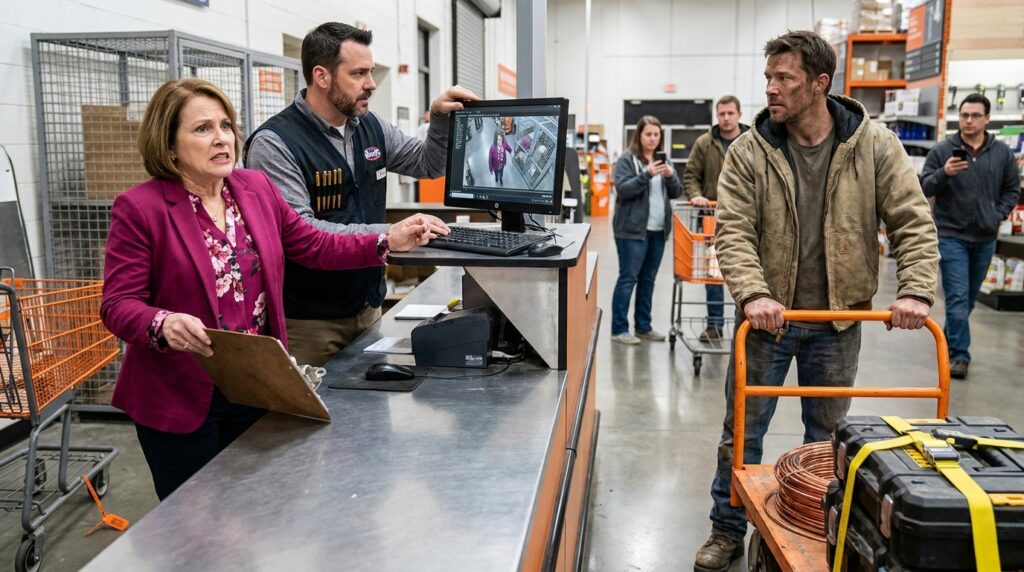
David Croft’s rubber-soled work shoes made no sound on the polished concrete, but his presence brought an immediate, chilling drop in the room’s temperature. He moved between the end of the register counter and Evelyn’s blocked cart, his dark store vest unbuttoned just enough to reveal a pen-caddy stuffed with brass-tipped inventory markers. His eyes, small and quick beneath heavy eyelids, didn’t waste a second on the crowd or the ringing phones. They went straight to the two-inch gap where Evelyn’s cart frame was jammed hard against Marcus’s flatbed.
“Clear the lane gap, Mrs. Pryor,” Croft said. His voice was flat, unhurried, calibrated by fifteen years of retail management to de-escalate without offering an apology. “Tyler, set your register divider to closed.”
Evelyn didn’t move her cart. Instead, her fingers snapped the metal clip on her leather clipboard, pulling free a folded sheet of bright yellow carbon paper. “I’m not clearing anything until you review the stock variance report for Aisle Four, David. I’m standing here as a representative of the Business District Oversight Board, and I am reporting an active inventory swap.”
Marcus felt the weight of the flatbed cart through the soles of his boots as the rubber tires settled into a fine groove in the concrete. He kept his hands flat on the rubber grip. He didn’t speak. He watched Croft’s face. A seasoned contractor could tell the load-bearing capacity of a pine joist by the direction of its grain; Marcus could tell within three seconds that Croft was calculating store liability, throughput efficiency, and local press exposure all at once.
“What inventory swap?” Croft asked, taking the yellow sheet between two fingers. He didn’t look at the paper immediately; he kept his gaze fixed on Evelyn’s face.
“He was behind the sheetrock pallets for eleven minutes,” Evelyn said, her voice dropping into a tight, rehearsed rhythm that carried clearly over the hum of the overhead halogen banks. She pointed a manicured finger over the top of her clipboard toward the bottom shelf of Marcus’s flatbed. “He took two clearance-priced Model 880 tool cases off the endcap. Then he used his contractor utility shears to slit the back seams, pulled out the brushless drills, and stuffed eight two-hundred-amp commercial breaker panels inside the empty plastic shells. He re-crimped the yellow shipping straps using his own tool belt pliers.”
A collective murmur rippled through the line behind them. The man with the drill bit set stepped closer, angling his phone camera over Evelyn’s shoulder to capture the heavy yellow plastic straps wrapping the dark green tool cases on Marcus’s lower rack.
Croft finally lowered his eyes to the yellow paper. “This is an internal stock audit sheet from Dept-08.”
“I pulled it from the supervisor rack when I noted the variance this morning,” Evelyn said, her posture puffing up, her gold lanyard clip flashing under the ceiling lights. “The part numbers on those commercial breakers match the missing unit codes from the glass cage behind the electrical desk. Two thousand dollars in solid copper and silver contacts, hidden inside forty-dollar plastic tool shells.”
Marcus looked down at the tool cases on his lower rack. The heavy yellow thermoplastic straps were continuous, machine-tensioned loops with heat-welded seams—the kind stamped out by automated packaging plants in Ohio, not hand-crimped with job site pliers. But Evelyn’s explanation was detailed, technical, and delivered with the absolute certainty of an auditor holding official paper. To the twenty people standing in line behind her, it sounded like a confession caught in real-time.
“Let me see the yellow paper, Mr. Croft,” Marcus said quietly.
Evelyn immediately snatched at the corner of the sheet. “You don’t have authorization to view internal store audit records!”
“It’s not an internal record,” Marcus said, his tone remaining as level as a laser line across a dry frame. “The store doesn’t use yellow tri-fold carbon for Dept-08 audits. They switched to digital handheld zebra terminals three years ago. That paper is an old contractor return slip from the commercial desk.”
Croft’s eyes narrowed slightly. His thumb moved across the bottom edge of the paper, feeling the texture of the sheet. He didn’t confirm or deny Marcus’s observation, but his grip on the yellow paper tightened, preventing Evelyn from pulling it back beneath her clipboard clip.
“We aren’t doing a box-stripping audit on a register floor in the middle of a Saturday rush,” Croft said, his tone turning crisp and cold. He looked up at the security camera mounted on the steel beam directly above Register Four, its small black dome reflecting the glare of the lights. “Mrs. Pryor, pull your cart back three feet.”
“You’re going to let him wheel two thousand dollars of stolen commercial breakers out into the parking lot?” Evelyn demanded, her voice cracking into a high, shrill register that made several cashiers two lanes over turn their heads. “I have a documented variance sheet right here in my hand! Search the cases right now! Unsnap the straps!”
“If I unsnap factory-tensioned plastic straps on paid merchandise without verification, the store assumes liability for damaged packaging on commercial goods,” Croft replied flatly. He turned to the junior security guard standing at the edge of the queue. “Jackson, stand by this flatbed. Nobody touches the freight.”
Croft then turned his head toward the central aisle, pointing toward the raised desk of the main customer service counter twenty yards away. “We are moving this entire matter to the main terminal monitor. We will cross-reference the POS transaction logs, the serial scan history, and the live overhead camera archive from Aisle Four.”
Evelyn stiffened, her jaw locking as she pressed her clipboard flat against her magenta jacket. “I demand that my handwritten variance log be entered into the official incident record!”
“It will be reviewed,” Croft said, his hand gesturing firmly toward the walkway. “Along with every inch of video recorded between two o’clock and right now. Move your cart, Mrs. Pryor. Or I’ll have Jackson remove it for obstructing a fire exit lane.”
Evelyn hesitated for a single second, her eyes darting toward the broken orange plastic seal still lying near her left shoe on the concrete floor. Then, with a dramatic, exaggerated sigh, she yanked her cart backward, the rubber casters squealing against the polished surface.
Marcus didn’t celebrate. He kept his hands on his flatbed handle, his boots striking a steady, measured rhythm against the concrete as he wheeled his two-thousand-dollar load behind Croft, knowing the fight hadn’t been won—it had simply been moved to a room with higher resolution.