
CHAPTER 5: THE WEIGHT OF QUIET RESTRAINT
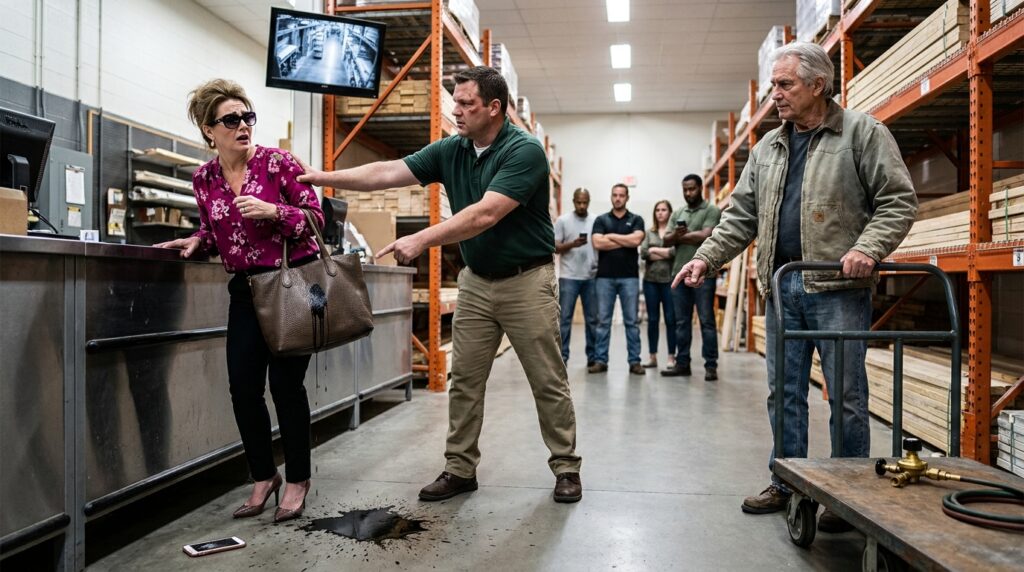
The two uniformed asset protection officers moved in with practiced, silent efficiency. The taller one, a broad-shouldered man with a heavy radio harness clipped to his chest, stepped neatly between Brenda and the exit doors. His partner, a woman with her hair secured in a tight military bun, gestured calmly toward the cracked phone lying facedown on the scuffed concrete.
“Ma’am,” the lead guard said, his voice flat, neutral, and entirely devoid of heat. “Please leave the bag on the counter rail and step back toward the customer service desk.”
Brenda’s chest heaved. The magenta floral blouse was wrinkled at the waist where her arm had pressed the heavy tote bag against her ribs. She looked around the circle—from Miller’s steady, unyielding stare to Kowalski’s pale face behind the register, past the wall of dust-caked contractors whose arms remained locked, and finally down at the dark, pungent stain spreading beneath her heels.
“This is a mistake,” she whispered, though the volume had dropped out of her voice, leaving it thin and dry like paper dragging across gravel. “I am a prominent member of this township. My husband’s firm handles commercial zoning for this district.”
Miller didn’t blink. “Your zoning credentials don’t clear unpaid inventory from a personal bag, Mrs. Lawson. And they don’t erase five minutes of overhead digital footage.” He turned to the female officer. “Take possession of the bag. Check the interior lining against the open stock list for Aisle Four. Three commercial transformers, brass housing.”
The female guard stepped forward, her gloved hands taking hold of the leather tote straps. Brenda’s fingers twitched as if to yank them back, but as the guard lifted the bag, the broken brass latch at the top gave way entirely.
With a heavy, metallic thud that echoed off the high corrugated ceiling, three heavy, rectangular transformer boxes spilled out onto the rubber checkout mat. Each unit was wrapped in factory plastic, stamped with yellow inventory tags, and smeared along the base with the dark, sticky film of thread sealant from an unsealed display drum in Aisle Four.
A low, collective rumble of satisfaction moved through the crowd of tradesmen.
“Unopened commercial transformers,” Kowalski murmured, his eyes wide as he verified the stock numbers on his terminal screen. “Ninety-eight dollars apiece. Not logged to any cart or register.”
The lead guard gestured politely toward the wide automatic doors at the front of the contractor bay. “Mrs. Lawson. We’ll complete the paperwork and wait for the township police in the asset protection office. Right this way.”
Brenda didn’t look back as she stepped over her cracked smartphone. She walked between the two guards, her shoulders slouched, her designer heels clicking a erratic, hollow rhythm against the polished concrete floor until the sliding glass doors hissed open and swallowed her into the muggy August morning outside.
The silence that settled over the contractor bay was immediate and absolute.
The painter in the white overalls let out a long breath, stepping up to the counter and slapping a heavy palm down against the stainless steel rail. “Hell of a way to spend twenty minutes on a Saturday,” he said, turning his head to look at Marcus. “Nice call on the I-beam camera, chief.”
Marcus didn’t boast. He reached out with his calloused hand, picked up his five-pound brass regulator from the rubber mat, and laid it carefully back into the wire basket of his cart. The cold metal felt familiar, grounding him in the quiet, unhurried reality of his morning.
Miller reached into his pocket, pulled out a small black rubber stamp, and pressed it against the physical paper receipt spitting out of Kowalski’s terminal. He handed the stamped slip directly to Marcus.
“Mr. Holloway,” Miller said, his tone carrying a quiet, genuine respect that didn’t require dramatic words. “I apologize for the delay at our desk. Your commercial account is flagged for top-tier clearance. If you ever run into an issue in Seven or anywhere else in this store, you ask for me directly.”
“Thank you, Mr. Miller,” Marcus said simply. “Appreciate you checking the tape.”
“A tape doesn’t lie when a man stands his ground,” Miller replied, stepping back to let Kowalski clear the register screen for the next transaction.
Marcus took his stamped receipt, folded it neatly into quarters, and slid it into the front pocket of his faded canvas jacket. He gripped the rubber handles of his flatbed cart, turned it smoothly around the end-cap, and pushed it toward the loading bay exit.
As he walked out into the bright, humid morning air, the heavy double doors clicked shut behind him, sealing off the distant hum of the hardware store. The engine of his pickup truck started with a low, steady purr, the brass fitting resting securely on the passenger seat beside his thermos.
He sat for a moment in the cab, looking out at the sprawling asphalt parking lot. He didn’t feel anger, nor did he feel the rush of a chaotic victory. He felt only the clean, uncomplicated weight of a job finished correctly—the satisfaction of a man who knew that in a world full of loud noise and false authority, a quiet boundary backed by hard facts would always hold the line.
Marcus shifted the truck into gear, pulled out onto the township road, and headed home to fix his plumbing.