CHAPTER 5: THE NOCTURNAL ESCALATION
At 02:14 AM, the infrared night-vision alert on David’s phone didn’t chime. It vibrated once against the wooden nightstand—a low, rhythmic pulse that woke him instantly.
David was out of bed before the third pulse. He wore gray sweatpants and a dark t-shirt. He did not turn on the bedroom light. Moving with the practiced, silent efficiency of a logistics officer navigating a dark field tent, he walked to the front window, stepping to the side of the frame to keep his silhouette hidden behind the heavy blackout drape.
Outside, a bitter autumn frost had settled over Hawthorne Drive, turning the lawns into sheets of glittering silver.
Beneath the amber glow of the driveway security floodlight, a tall, heavy-set figure clad in a dark hooded sweatshirt stood beside David’s utility trailer. The man moved with a clumsy, hurried desperation, leaning his body weight into a sharp, downward thrust against the sidewall of the trailer’s front passenger tire.
A loud, violent HISS ripped through the quiet night air, followed by the acrid, chemical smell of escaping pressurized air and liquid tire sealant.
The figure didn’t stop. He shuffled quickly to the rear tire, drove a dark metallic tool into the rubber with a guttural grunt, then turned toward the driver’s side of David’s Ford pickup. A long, screeching scrape of steel biting through clear coat, primer, and sheet metal echoed off the brick facing of the garage as the man dragged a hardened utility blade from the taillight down to the front fender.
David did not open the window. He did not shout. He reached into his pocket, hit the manual record lock on his phone’s camera system to archive the four-camera 4K feed, and dialed Officer Marcus Brody’s direct dispatch desk.
“Brody,” the officer answered on the second ring, his voice rasping with night-shift exhaustion.
“It’s David Mercer,” David said, his tone entirely level, carrying no more urgency than a routine inventory report. “I have active criminal mischief in progress at 114 Hawthorne Drive. Howard Garrick is currently on my driveway with a utility blade. He has destroyed two tires on my trailer and is keying the driver’s side panel of my truck.”
A heavy silence fell over the line, followed by the sharp rustle of a leather duty belt being pulled tight. “Is he armed with anything other than the blade, David?”
“Negative,” David replied, watching the hooded figure stumble over the curb, dropping a small, metallic object into the frost-covered turf before running toward the Garrick porch. “He just completed the damage and entered the Garrick residence. The entire incident is captured on three high-definition infrared cameras with multi-angle coverage.”
“Two minutes,” Brody said flatly. “Keep your door locked until we roll up.”
By 02:18 AM, the quiet suburban street was bathed in the rhythmically sweeping blue lights of two patrol cruisers. The engines idled with a deep, guttural rumble against the freezing air.
David stepped onto his porch carrying two things: his dark ceramic mug filled with steaming coffee, and his blue vinyl binder tucked under his arm. He wore his canvas work jacket against the biting cold, his steel-toed boots crunching softly over the frost-dusted driveway.
Officer Brody met him at the base of the steps, accompanied by his night-shift partner, Officer Hendricks—a broad-shouldered veteran with thirty years on the force and a face carved out of granite.
“You okay, Mercer?” Brody asked, pulling a heavy flashlight from his belt and directing the bright LED beam onto the trailer.
The beam illuminated two completely flattened rubber carcasses resting against the concrete, the sidewalls torn open in jagged, six-inch gashes. Beside the truck, the deep, white-edged key scratch ran six feet down the metallic gray paint, exposing the bare steel underneath.
“I’m fine, Marcus,” David said softly. He pointed his toe toward the grass line near the mailbox. “He dropped his blade sheath when he tripped over the curb apron. It’s sitting in the frost right there.”
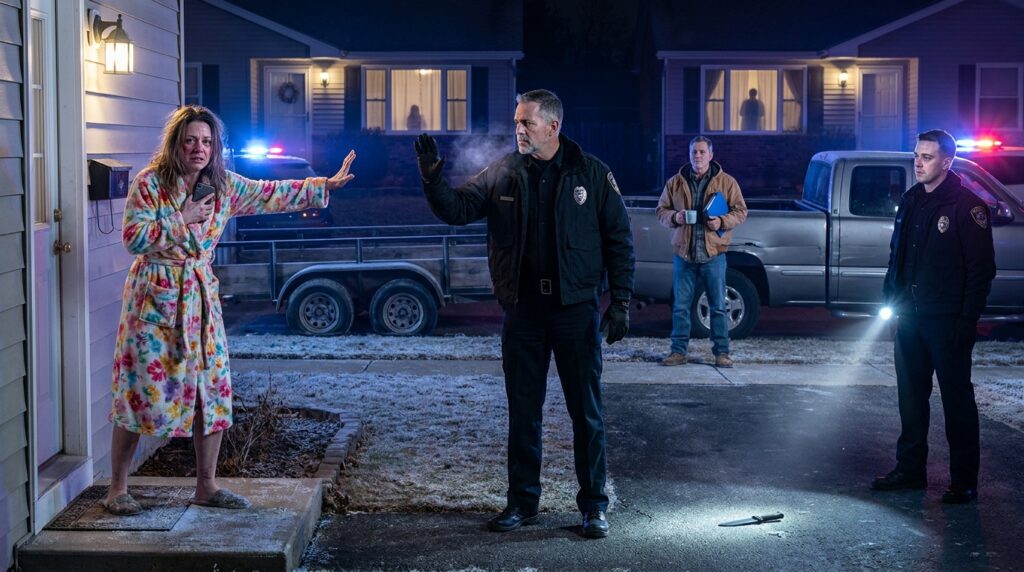
Hendricks walked over, shining his flashlight down at a black plastic utility knife sheath bearing a yellow caution label. “Didn’t even wear gloves,” Hendricks muttered, shaking his head. “Left clear boot impressions in the frost from his porch straight to your tire.”
“Let’s go talk to Howard,” Brody said, unbuttoning the retaining strap on his holster.
David followed the two officers to the edge of the Garrick lawn, stopping at the sidewalk line while the patrolmen stepped onto the porch. Brody knocked three times—a heavy, authoritative boom that rattled the glass oval in the center of the Garrick front door.
Ten seconds passed. Then twenty.
The door swung open four inches. Evelyn Garrick stood in the foyer, wrapped in her bright floral bathrobe, her hair unstyled and flat on one side. Her eyes were wide, bloodshot, scanning the flashing blue lights parked at her curb with frantic, erratic shifts.
“What is the meaning of this intrusion?” Evelyn demanded, her voice shrill, though an unmistakable tremor of panic undercut her sharp tone. “It is two in the morning! You are disturbing a peaceful residential block!”
“Mrs. Garrick, we need to speak with your husband, Howard,” Brody said, stepping closer to the door frame. “We have an active investigation regarding felony criminal mischief occurring at 114 Hawthorne Drive ten minutes ago.”
“Howard has been in bed asleep beside me all night!” Evelyn snapped instantly, her chin rising in that familiar, rigid posture of false authority. “Whatever ridiculous lie Mr. Mercer is telling you, it is a fabrication designed to harass us! My husband hasn’t left this house since six o’clock yesterday evening!”
Hendricks leaned forward, his voice dropping into a cold, dangerous register. “Mrs. Garrick, I’m going to advise you very carefully right now. Providing a false alibi for a felony suspect during an active investigation is an obstruction of justice charge under State Statute 22C. We have high-definition infrared video of a man matching your husband’s exact height, weight, and gait slashing tires across the street three minutes ago.”
Evelyn’s mouth opened, but no words came out. Her gaze drifted past Brody’s shoulder, locking onto David, who stood quietly beneath the streetlamp thirty feet away, holding his coffee mug in one hand and his blue binder in the other.
“He set us up…” Evelyn whispered, her voice cracking as the color completely drained from her face. “He’s been recording the street… he’s using unauthorized surveillance—”
“Howard!” Brody called out loudly into the dark hallway behind her. “Step out onto the porch, now.”
From the shadows of the living room, Howard Garrick slouched into the doorway. He was wearing gray sweatpants and a dark hoodie, his right sleeve torn at the wrist, his breathing heavy and ragged. He looked down at his bare feet, refusing to make eye contact with the officers or his wife.
“Howard, don’t you say a word!” Evelyn shrieked, grabbing her husband’s arm. “They don’t have a warrant! They can’t do anything without a municipal citation!”
“We don’t need a warrant for a felony in progress with physical evidence on the scene, ma’am,” Hendricks said calmly, stepping past her onto the porch and placing a heavy hand on Howard’s shoulder. “Mr. Garrick, turn around and place your hands behind your back.”
As Hendricks clicked the steel handcuffs over Howard’s wrists, Evelyn began to scream—a loud, incoherent rant about police corruption, municipal harassment, and township code enforcement that echoed off the quiet houses up and down Hawthorne Drive. Front porch lights began flicking on across the street. Neighbors pulled back their curtains, watching in dead silence as Howard Garrick was led down his front steps in handcuffs.
Brody walked back over to David, pulling out his notepad. “The DA is going to charge him with felony vandalism based on the property value damage to the truck paint alone. But David… this is going to escalate her.”
“I know,” David said softly, taking a sip of his coffee. “She still thinks this is a neighborhood feud she can win through her intake desk at the Transit Authority.”
Brody looked at the blue vinyl binder under David’s arm, then at the calm, unyielding expression on David’s face. “The preliminary hearing for Howard’s arraignment and your civil protection order is scheduled for Thursday morning at nine. Are you ready for this?”
“I’ve been ready for three months, Marcus,” David said.
As the patrol cruiser pulled away with Howard in the back seat, Evelyn remained standing on her porch in her floral bathrobe, her phone pressed to her ear, screaming frantic demands into a voice mail.
David walked back to his garage, unlocked his desk, and opened the blue binder. He logged the arrest report number, the forensic photograph of the utility blade sheath, and the video timestamp file for 02:14 AM.
Then, his phone buzzed. A text message from Child Protective Services intake alert system flashed on his screen:
NOTICE: ANONYMOUS RETALIATORY COMPLAINT LOGGED REGARDING MINOR CHILD AT 114 HAWTHORNE DRIVE. CASEWORKER ASSIGNED FOR IMMEDIATE ON-SITE VERIFICATION.
David stared at the screen for three long seconds. The ultimate boundary had been crossed. Evelyn Garrick had just weaponized child welfare against his daughter.
David didn’t feel anger. He felt the cold, absolute clarity of an operational command entering its final phase.
He picked up his phone and dialed Captain Diane Ortiz.
“Diane,” David said, his voice as smooth and lethal as polished ice. “Issue the executive administrative summons for Clerk Evelyn Garrick. Thursday morning, 09:00 AM, Courtroom 3B. Bring her complete employment file, her ethics filings, and her termination papers.”
“Understood, Director,” Ortiz replied. “She has no idea what’s waiting for her.”
“She’s about to find out,” David said.