
CHAPTER 5: THE CLEARING OF LANE FOUR
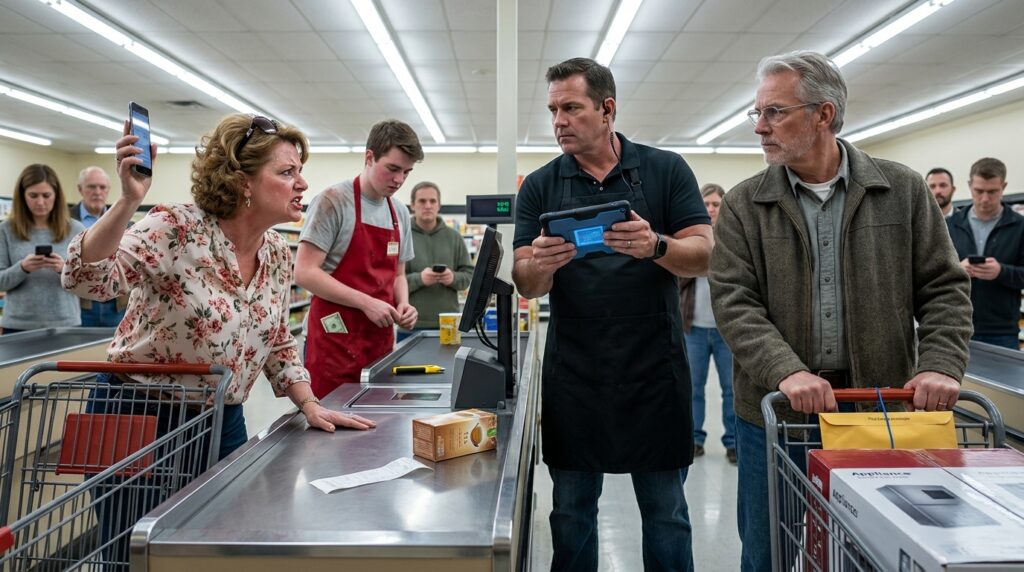
The silence that followed Marcus’s question was heavy, thick with the scent of floor wax, stale coffee, and the cold ozone hum of the register monitors. Gary didn’t answer. He didn’t have to. The crisp green corner of the bill protruding from his apron pocket, paired with the orange timestamp on the tablet display, said everything the store needed to hear.
“Gary, hand over your apron and walk back to the manager’s office,” Marcus said, his voice dropping into a quiet, icy register that carried across the entire front end. “We’re calling regional HR right now.”
The young clerk didn’t look at Brenda. He didn’t look at the crowd holding up a dozen glowing phone screens. He unclipped his name badge with trembling fingers, dropped it onto the stainless-steel ledge of Register 4, and walked away into the back cross-aisle with his chin pressed against his chest.
Marcus turned his full attention to Brenda. His posture straightened, his broad shoulders blocking the lane as a uniformed loss-prevention officer stepped up beside him from the customer service counter.
“Brenda,” Marcus said, his voice amplified by the hard vinyl surfaces of the store. “You’re done here today. You need to leave the premises immediately.”
Brenda’s hands tightened around her phone, her knuckles turning a mottled white. “You can’t ban me from a public retail chain, Marcus! I am a neighborhood watch captain! I was ensuring store compliance!”
“You bribed an employee to falsify a store record, you attempted to confiscate paid property, and you obstructed a paying customer in Lane Four,” Marcus replied, holding up his hand as she tried to step forward. “Your shopping privileges at Oakridge Supermarket are suspended pending a formal review by corporate management. If you don’t turn around and walk out those sliding doors right now, I’m having the officer beside me execute a formal trespass notice.”
The surrounding shoppers broke into an audible chorus of agreement. A man in a flannel shirt near the battery display scoffed loudly. “Move your cart, lady! Some of us have places to be!”
Brenda looked at Marcus, then at the loss-prevention officer whose hand rested firmly near his belt, and finally at the sea of smartphone lenses tracking her every breath. The theatrical, aggressive authority that had carried her through dozens of neighborhood disputes crumbled into a raw, red-faced embarrassment.
Without another word, she grabbed the wire handle of her empty shopping cart, yanked it violently backward out of the track of Lane 4, and turned on her heel. The rubber wheels squeaked in protest against the polished tile as she pushed the cart toward the automatic glass doors, her head lowered, her oversized sunglasses slipping sideways across her hair. The crowd parted silently to let her pass, the sound of dozens of camera shutters clicking behind her like dry leaves in a gust of wind.
Marcus took a deep, steadying breath, pressing his radio earpiece back into his ear. He looked at Arthur, his expression shifting from stern authority to worn, professional exhaustion.
“Mr. Pendelton,” Marcus said, extending his hand. “I apologize for the delay and the disruption. You’re clear to proceed.”
Arthur shook the manager’s hand once, a firm, brief grip. “Thank you for following the records, Mr. Vance. That’s all anyone can ask.”
Tim, the young cashier, quickly scanned the remaining clearance codes, handed Arthur his printed gate pass, and pressed the green button that unlocked the automatic lane gate.
Arthur placed both hands back on the tubular steel handle of the heavy flatbed cart. He leaned his weight forward, feeling the momentum of the two boxed commercial ovens as the steel wheels began to roll smoothly over the linoleum, crossing the threshold of Lane 4 and heading out toward the bright autumn sunlight waiting beyond the automatic doors.