
CHAPTER 4: THE PROOF REVEAL AND THE BLUE STAMP
Todd’s fingers trembled so hard against the rubberized keys of the service terminal that he miskeyed his manager PIN twice. The glowing blue monitor hummed, casting a pale, cold wash across his sweat-beaded forehead.
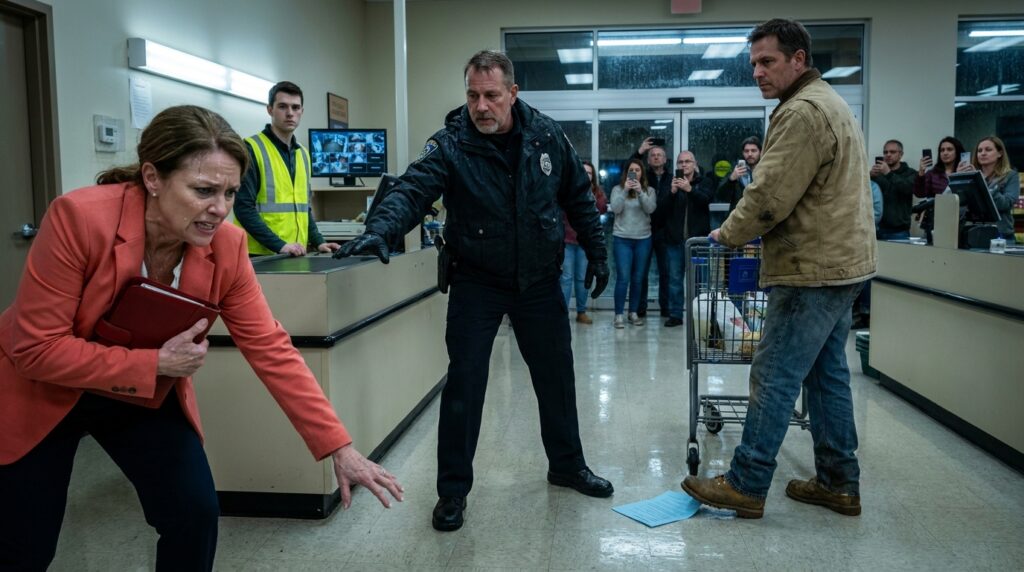
Behind us, the crowd from the front registers had crept forward in a tight, silent semi-circle. Fifty people stood shoulder-to-shoulder under the buzzing fluorescent tubes, their breathing muffled by the heavy rain drumming against the roof. Cashiers leaned over their conveyer belts, and two stockers in red aprons paused near the battery display, watching the monitor screen over Officer Carmichael’s shoulder.
“Take a breath, Todd,” Carmichael said, his voice dropping into that low, even tone that offered zero comfort. “Pull up the POS transaction feed for Register Four between 6:10 PM and 6:15 PM.”
Todd clicked the mouse. The terminal screen flickered, shifting from the blue login screen to a detailed spreadsheet of itemized sales.
“Scroll to 6:12 PM,” I said, leaning forward just far enough for my coat to brush the edge of the counter. “Look for a debit transaction ending in 4108.”
The third line down highlighted in bright green: Trans ID #88492 — $114.32 — Approved.
Todd stared at the green bar as if it had bitten him. “That’s… that’s a cleared total,” he muttered, his voice barely audible over the hum of the refrigeration units.
“Expand the line item manifest,” Carmichael ordered.
Todd double-clicked the entry. The screen populated instantly: two packs of prime ribeye, three jars of steak marinade, a five-pound bag of potatoes, two brass door latches, and a box of carpenter’s pencil refills. Line for line, item for item, it matched every single object resting inside my grocery cart.
“He… he paid,” Todd whispered, shrinking back an inch into his high-vis vest.
“Of course he paid,” Carmichael said coldly. He turned his head slowly to look at Brenda, whose manicured fingers were now digging so hard into the leather cover of her planner that the red material bunched up beneath her nails. “Now pull up the overhead surveillance feed for Register Four. Let’s see how that receipt was issued.”
“That isn’t necessary!” Brenda blurted out, her voice pitching up into a thin, erratic screech that made several shoppers in the front row wince. “The terminal system could have been glitched! Or he could have manipulated the cashier! I saw him in Aisle Seven carrying those meats toward his personal canvas bag! I have video on my phone!”
“Put your phone on the counter, Mrs. Vance-Kemp,” Carmichael said, his voice turning into flat iron. “Todd, playback Register Four overhead.”
Todd clicked the camera icon. A square video window popped up on the monitor, showing a crisp, high-definition angle looking straight down at Cashier Jenny’s lane. At 6:11:40 PM, the video showed me standing calmly at the end of the belt. It showed Jenny scanning the ribeyes, the marinade, and the door latches. It showed me reaching into my jacket, tapping my debit card against the black terminal, and taking the long paper receipt as Jenny pressed the manual feed button twice to clear the jammed roller.
The overhead camera captured the entire interaction in stark, undeniable clarity: I placed the receipt in my pocket, loaded my bags into the cart, and walked toward the exit. I never touched my shoulder tote. I never reached near my coat.
A sharp, collective gasp rippled through the gathered crowd of shoppers.
“Look at that,” a man in a yellow rain slicker shouted from the back. “He didn’t do a damn thing!”
“She lied!” a woman with two kids yelled, holding her phone high over the crowd. “She trapped him at the door for nothing!”
“Hold on,” Carmichael said, his eyes narrowing as he leaned closer to the monitor. “Todd, rewind the feed five minutes. Shift the camera angle to Aisle Seven.”
“Why?” Brenda gasped, her voice trembling now, her composure entirely disintegrating. “There’s no need to look at Aisle Seven! The matter is concluded! It was a simple misunderstanding!”
“Rewind it,” Carmichael repeated, ignoring her completely.
Todd’s hand hovered over the mouse, then clicked the camera toggle. The screen shifted to the wide-angle view of the spice and marinade aisle.
At 6:04 PM, the footage showed me standing near the marinade section, holding a glass jar. Four yards behind me, ducked half-concealed behind a cardboard endcap display, was Brenda Vance-Kemp. Her phone was raised, but she wasn’t recording my face. She was zoomed in on my canvas shoulder tote, her face twisted into a sharp, bitter scowl.
The video played forward. As I turned my back to select a second bottle, Brenda stepped out from behind the display. The overhead camera caught her reaching out with her left hand, deliberately snatching two unpriced specialty jars from the shelf, and slipping them into another elderly woman’s open cart while the woman wasn’t looking, before turning back to track my movements.
The entire lobby went dead silent.
Carmichael slowly turned away from the terminal screen, his boots grinding slightly against the grit on the floor. He stepped directly into Brenda’s path, blocking her from the exit.
“Mrs. Vance-Kemp,” Carmichael said, his voice dangerously quiet. “You didn’t track Mr. Delaney because you thought he was shoplifting. You followed him into this store to stage a scene.”
Brenda’s mouth worked silently. Her eyes darted from the officer to the sea of angry faces surrounding her, then down to her red leather planner. In her panic, her grip slipped, and the planner hit the linoleum floor with a heavy, slapping thud.
The red binder popped open. The bright blue paper slip—stamped Oakridge City Procurement Seal: Bid Selection Notice – Historic Library Renovation—slid out across the floor, coming to rest right at the toe of my work boot.
I didn’t bend down to pick it up. I simply looked at the blue paper, then up at Brenda’s pale, sweat-streaked face.
“Your husband’s firm lost the municipal bid on Tuesday, Brenda,” I said, my voice cutting through the hum of the store like a saw blade hitting hardwood. “Vance-Kemp Construction was four hundred thousand dollars over budget on the oak framing, and the city council turned you down flat. You thought if you made enough noise in this lobby, you could drag my name through the mud before the contract papers were signed on Monday morning.”
Brenda backed up until her spine hit the edge of the customer service desk. Her hands shook violently at her sides, her silver bangles clinking against the counter.
Around us, the crowd didn’t just murmur—they erupted. Phones recorded every inch of her face as the murmurs turned into open jeers, scoffs, and angry shouts from the neighbors she had tried so hard to rule.