
CHAPTER 3: THE LAMINATED SUMMONS
The diesel exhaust drifted heavy and acrid across the lawn, hanging thick in the humid morning stillness before dissipating against the beige siding. The white van didn’t park at the curb; it rolled into the mouth of Marcus’s driveway, its heavy front tires crunching over the dried pine needles and loose asphalt grit.
Sandra didn’t flinch. Her posture simply hardened, shoulders pulling back beneath the pastel cardigan with the rigid, mechanical precision of a lever clicking into place. She didn’t look back at the idling van. Instead, she took another aggressive stride onto the damp sod, the tip of her leather loafer pressing directly against the boundary stones separating Marcus’s garden bed from the lawn.
“Go ahead and look smug, Marcus,” she said, her voice dropping into a razor-sharp, clipped whisper that barely carried beyond the cedar mulch. “You think having a county truck on Elm Street is your shield? That truck is here because I scheduled an emergency structural audit three days ago.”
Marcus kept his left forearm braced against the open steel flap of the disconnect box. His fingers rested half an inch above the jagged knockout hole, where the ancient, cloth-wrapped lead dipped down into the darkness of the foundation sleeve. The ambient vibration through the wire was constant—a persistent sixty-cycle hum that told him thousands of watts were bleeding through that unmetered tap right now.
“You called code compliance on a permitted installation?” Marcus asked, keeping his tone measured, stripping every drop of heat from his words to deny her the escalation she wanted. “My permit card was signed off by the chief electrical inspector on the twelfth. It’s taped to the inner door of the basement sub-panel.”
“Your permit card is a nullity,” Sandra shot back. She unclipped a second document from beneath the faded corporate letterhead, the thick laminated plastic snapping against the metal board with a sound like a small-caliber gunshot. She thrust the sheet within six inches of Marcus’s eyes. “This is an emergency preservation order issued under Subsection 4-B. Your contractor falsified his county clearance numbers. You bypassed the board’s mandatory architectural review, installed non-conforming industrial-grade utility conduit across a primary street-facing elevation, and compromised the structural exterior fire envelope.”
Marcus’s eyes scanned the dense, single-spaced legalese. The title was bold, black, and intimidating: MUNICIPAL & RESIDENTIAL ARCHITECTURAL DIRECTIVE: ORDER OF REMOVAL AND UTILITY ISOLATION. Beneath it sat a stamped registration number that looked convincing at a glance, alongside a signature block claiming to represent the Executive Architectural Committee of Elm Subdivision.
It was an exquisite decoy—a blizzard of official-sounding terminology designed to terrify any homeowner into immediate compliance. It laid the entire blame at Marcus’s feet, painting his energy-efficient heat pump as a rogue, illegal installation that endangered the subdivision’s electrical grid.
“Look at the date,” Sandra pressed, her fingernails digging into the edge of the acrylic board until the plastic bowed. “Seven days ago. You were given statutory notice. When you failed to self-remedy, the board authorized direct utility abatement. Jenna isn’t trespassing—she is executing an administrative lien under my direct supervision.”
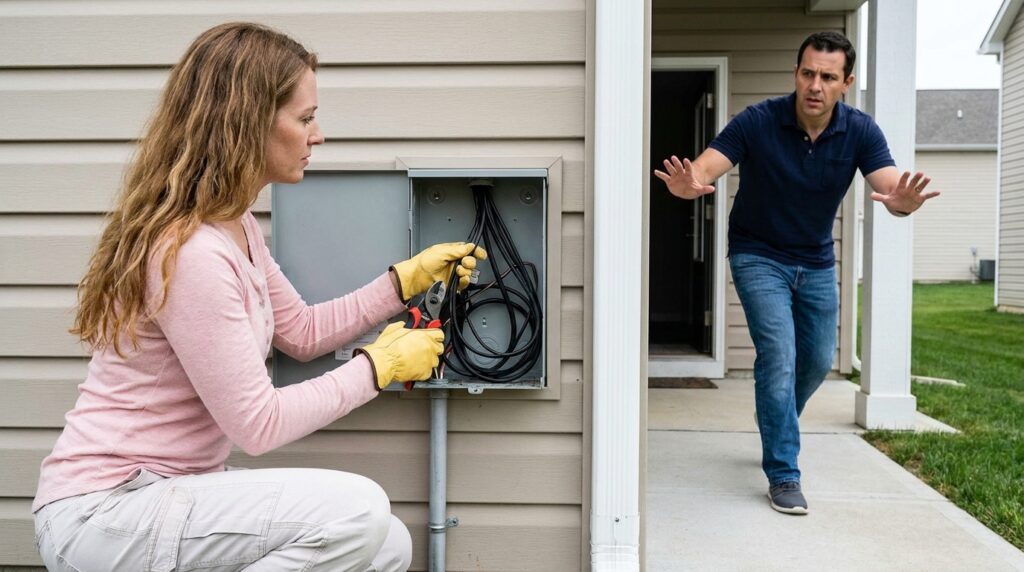
Down in the mulch, Jenna had pulled herself entirely behind the green fiberglass pedestal. She was pulling off her yellow rubber work gloves with trembling fingers, her gaze darting between the laminated order in Sandra’s hands and the heavy steel cutting tool lying abandoned in the dirt.
“She told me this was a county-sanctioned teardown,” Jenna whispered, her voice rough with panic as she leaned toward Marcus. “She handed me that exact sheet in the parking lot behind the grocery store. She had the cash in a plain envelope. She told me the owner was an investor dodging code violations.”
“Keep your mouth shut, Jenna,” Sandra said without turning her head. “You are an independent vendor under a binding agreement. Finish the severance or forfeit your retention bond.”
“She doesn’t have a bond with you, Sandra,” Marcus said quietly. He didn’t take the paper. He didn’t reach for it. He let his gaze drop deliberately from the laminated sheet down to the red-and-black shears resting in the cedar shavings, then over to the thin, ancient wire running out of the bottom of his enclosure. “And this order doesn’t say a word about an emergency utility abatement. It’s an internal committee resolution signed by one person. Where is the rest of the board’s quorum? Where is the township seal?”
“The board vested full emergency executive power in my committee when the original developer dissolved,” Sandra snapped, her voice rising in pitch as she heard the van door slam shut behind her. “I am the designated conservator of this block. That gray pipe ruins the street line. It drops the comps for every home on this side of the cul-de-sac. It comes down today.”
“The pipe is schedule-eighty PVC, fully insulated, painted to match the siding, and installed per national electrical code,” Marcus said. He stepped forward, finally closing the heavy steel cover of the panel with a solid, echoing clang that latched the mechanism shut. He planted himself squarely in front of the box, crossing his arms over his navy polo. “And whatever is pulling power through that bootleg auxiliary line under my slab, it sure as hell isn’t my heat pump.”
Sandra’s face went completely rigid. For a fraction of a second, the aggressive legal swagger vanished, replaced by an icy, predatory stillness. The hand holding the clipboard dropped two inches, exposing the corner of her cardigan where a set of brass master keys jingled faintly in her pocket.
Before she could speak, heavy, measured boots struck the driveway asphalt.
“Morning, folks,” a gravelly voice called out.
Dave, the master electrician who had overseen Marcus’s installation, rounded the front quarter-panel of the utility van. He was wearing his faded canvas work vest, a heavy leather tool belt slung over one shoulder, and a yellow hardhat tucked under his arm. But he wasn’t alone.
Walking beside him, holding a thick leather-bound inspection ledger and wearing the dark navy windbreaker of the County Department of Building and Code Compliance, was Inspector Miller—the chief regional enforcement officer whose stamped signature supposedly sat on Sandra’s laminated order.