
CHAPTER 1: THE SHEARS AT THE SIDING
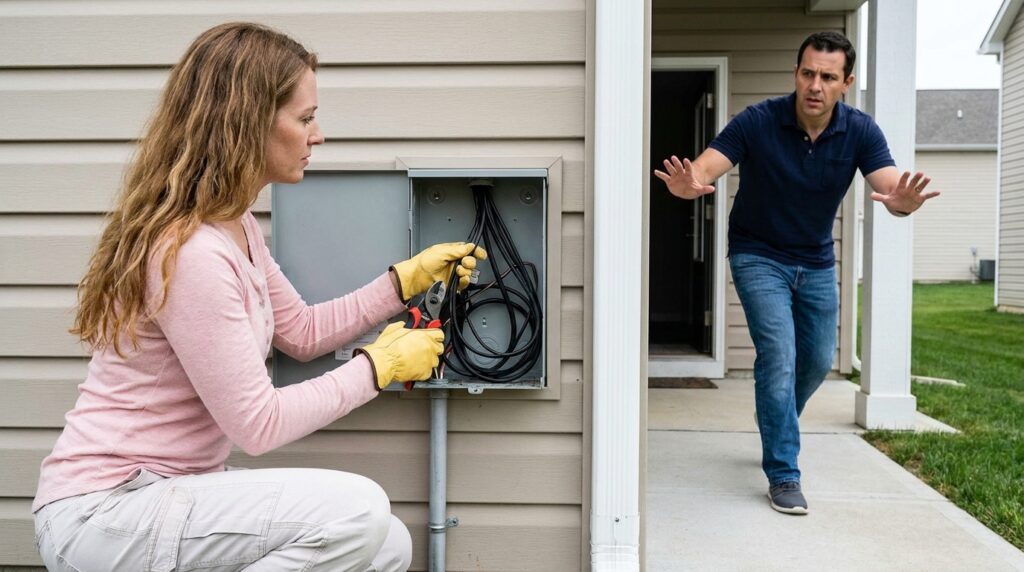
The metallic bite of cold steel against live copper was less than two inches from discharging twenty-four thousand watts of current through the damp mulch bed.
Marcus hit the front doorframe with his shoulder, the deadbolt latch rattling loose against the oak jamb as his work-from-home monitors died in a single, breathless snap inside. The sudden silence in the house had not been the dull thump of a tripped fifteen-amp breaker in the basement. It had been the dry, high-pitched whine of an external line load dropping out under tension—a shudder that vibrated through the floor joists before the climate system sighed into dead iron.
He took the porch steps in one lunging stride, gravel scattering across the concrete walk.
“Get your hands off that box!”
In the shadow of the beige vinyl siding, wedged between the dormant boxwoods and the gas meter, a woman in a faded pink long-sleeve shirt and stiff yellow rubber gloves froze on both knees. Her knuckles were white around the grooved grips of a pair of red-and-black insulated cutting shears. The weather-tight steel casing of Marcus’s exterior disconnect panel was already pried wide, its hinged door dangling at a crooked angle where the latch had been forced. Three thick, matte-black feeder cables hung looped out into the open morning air, their heavy rubber sheaths gathered directly between the jaws of the cutter.
Jenna looked up, her face pale under the brim of a dust-streaked ball cap. The steel jaws didn’t open, but her wrists locked in place, trembling against the physical weight of the tool.
“Don’t move the blades,” Marcus said, his voice dropping into a tight, gravel-edged register as he planted his work boots in the cedar mulch three feet away, palms held flat and low to keep the space between them clear. “Those lines are hot. That is a two-hundred-amp energized service feed. If you shear through that neutral under load, you’re not just tripping a panel—you’re vaporizing those jaws.”
“I was told it was disconnected,” she stammered, the yellow rubber squeaking against the steel handle. “I was told this was a vacant unit under an abatement work order.”
“You were lied to,” Marcus said, his pulse hammering a hard, rhythmic iron beat in his throat. “This is a private deed. That meter is turning. Let go of the handles.”
Before Jenna’s fingers could loosen, the heavy, measured crunch of low-heeled loafers on the asphalt driveway cut through the low hum of the neighborhood transformers.
“She will do nothing of the sort,” a voice rang out, sharp and practiced as a court summons.
Sandra stepped off the edge of the asphalt and onto the turf, holding an acrylic clipboard tucked tight against the pastel wool of her cardigan like a shield. Her oversized tinted sunglasses were pushed down the bridge of her nose, her pale eyes locking onto Marcus with the cold, unblinking certainty of someone who believed the township lines ended where her neighborhood committee began.
“You were given forty-eight hours to remove that unapproved exterior conduit, Marcus,” Sandra said, tapping a silver ballpoint pen against the clipboard’s steel clip. “Section Four of the subdivision covenant is quite clear regarding non-conforming mechanical fixtures on street-facing elevations. This is a sanctioned nuisance mitigation. Stand aside and let her finish.”
Marcus didn’t shift his boots. He kept his shoulder turned between Sandra and the open breaker box, his eyes tracking the red-and-black shears still resting against the live insulation.
Then his gaze dropped to the corner of the paper clamped to Sandra’s board—not the standard blue municipal seal of the county building division, but a hand-stamped header bearing the unauthorized crest of an LLC that had dissolved three years ago.