
CHAPTER 2: THE CALCULATED PAUSE
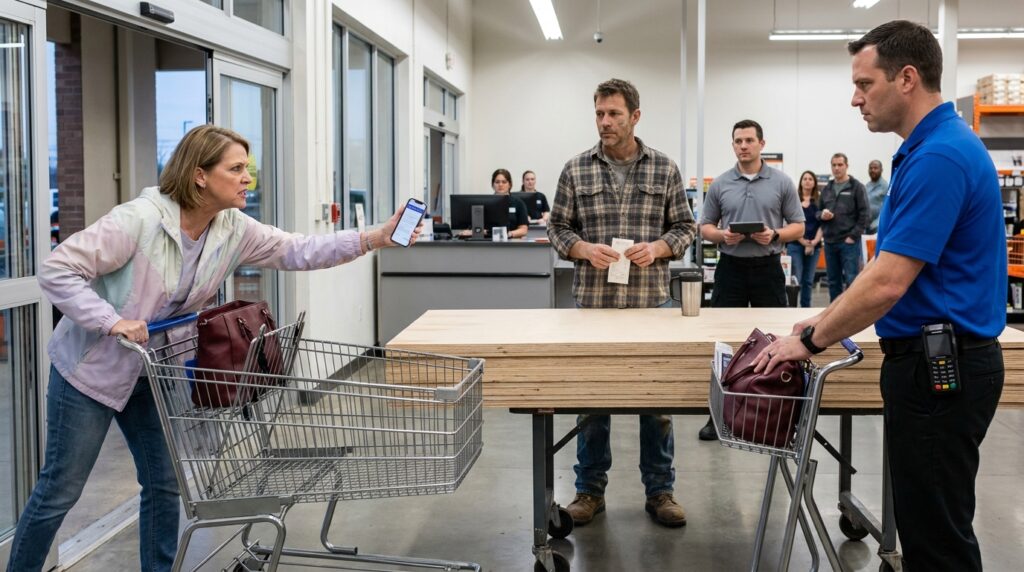
Manager Greg Miller’s shoes squeaked on the high-gloss concrete, a double-tap of rubber that died against the overhead hum of the HVAC. He didn’t look at Marcus first. His eyes went to the physical geometry of the bottleneck: Brenda’s shopping cart wedged at a thirty-degree angle into the sliding door track, the sensor light blinking a panicked, rhythmic red, and Marcus standing erect behind three hundred pounds of maple timber, holding a steel mug as if it were an extension of his forearm.
“Brenda,” Greg said. His voice was low, clipped, the tone of a man who managed twenty-four hourly employees and three corporate compliance audits a year. “Pull the cart back out of the door track. You’re tripping the emergency fire-egress sensor.”
“I am holding a suspect for loss prevention, Gregory,” Brenda said. She didn’t lower her phone. The lens remained fixed on Marcus’s collarbone. “This isn’t a retail glitch. This man was handed a pair of high-value carbide bits from the locked case in Aisle 4 by your new stock boy, Tyler. He did not request a red-tally escort. He placed them in his cart tray next to his personal mug and walked straight through the front perimeter.”
Marcus didn’t shift his weight. He kept his feet planted shoulder-width apart, feeling the subtle vibration of the store’s air scrubbers through the soles of his work boots. He let the accusation hang in the air, uncorrected. Silence was an operational tool; people like Brenda hated empty air and inevitably filled it with extra details that could be dismantled later.
“Sir?” Greg turned to Marcus, his hands resting on his belt. “You have the receipt?”
“Left front pocket,” Marcus said. He didn’t move until Greg gave a brief, singular nod. Then, using two fingers, Marcus slid the folded thermal paper from his flannel shirt. “Scanned by Sarah at Register 3. Time stamp should read 07:42.”
Greg took the slip. The paper crinkled—thin, cheap stock that smelled faintly of warm ink. He unfolded it with practiced speed, his eyes scanning the printed lines. “Three sheets 3/4-inch Maple. One Carbide Router Bit set, SKU 88412. Total paid $214.50. Sarah’s blue ink line across the top header.”
“That receipt is a smoke screen!” Brenda stepped forward, her pastel sleeve brushing the chrome bumper of Marcus’s flatbed. The sharp, artificial scent of lavender hand cream drifted off her wrist—the exact same scent Marcus had caught five minutes ago when he stood in Aisle 4 waiting for the display case to open. “Check your handheld, Gregory. Go ahead. Query SKU 88412 in the live floor system right now.”
Greg frowned, pulling a black terminal from his holster. His thumb clicked through the inventory screen. He tapped the four-digit store code, entered the SKU, and waited as the store’s local network processed the query.
A quiet beat passed. The fluorescent lights overhead buzzed, a steady 60-cycle drone.
Greg’s brow creased. He tapped the screen again. “That’s odd.”
“It’s not odd,” Brenda declared, her voice dropping into a register of triumphant satisfaction. Her phone screen flickered as she toggled her recording app. “It says zero in stock, doesn’t it?”
Greg hesitated, looking from the terminal to the receipt, then back to Marcus. “System shows three units were logged on this morning’s freight manifest, but the floor count reads zero available. The system says none were scanned out at Register 3.”
“Because he didn’t buy those,” Brenda pounced, her finger pointing directly at the small, clear plastic package sitting on Marcus’s cart tray. “The clerk Tyler never logged the unlock on his floor terminal. He bypassed the cage lock, handed the item over without an inventory entry, and Sarah marked a blank receipt header. It’s an internal bypass ring, Greg. He didn’t steal them alone—your staff helped him slip them past the ledger.”
The shift in the air was immediate. The two contractors by the desk, who had been chuckling a moment prior, went still. Cashier Sarah at Register 3 straightened up, her hands leaving her counter. A systemic charge of employee collusion was vastly different from a simple shoplifting spat; it brought corporate loss prevention and police involvement straight to the floor.
Marcus felt the sharp edge of the trap closing, but his pulse remained steady. He looked at the package on his cart tray. The clear plastic blister pack was pristine, sealed with factory heat-stamps. But on the top left corner of the cardboard backing, where the store’s yellow clearance tag usually sat, there was a tiny patch of grey adhesive residue—as if a label had been peeled off within the last ten minutes.
He remembered the lavender scent in Aisle 4. When he had arrived at the cage, the display door had already been unlocked by an inch, resting on its latch before Tyler ever walked up with his master key.
“Mr. Miller,” Marcus said, his voice cutting through Brenda’s rising momentum with surgical precision. “You have floor cameras with independent time stamps on every main aisle, don’t you?”
“We do,” Greg said, his grip tightening on his terminal.
“Then stop looking at the live inventory screen,” Marcus said, pointing his mug toward the ceiling dome above Aisle 4. “Look at the footage from twenty minutes ago. Start at 07:30. Watch who touched that cage before I ever walked down the aisle.”
Brenda’s phone hand twitched, her pastel sleeve pulling tight against her elbow. “This is a stall tactic! He’s trying to shift blame onto floor staff!”
“No, ma’am,” Marcus said, turning his gaze slowly toward her. His eyes were cold, calculating, and entirely devoid of heat. “I’m making sure when the police look at the footage, they see exactly whose fingers were on that glass.”