
CHAPTER 5: THE PUBLIC COLLATERAL
The heavy door of the administrative hallway swung outward, hitting the wall buffer with a muffled rubber thud. Marcus stepped through first, Officer Ruiz half a pace behind his right elbow, his polished leather gear squeaking softly in the sudden expanse of the main concourse.
Aisle Seven was no longer just an aisle; it had become an arena.
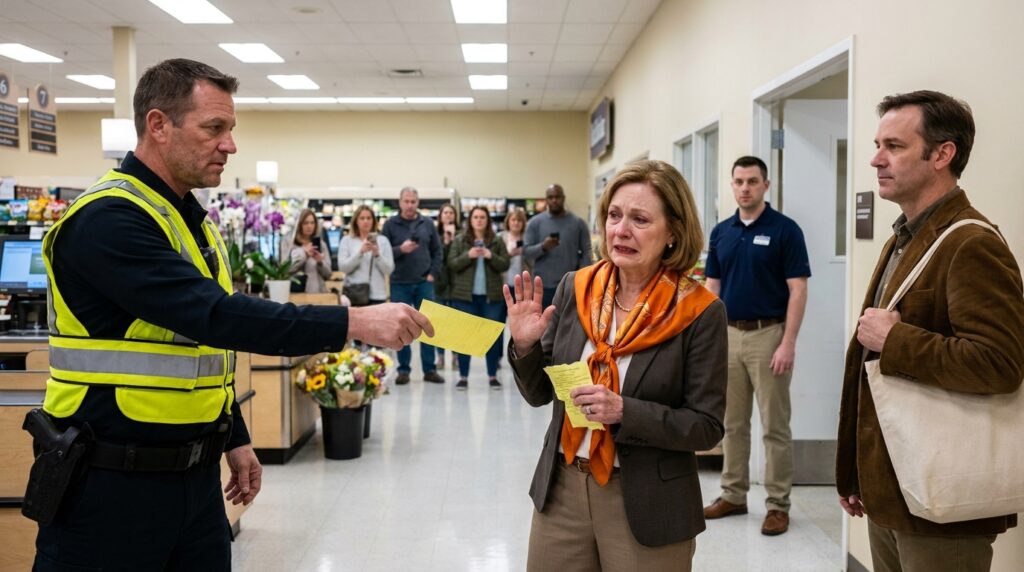
Where three shoppers had stood twenty minutes ago, thirty now lingered. They stood clustered between the registers and the floral displays—parents with resting carts, a deli clerk still holding a paper ticket, two teenagers with smartphones held horizontally. The store’s background music had cycled to a slow acoustic track, but no one was listening to it. Every eye in the building locked onto the doorway the second Officer Ruiz’s bright yellow vest cleared the frame.
Marcus didn’t lower his head. He didn’t adjust his corduroy jacket. He adjusted his grip on the canvas tote, bringing it to rest against his side like a shield forged from cotton and cold porcelain.
Behind them, Ken held the gray door open. Brenda emerged last.
She looked smaller. Without the framing of her smartphone camera elevated at eye level, without the manicured gesture of authority, her orange silk scarf looked loud, almost desperate against the stark white tile. Her dark sunglasses were tucked awkwardly into her purse strap, and her eyes—red-rimmed and unblinking—darted across the crowd.
A girl in the front row—a neighbor from the lower drive who usually walked her golden retriever past Marcus’s lawn—looked down at her phone screen, then looked up at Brenda. The live stream feed Brenda had broadcast ten minutes earlier had already metastasized through the local community network, but the comments were no longer validating her.
“Mrs. Vance,” Officer Ruiz said. His voice wasn’t raised, but in the tense silence of the front registers, it carried to the glass exit doors. “I am issuing you a formal citation for disorderly conduct and filing a false report. You have five minutes to exit these premises, or I will take you into custody for criminal trespass.”
A low, collective intake of breath rippled through the checkout lanes.
“Officer,” Brenda started, her hand twitching toward her scarf, her voice straining for that familiar, polished cadence of board-meeting command. “This is a private dispute regarding—”
“It stopped being a private dispute the second you grabbed a patron in a commercial aisle and lied to emergency services,” Ruiz interrupted smoothly. He reached into his pocket and handed her a yellow carbon slip. “Sign the citation, Mrs. Vance. Do not return to Oakridge Select Market.”
Ken stepped forward, his posture rigid, his hands clasped behind his back in front of his staff. “Your store membership has been revoked, Brenda. I’ve already flagged your profile at the customer service register.”
Brenda took the yellow slip. Her fingers shook so hard the carbon paper rattled like dry leaves. She looked around the circle—at the deli worker who turned his back to wipe down the glass counter, at the parents who pulled their carts aside to clear a wide, humiliating path to the sliding doors, at the teenagers whose phone cameras were now recording her exit instead of Marcus’s stance.
She didn’t speak another word. She couldn’t. The theatrical illusion she had cultivated for six years—the unassailable matriarch of the ridge—had collapsed under the weight of an overhead security tape and a twenty-two-dollar estate receipt. She clutched her handbag against her ribs, turned her back on Aisle Seven, and walked through the double glass doors into the chilly evening air, her heels clicking a fast, frantic rhythm against the concrete apron outside.
The crowd began to disperse slowly, the sudden vacuum of tension filled by the quiet murmurs of neighbors re-evaluating three years of rumors.
Marcus turned to Ken and Officer Ruiz. He offered a concise, single nod of appreciation—no grand speeches, no theatrical victory laps.
“Thank you for your time, Officer. Ken.”
“Have a good evening, Mr. Holloway,” Ruiz said, touching the brim of his cap. “Drive safe.”
Marcus walked out through the sliding glass doors. The autumn air hit his face like a cold towel, smelling of damp oak leaves and distant woodsmoke. The parking lot was quiet, illuminated by the tall sodium lights humming overhead.
He reached his sedan, opened the passenger door, and placed the canvas tote onto the floorboard. He reached inside, his fingertips sliding beneath the bubble wrap to feel the raised, gilded rim of the 1840s porcelain platter. It was heavy, cold, and solid.
Loud accusations didn’t rewrite receipts. False authority didn’t alter time-stamped video. He closed the car door, got into the driver’s seat, and turned the key, leaving the shadows of Oakridge Market behind in the rearview mirror.