
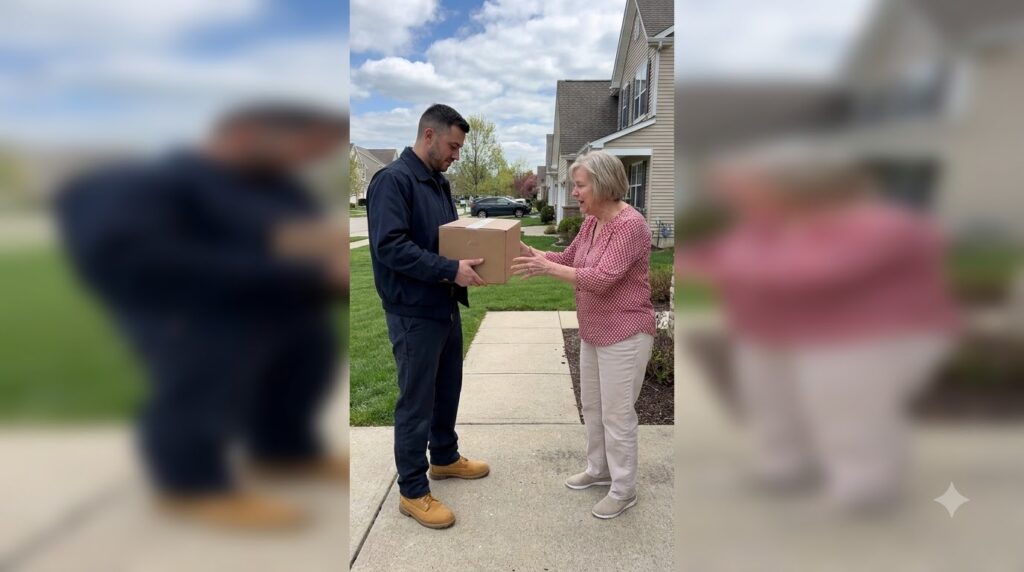
CHAPTER 1: A RUPTURE IN COLD CARDBOARD
“Let me see what’s inside,” she said, her fingers already biting into the seam before his boots had even settled onto the aggregate concrete.
Miller didn’t pull back. When you drove seventy stops before noon, you learned the rhythm of hands—some hesitant, some indifferent, some snatching like they expected the package to evaporate if they blinked. Her manicured thumbnail dug under the reinforced paper tape, peeling back the gummed fiber with a dry, ripping hiss that cut straight through the drone of a distant lawnmower.
“Sure, go ahead,” he said.
The sun sat directly overhead, bleaching the white siding of the house until it burned the eyes. The air smelled of freshly cut fescue and the hot bitumen coming off the cul-de-sac asphalt. Miller kept his left thumb hooked into the nylon strap of his scanner harness, eyes tracking the clean line where the brown flaps parted. It was reflex, nothing more. A routine handoff to a woman whose graying fringe fluttered against her forehead in the midday breeze.
Then the flaps gave way.
Inside the corrugated walls lay no bubble wrap. No air pillows stamped with corporate logos. Just four heavy, vacuum-compressed bricks wrapped in matte polyethylene, their edges squared off with geometric precision. Beneath the clear plastic, the compressed powder was chalky, dense, and stark against the cardboard lining.
The woman froze. Her hands remained hooked inside the box’s lip, her knuckles white where the skin pulled tight over bone. The nervous anticipation that had pulled her down the front steps vanished, replaced by an absolute, rigid paralysis.
“What is this?” she asked.
The question wasn’t aimed at him, not really. It hung between them in the heat, small and terrible.
Miller did not answer immediately. His gaze dropped from her wide, dilated pupils down to the corners of the plastic. The seams were industrial, heat-sealed twice with cross-hatch crimping—not kitchen-grade, not pharmacy-grade. He knew freight weight. This was four kilograms minimum. At least forty times what his delivery truck was insured to carry without an armed escort manifest.
“Check the label,” she whispered, her voice dropping an octave as her gaze darted toward the street.
Miller pulled his scanner from his belt. The glass was hot beneath his fingers, the screen glaring back with greasy reflections of the white sky. He tapped the tracking interface to pull up the digital bill of lading.
The status line was already flashing emerald green.
Delivered: 11:42 AM.
Accepted by: M. VANCE.
Miller stared at the blinking prompt. He hadn’t scanned the barcode yet. His finger hadn’t even hovered over the laser trigger.
Worse, embossed beneath the digital clearance code was a six-digit internal override key—one that belonged exclusively to the terminal hub manager who had personally handed him his manifest before sunrise, thirty miles north.
Miller’s head came up slowly. Down at the mouth of the driveway, the black sedan that had trailed him through two right turns three blocks back had just pulled quietly against the curb, its tinted driver’s window easing down an inch into the shadow.