Chapter 5: What the Cameras Saw
By the end of the week, the neighborhood had become a construction zone.
The damaged hydrant had been removed.
The broken section of water main was being replaced.
And Karen’s SUV sat in a repair shop.
But another problem remained.
The city needed to determine whether Karen would be responsible for the hydrant damage.
Her insurance company requested every available photograph and video.
Daniel provided his.
So did several neighbors.
Karen expected the footage to make her look terrible.
She was right.
But one recording showed something else.
It came from a security camera mounted on a nearby house.
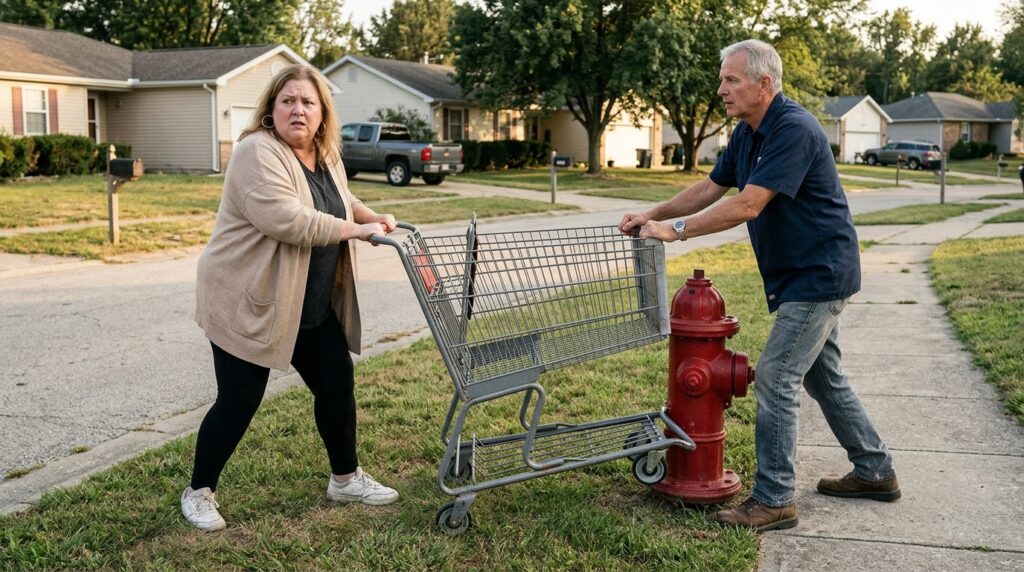
The video showed Karen stopping near the curb before the collision.
She looked at the hydrant.
She looked at the empty space.
Then she deliberately turned the wheel.
The impact was unmistakable.
But after the collision, the camera captured something none of them had noticed that morning.
A large section of pavement near the hydrant visibly sank.
The ground dropped slightly beneath the force of the water.
The utility crew reviewed the footage.
Marcus watched it twice.
“That helps,” he said.
Karen looked surprised.
“How?”
“It confirms the underground soil was already unstable.”
The video did not erase Karen’s decision.
But it helped establish the larger story.
The hydrant had been damaged by the collision.
The underground system had already been deteriorating.
And the escaping water had exposed the weakness.
Then Marcus found another problem.
The water-main damage extended beneath a portion of the sidewalk.
If it had remained hidden for another few months, the ground could have become dangerously unstable.
The city issued a warning to residents.
Karen read it slowly.
For the first time, she understood that the accident had not only caused damage.
It had uncovered something that might otherwise have remained invisible.
She thought about all the angry things she had said that morning.
She thought about the parking space.
She thought about Daniel trying to stop her.
And she thought about the expression on his face when the water exploded from the hydrant.
She had spent years believing that being forceful meant being strong.
Now she was beginning to understand that sometimes strength meant stopping before you caused harm.
The next day, Karen walked to Daniel’s house.
She carried no argument.
Only an envelope.
Inside was a check for her share of the neighborhood cleanup costs that insurance would not cover.
Daniel looked at it.
“You don’t have to give me this.”
“I know.”
He waited.
Karen swallowed.
“I should have stopped.”
It was the first apology he had heard from her.
But before he could answer, a city inspector arrived.
He had news about the street.
The repair had uncovered another section that needed immediate replacement.
And this time, the problem ran directly beneath Daniel’s driveway.