
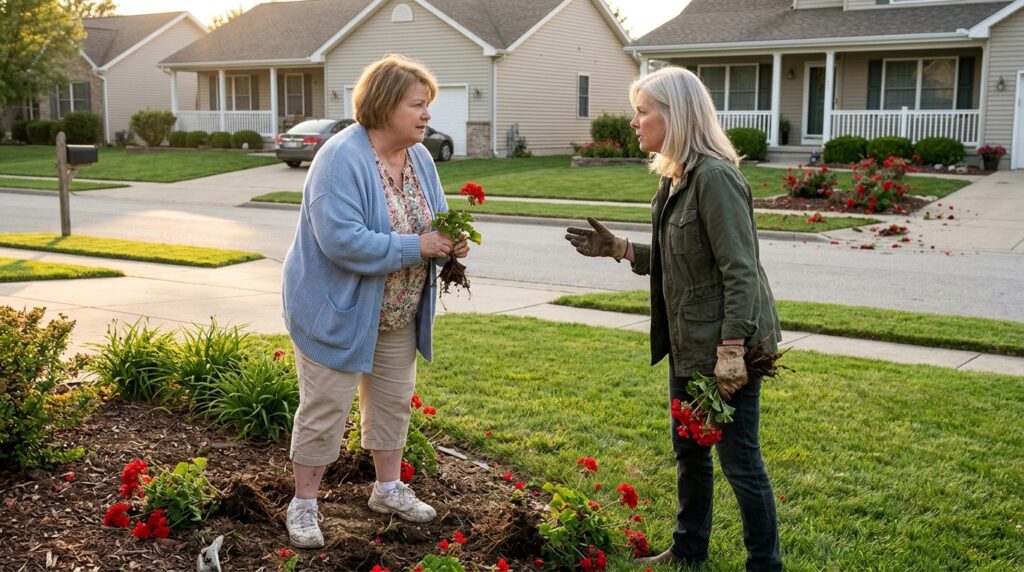
Chapter 7: The Garden Grew Back
Two weeks later, the neighborhood held its summer gathering.
The same gathering Karen had wanted the street to look “perfect” for.
But the neighborhood looked different.
There were yellow flowers.
Purple flowers.
White flowers.
And red flowers everywhere.
Some had been replanted by homeowners.
Others had been replaced entirely.
Margaret rebuilt her garden with help from June, Frank, and several neighbors.
They worked slowly.
People in their sixties and seventies bent over the soil together, laughing when someone complained about their knees.
Harold brought coffee.
June brought homemade cookies.
Frank insisted on carrying bags of mulch even after everyone told him not to.
The garden became less perfect than it had been before.
And somehow, Margaret liked it more.
At the community gathering, David announced the association’s new policy.
There would be no unofficial rules.
No resident could claim authority they didn’t possess.
Any proposed landscaping change would have to be discussed openly, recorded, and voted on according to the association’s actual procedures.
Most importantly, residents were reminded that their homes remained their own.
Karen attended.
She stood at the edge of the crowd.
She didn’t speak.
Then she approached Margaret.
In her hands was a small pot containing a young red flower.
She held it out.
Margaret looked at it.
Karen swallowed.
“I owe you this.”
Margaret accepted the plant.
She didn’t say that everything was forgiven.
She didn’t say the damage didn’t matter.
Instead, she walked toward the garden and dug a small hole.
Karen watched.
Margaret placed the flower into the soil.
Then she pressed the earth around its roots.
A breeze moved through the leaves.
Across the street, June’s rebuilt garden was blooming again.
So was Frank’s.
So were the others.
The red flowers hadn’t disappeared.
They had survived.
And Margaret finally understood that a neighborhood didn’t become beautiful because every house looked the same.
It became beautiful when people could live beside one another without needing to control one another.
Karen stood quietly for another moment.
Then she walked over to help June carry a tray of lemonade.
No one applauded.
No one made a speech.
There was no dramatic forgiveness.
There was only a small act of choosing to behave differently.
For Margaret, that was enough for one afternoon.
She looked at the red flower she had planted.
Its petals were still closed.
But beneath the soil, the roots were beginning to take hold.
And this time, nobody was going to pull it out.