Chapter 3: The Minutes Everyone Would Remember
The fire was contained before it spread to the neighboring homes.
But the Millers were found in the hallway near the back bedroom.
June had inhaled smoke.
Frank had suffered a fall while trying to reach her.
Both survived.
The relief that followed was enormous.
So was the anger.
By evening, residents gathered near the clubhouse.
Nobody had called a meeting.
Nobody needed to.
The incident had become the only thing anyone was discussing.
Karen sat at the edge of the parking lot inside her SUV.
She had refused to come into the clubhouse.
Inside, Margaret was speaking with Walter and several other residents.
Daniel had already left with the fire crew.
But before leaving, he had given the community manager a short incident report.
The report did not call Karen reckless.
It did not accuse her of intentionally trying to hurt anyone.
It simply recorded what had happened.
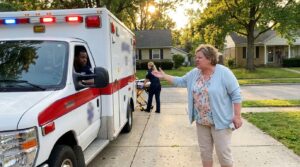
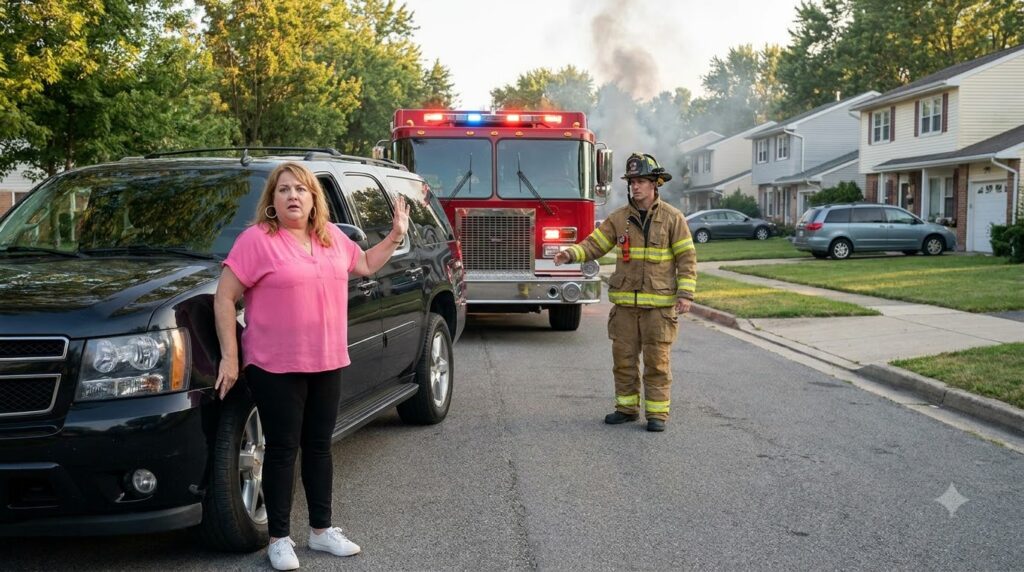
The emergency vehicle arrived.
A private vehicle was positioned across the access lane.
The vehicle remained in place despite repeated requests to move.
A second vehicle further restricted access.
The fire crew experienced a delay entering the affected area.
Those words were enough.
Karen’s version of events suddenly sounded very different from what everyone else had witnessed.
She insisted she had been protecting the community.
She said the road was private.
She said strangers couldn’t simply drive wherever they wanted.
She said she had only asked for verification.
But there was one problem.
The community manager, Linda Foster, had reviewed the association’s emergency-access rules.
The road was private.
The fire lane was not.
Emergency vehicles had unrestricted access.
And residents were prohibited from blocking it.
Karen had spent years enforcing ordinary neighborhood rules—trash cans, visitor parking, lawn maintenance, overnight guests.
People had tolerated her because most of her complaints involved things that could be fixed by moving a chair or repainting a mailbox.
This was different.
This had involved someone’s safety.
Late that evening, Karen received an email from the association.
She read it twice.
Then a third time.
The board was requesting a formal meeting.
Not about her attitude.
Not about the argument.
About her decision to obstruct emergency access.
Karen’s fingers tightened around her phone.
Then she noticed something else.
The email included a photograph.
A resident had captured the street moments before the fire engine arrived.
Karen’s SUV was clearly visible.
So was Margaret’s car.
And behind them, nearly hidden by the angle, was something Karen had never expected anyone to notice.
A second emergency-access sign.
It stood directly beside the place where Karen had parked.