CHAPTER 4: THE OVERHEAD FEED
The glass-walled office at the front of the store smelled of dry-erase markers, stale ozone, and wet coats. Marcus stood inside the narrow doorway, his shoulders nearly filling the frame, while Greg tapped a sequence of keys on a desktop computer behind a cluttered laminate desk.
Patricia stood opposite Officer Vance, her yellow coat wrapped tightly around herself, her arms crossed over her chest so hard her knuckles showed white. Her eyes darted continuously across the nine split screens flickering on Greg’s primary monitor, watching the black-and-white grid of store aisles like a gambler watching a losing table.
“Aisle Seven camera feeds directly to the main DVR server,” Greg said, his voice clipped and dry as he grabbed a computer mouse and dragged a red timeline scrub-bar backward across the grid. “Camera 04, overhead angle on Lane Four entrance and the bakery crossover bay.”
“Make sure you’re looking at nine o’clock sharp, Greg,” Patricia interjected, her voice tight, raspy, and vibrating with an aggressive edge that no longer found any traction in the quiet office. “That’s when I entered the aisle after checking the sourdough display. That’s when he grabbed the cart.”
Greg didn’t answer. He clicked a magnifying glass icon on the playback interface. The top-left quad expanded to fill the entire twenty-four-inch display screen.
The timestamp overlay in the bottom corner read 09:38:12 AM.
On the screen, in crisp, unyielding high-definition gray tones, the glass sliding doors at the store entrance parted. Patricia Gable walked into the building. She wore her bright coat, her designer sunglasses perched on her head, her leather purse slung over her arm. Her hands were completely empty. She didn’t have a cart. She didn’t have a grey staging bin. She carried only her handbag and her phone.
“Pause it,” Officer Vance commanded calmly.
Greg hit the spacebar. The frame froze. The camera angle was tilted slightly downward from the dropped ceiling, capturing Patricia’s face as she stepped across the black rubber entry mat. The timestamp read 09:38:15 AM.
Marcus watched the screen without a word. He felt no surge of triumph, only the dull, heavy satisfaction of a man watching a rusted bolt finally yield under the leverage of a long pipe wrench.
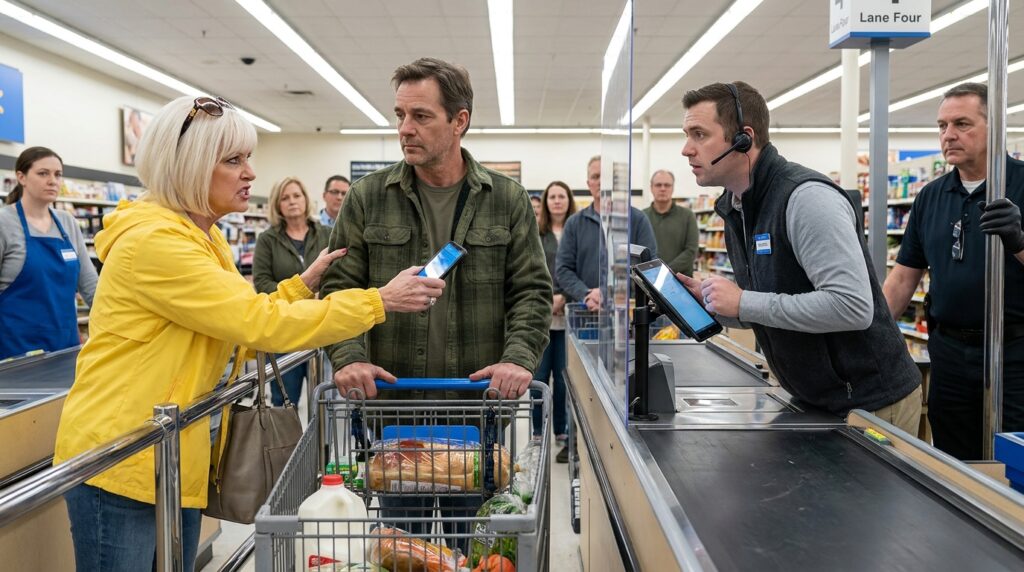
Officer Vance turned his head slowly toward Patricia. “You walked through the front doors four minutes before you grabbed Mr. Holloway’s arm at Lane Four, Patricia. You didn’t visit the bakery. You didn’t go to the staging bay. You walked straight from the entrance to the register line.”
Patricia stared at the screen, her mouth working silently for two long seconds. Her eyes widened behind her thick mascara, reflecting the cold blue light of the LCD panel. The lie she had constructed—the story of a stolen curbside order, an administrative glitch, a hardworking committee member robbed of her weekly groceries— lay dismantled on the desk between them in black-and-white pixels.
“I… I thought that was my cart,” Patricia stammered, her voice dropping an octave, losing its sharp public carrying power and degenerating into a desperate, thin rasp. “The items… the roast, the bread… it looked identical to what I put in my digital basket last night before my card was… before the update.”
“Your card was declined at eight-fifty-five, ma’am,” Greg said, his voice flat, neutral, and entirely devoid of sympathy as he pulled up the register log on a secondary window. “The app notified you forty-five minutes before you entered this building. The items were never pulled because the payment didn’t process.”
Patricia’s face flushed a deep, ruined magenta. She looked at Greg, then at Officer Vance, and finally at Marcus. For the first time since she had slammed her palm onto the metal frame of Lane Four, she looked directly into Marcus’s eyes.
She didn’t see a flustered, easily intimidated target who could be publicly shamed into handing over a cart to avoid a scene. She saw a man standing as immovable as an iron bridge trestle, completely unbothered by her voice, her position, or her threats.
“You knew,” Patricia whispered, her chin trembling slightly as her social authority evaporated inside the four walls of the office. “You knew the camera was right there.”
“I knew the camera didn’t care who you were,” Marcus said softly.
Officer Vance stepped between Patricia and the door, pulling a small leather-bound notepad from his breast pocket. “Patricia, you’ve caused a major public disruption, made false accusations of theft against a customer, and attempted to claim goods you hadn’t paid for. I’m filling out a formal store exclusion notice right now.”
“An exclusion?” Patricia gasped, her hand flying to her throat as if the word itself were a physical blow. “You’re banning me? I’ve lived in this township for twenty-two years! I organize the spring street fair!”
“And today you’re leaving the premises,” Vance replied without looking up from his notepad, his pen scratching firmly against the paper. “If you set foot on this property before the ninety-day cooling period is up, I’ll cite you for criminal trespass. Am I clear?”
Patricia’s shoulders caved. She didn’t look back at the monitor screen, nor did she say another word to Greg or Marcus. She snatched her handbag off the edge of the desk, pulled her yellow jacket tightly around her frame, and hurried out the office door, keeping her head down as she walked past the line of shoppers still waiting near the customer service desk.
Greg closed the video player with a quick double-click of his mouse, the screen returning to the quiet live grid of empty aisles and moving carts. He looked up at Marcus and extended a hand across the laminate desk.
“I’m sorry about the hassle, Mr. Holloway,” Greg said. “Lane Four is cleared. The cashier held your order at the top of the belt.”
Marcus shook the manager’s hand, his grip firm and calloused. “Appreciate it, Greg.”
He turned and walked back out onto the scuffed linoleum of the main concourse, the quiet hum of the supermarket washing over him once again—the rhythmic beeping of the scanners, the squeak of rubber cart wheels, the steady, unhurried rhythm of a Saturday afternoon.