
CHAPTER 4: THE SYSTEM VERIFICATION REVERSAL
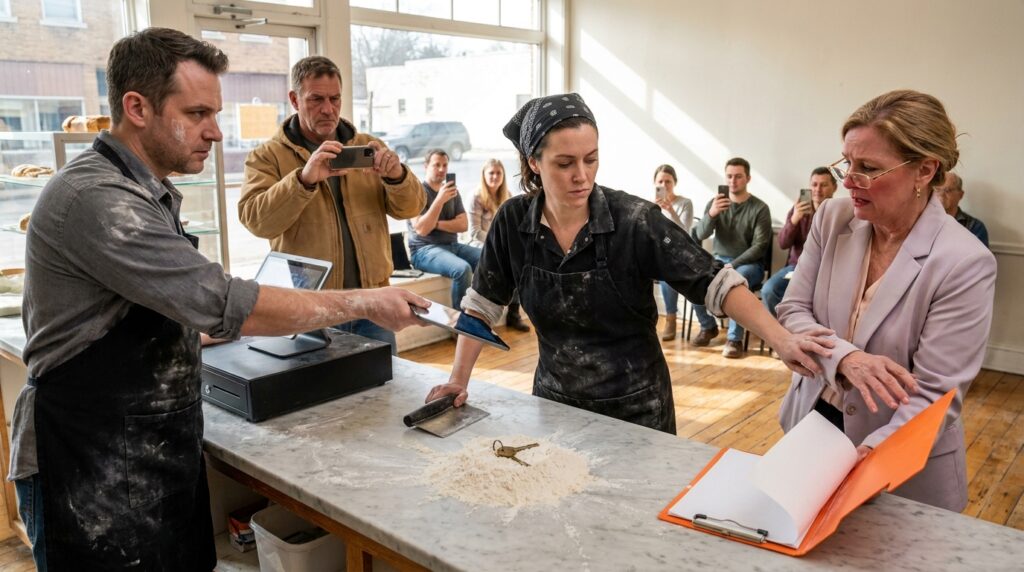
The glare from the tablet screen hit Patty’s tinted glasses like a mirror flash as Marcus turned the pivot arm full circle.
He didn’t raise his voice or gesture toward the crowd. He simply planted one palm flat on the marble, his fingers dusted with fine white flour from the morning prep, and used his thumb to tap the high-contrast administrative tab. The system hummed, pulling down the live cloud feed from the state business portal in real time.
“Line item one,” Marcus said, his words measured, cutting through the low murmur of the shop. “Active Commercial Operating License Number 408-B. Issued to Clara Bennett, Bennett Provisions LLC. Property address: 114 Main Street. Status: Fully compliant, zero outstanding municipal liens, zero pending zoning reviews.”
Patty’s retreat faltered. Her shoe heel caught on the raised brass sill near the threshold, and she stumbled sideways half an inch, her pastel blazer hitching over her hip. “That’s an internal system display! It has no legal standing over a municipal notice—”
“Line item two,” Marcus interrupted, his voice dropping another octave into steady, unhurried iron. He swiped to the secondary verification window. “State Department of Revenue tax compliance certificate, stamped electronic renewal from thirty days ago. Property ownership verified by county recorder.”
A sharp, audible chuckle broke from Hank’s throat near the sugar bar. The contractor lowered his phone just enough to look over the top of the casing, his eyes hard and mocking. “Looks like your ‘coalition’ forgot to check the public record before they printed their letterhead, Patty.”
“Quiet, Hank!” Patty snapped, her face twisting into a tight mask of red-hot indignation. She swung her gaze back toward Clara, her hands tightening on the orange clipboard until the hard plastic groaned under the stress. “You think you can hide behind a computer screen, Clara? You think a digital stamp wipes out fifteen years of community standing? My family helped establish the commercial district in this town when you were still working double shifts for tip money in the valley!”
Clara took a single step closer to the glass display case. She didn’t look at the tablet, and she didn’t look at the phone lenses pointed in her direction. Her focus remained entirely locked on Patty’s white-knuckled grip on the clipboard.
“Your family held the subordinate mortgage on the building’s old hardware store,” Clara said softly, the realization settling into place like a heavy steel pin entering a slot. “The one that expired when Oakfield Farmers Trust went into liquidation in twenty-four. That’s what that brass vault key is for, isn’t it? You didn’t come here to save a bakery for your daughter. You came here because the old bank vault records are being audited by the county this month, and you needed to establish a physical claim on this floor before the old paper line gets erased for good.”
The silence in the room changed instantly. It was no longer the tense, awkward quiet of neighbors watching a loud argument at a coffee counter. It became the cold, heavy stillness of a small town watching a long-buried bluff get dragged out into the daylight.
Patty’s breath hitched. For a fraction of a second, her theatrical composure completely dissolved, exposing the raw, desperate panic beneath the pastel blazer and the gold-plated jewelry. She looked down at the orange clipboard in her hands as if it had suddenly turned white-hot.
“You don’t know what you’re talking about,” Patty whispered, but the carrying pitch had vanished from her voice, replaced by a thin, rasping rattle.
“Flip the cover, Patty,” Clara said, leaning forward until her forearms rested on the clean, cold marble. “Open the binder in front of Hank’s camera. Show everyone the signatures on your ‘community petition.'”
Marcus reached across the partition. Before Patty could jerk the board away, his long, flour-dusted fingers caught the edge of the blue backing sheet. With a swift, smooth pull, he flipped the top three pages upward over the heavy metal spring clamp.
The pages fell back, revealing the interior stack.
There were no signatures. There were no municipal seal stamps, no lists of disgruntled merchants, and no formal legal grievances. Beneath the fake cover page lay four crisp, unprinted sheets of standard twenty-pound white copy paper, completely blank.
A collective gasp rippled through the front half of the shop, followed immediately by a sharp, cutting bark of laughter from the two county clerks at the corner table.
“Blank paper,” Hank said into his phone, zooming the camera lens directly in on the exposed clipboard. “She brought a stack of printer paper to evict a business.”
Patty stared at the exposed white sheets, her mouth opening and closing without making a sound. Her hands began to shake so violently that the clipboard slipped from her fingers, clattering against the marble counter before sliding off the edge and hitting the pine floorboards with a sharp, hollow crack.
The brass vault key tumbled out of the clear plastic sleeve, bouncing once against Clara’s bench knife before coming to rest directly in the mound of white flour on the slab.
Patty didn’t reach down to pick it up. She looked at her daughter, her eyes wide, searching for a single anchor in the room. “Chloe—”
Chloe didn’t answer. The eighteen-year-old took two fast steps backward toward the double glass doors, her face burning with dark, hot shame. She didn’t look at her mother, she didn’t look at the crowd, and she didn’t touch her phone. She shoved open the door, the brass chime above the frame ringing twice as she fled out onto the sidewalk and disappeared down Main Street.
Stripped of her fake documentation, abandoned by her daughter, and standing exposed in front of two dozen neighbors holding recording screens, Patty Holloway stood frozen beside the marble counter, her authority completely hollowed out.