
CHAPTER 1: THE REACH OF THE IRON LADDER
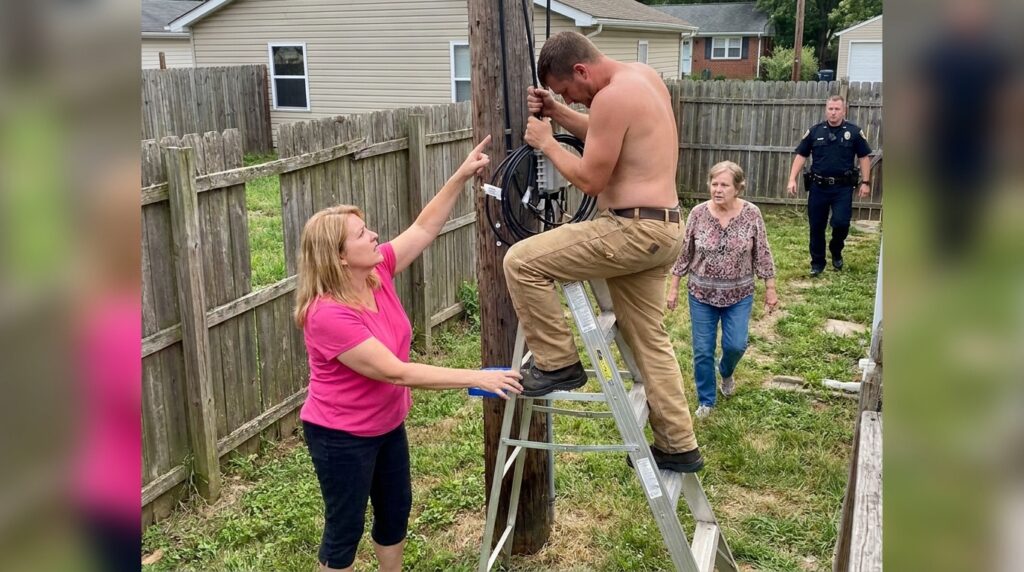
The heat coming off the creosote pole smelled like boiled tar and forty years of sun-baked pine. It sat heavy across my bare shoulders, sticking the sawdust and copper filings to my collarbone while my left hand held three pounds of lateral tension on the main drop bundle. Four rungs up on the aluminum step ladder, every fraction of an inch mattered; if the junction box shifted before I locked the terminal lug, forty-eight houses on the south circuit would lose phase synchronization.
“You can’t come back here and touch that equipment!”
The voice wasn’t just loud; it had the sharp, serrated edge of someone used to barking orders from behind a locked gate. Below me, her manicured nail cut the air so close to my boot heel that I felt the draft of her sleeve. She was in a bright pink short-sleeve top that looked almost radioactive against the bleached turf, her jaw locked tight, her chest heaving with rehearsed fury.
“Ma’am,” I said, not taking my eyes off the split casing where two hundred and forty volts of live service hummed under the neoprene jacket. “Stand clear of the ladder feet. This is an active line.”
“Get down from there right now! You have no right!”
She stepped right into the drop zone. Her left hand came up, fingers clawing toward the lowest loop of the secondary drop, her diamond rings flashing in the hard midday glare. One hard tug on that insulated drop wouldn’t ground her—the outer sheath was rated for six hundred volts—but it would rip the terminal lug out of the softened wood, throwing eight pounds of spring-loaded copper straight into my face.
Across the low cedar boundary on the right, the latch on the next gate clattered. An older woman in a faded floral blouse stepped into the dry clover, her arms crossing over her chest as her gaze locked straight onto the pink sleeve reaching for the pole hardware. She didn’t yell. She just stopped, her mouth tightening into a thin line that knew exactly how long the air conditioners on this street had been dead.
“I called the police three minutes ago,” the woman in pink barked, leaning her weight forward until her hip bumped the outer rail of my ladder. The aluminum shuddered under my boots. “They’re putting you in handcuffs for criminal trespass the second they round that corner. You don’t own this dirt!”
The ladder gave a sharp metallic ping as her hand brushed the lower rung. I locked my knees against the uprights, transferring my center of gravity into the pole itself, my work gloves gripping the heavy line jacket until my knuckles went white.
A boot crunch sounded in the dry gravel along the side access lane.
A dark patrol uniform cut through the shade of the overgrown maple tree behind her. The officer didn’t run. He walked with that measured, heavy-belted cadence that comes from knowing exactly how ugly backyard fights can get before noon. His hand wasn’t on his holster, but his fingers rested lightly against the leather strap of his chest mic, his eyes sweeping from the open gate to the trembling ladder, then straight to her reaching arm.
The woman didn’t hear him over her own shouting. “I said get down—”
The officer took two long strides, stepped directly between the pink top and the aluminum legs, and raised an open palm at chest height.
“Ma’am,” he said, the word dropping into the humid silence like an iron anvil. “Step back and let him work.”
She froze, her fingers inches from his navy sleeve, the color draining from her cheeks until the pink of her shirt looked like an open bruise against the fence.
I glanced down from the terminal head. Embedded in the dry soil two inches behind her left heel, half-hidden beneath a freshly laid strip of sod, was an unpainted surveyor’s iron pipe driven straight down through the severed copper grounding ribbon of the city’s main terminal.