
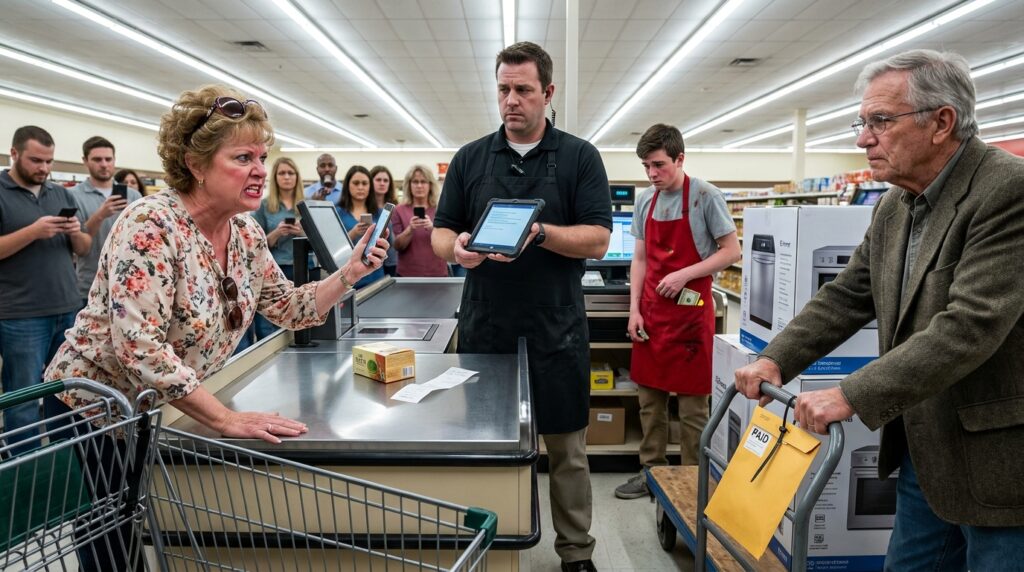
CHAPTER 2: ESCALATION AND WITNESS PRESSURE
“You’re not going to squirm out of this with fancy talk about camera logs, Marcus!” Brenda’s voice pitched higher, a shrill, theatrical frequency designed to cut through the hum of the store. She gripped the handlebar of her shopping cart with knuckles turned white beneath her rings, thrusting her chin forward. “Look at him! He won’t even let me touch his tote bag!”
The crowd at the end of Aisle 4 had doubled in the space of ninety seconds. A middle-aged man in a faded grease-stained jacket stopped his cart carrying two cases of sparkling water, exchanging a pointed look with a woman in scrubs. Across the aisle, the teenager with the varsity jacket shifted his posture, steadying his phone with both hands to frame Marcus’s open, raised palms against the backdrop of the dairy cases.
Marcus didn’t blink. The cold air from the open cheese display behind him seemed to settle into his joints, but his mind remained entirely warm, clear, and methodical. He kept his heels locked—left shoe jammed against the rear axle of his cart, right foot braced wide to form a tripod with his torso. If Brenda tried to shove her cart forward again to knock him off balance, the force would transfer directly into the heavy steel shelving unit beside him rather than pushing him backward.
“I haven’t touched my bag, Brenda,” Marcus said, keeping his tone measured, every syllable clipped and distinct for the benefit of the three active phone microphones within six feet of them. “And I’m not going to touch it. The item you’re screaming about isn’t in my possession, and I’m not giving you or anyone else a reason to claim I altered the contents of my cart before staff arrives.”
“Staff?” Brenda let out a harsh, rasping laugh that rattled in her chest. She turned her body toward the scrub-wearing woman, extending her left hand with the crumpled paper clutched in her fingers. “He wants to wait for a nineteen-year-old floor clerk so he can slide out the back door while everyone’s confused! I have the receipt right here! I bought this exact unit for the neighborhood HOA raffle two hours ago, left it in the staging cart by customer service, and watched him scoop it into his tote the second the clerk turned his back!”
Marcus’s eyes shifted down for a fraction of a second, zeroing in on the paper in her fist.
It was thermal register paper, thin and yellowed at the edges, but the top margin—where the bold blue ‘OAKRIDGE MARKET’ store emblem and tax ID were invariably printed—was torn away in a clean, jagged strip. The ink on the line items was slightly faded, carrying the characteristic purple tint of a dry-ink impact printer rather than the thermal black used at the main checkout registers up front.
A return-rack receipt, Marcus calculated instantly. From the clearance staging table near the back loading doors, not the front counter.
“Show the top of that paper to the camera, Brenda,” Marcus said softly.
“What?” Brenda snapped, her sunglasses slipping another fraction down her nose.
“The header,” Marcus said, pointing a single extended finger toward the paper without lowering his other palm. “The store header is missing. Oakridge Market hasn’t used purple impact ink on front-register receipts since the system overhaul three winters ago. That slip came off a secondary staging clipboard.”
A quiet murmur broke out among the bystanders. The man in the grease-stained jacket stepped forward two inches, leaning over to squint at the paper in Brenda’s hand. “He’s right about the ink. They got those new digital screens up front last year.”
Brenda’s face flushed a deep, mottled red beneath her foundation. Her chest heaved, the bright tropical leaves on her tunic twisting as her posture stiffened. “Are you calling me a liar in front of my neighbors? You think you can commit a felony in broad daylight and lecture me about receipt ink?” She slammed her palm down on the metal crossbar of her cart, making the wire basket rattle loudly. “Where is security? Where is the manager?”
“Right behind you, Mrs. Albright,” a heavy, flat voice announced from the main concourse.
The crowd parted instantly. Greg Lawson, the assistant store manager—a tall, weary man in his late forties wearing an ill-fitting navy vest and a brass name tag—strode into the intersection of Aisle 4. Beside him walked Deputy James Vance of the county sheriff’s office, his dark green uniform crisp, his right hand resting casually over his leather duty belt, two inches above his sidearm holster.
Deputy Vance’s eyes took in the geometry of the scene in a single three-second sweep: Brenda, red-faced, leaning heavily against her jammed cart; the crowd of six shoppers with raised phones; and Marcus, standing perfectly still beneath the black acrylic dome, his hands raised palms-out, his posture devoid of flight indicators or aggression.
“Alright,” Deputy Vance said, his voice dropping into the quiet, authoritative calm of someone who had unraveled a hundred suburban disputes before three in the afternoon. “Let’s lower the volume in here. What seems to be the problem?”
“Deputy, thank God,” Brenda stepped around her cart, reaching out as if to take Vance’s arm before the officer took one deliberate step back, maintaining a three-foot buffer. “I caught this man shoplifting a two-hundred-dollar espresso unit out of my staging cart. He’s got it hidden right there in his canvas tote, and he’s refusing to let anyone search it!”
Deputy Vance didn’t look at the tote. His gaze fixed on Marcus’s open hands, then drifted upward to the black dome hanging eight feet above their heads.
“Sir,” Vance said to Marcus, “mind telling me why your hands are up?”
“Because Mrs. Albright accused me of a felony ninety seconds ago, Deputy,” Marcus replied, his voice unhurried. “And I prefer that the overhead optical feed records every second of this interaction without any ambiguity about where my hands have been.”
Vance’s left eyebrow twitched up a millimeter. He turned back to the assistant manager. “Greg. How long to pull the feed from Dome Four on your tablet?”